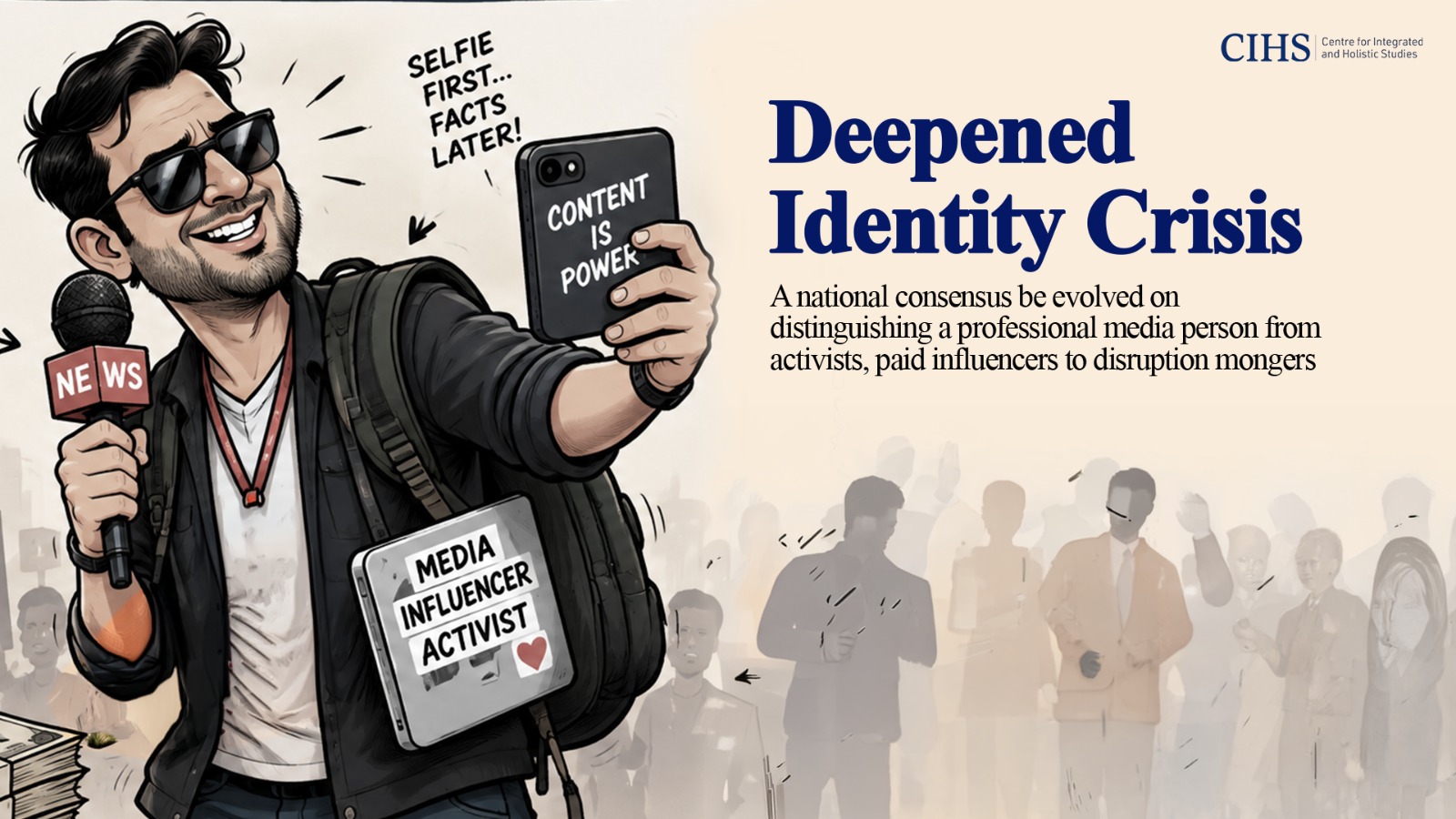


A national consensus be evolved on distinguishing a professional media person from activists, paid influencers to disruption mongers.
K. A. Badarinath
One Nadeem Ahmed Ameen who has a social media handle ‘news aina today’ circulated a fake and fabricated video of Vivek Bhagat, assistant commissioner of police that portrayed sexual conduct by the police officer.
Three other women who claimed to be reporters covering October 3 NSUI protest against Chief Election commissioner alleged that there was misconduct on the part of Delhi Police personnel.
On the other hand, women police constables and officers complained of facing harassment from drunken and lumpen elements in these protests that posed as bonafide journalists.
These recent incidents in the heart of national capital and scores of such reports emanating from states as well as elsewhere point to a larger issue. Who’s a journalist? Or, a news person?
Is anyone and everyone roaming the streets across Bharat be designated a media person dealing with news, views or writing editorials?
A quick check on the net suggests there were as many as 100 million digital creators operating out of India. Out of these, structured content creators were reported to be anywhere between 4 – 4.5 million. Hyderabad based Indian School of Business report of July 2026 pegged the creators’ number at 4.2 million.
Now, the billion-dollar question is do all these creators or a small fraction of them that converged at Jantar Mantar protests of cockroaches, Youth Congress, Aam Admi Party or left demonstrations be designated journalists?
Accredited or not accredited with centre, states, recognized or not recognized by city or district authorities, many of these creators who form core of protestors making video and reels designate themselves as journalists.
Many of them many not be part of known media houses and mostly one-member enterprises, they go around with micro-phones, mobile phones doing brisk business of making videos and reels.
A large number of these creators are paid influencers with their own social media pages. They are on hire for paltry to heavy sums for peddling content that’s soft, toxic, sensitive with socially devasting impact. These are on beck and call of lobbies, political parties and corporates as well. Now, do we call these paid social media influencers journalists?
Recent cockroach Janata party protests in Mumbai preceded by Delhi and school centric campaigns in states like Rajasthan were mostly consumed online or went viral on the net due to these creators. Should these paid creators be designated media professionals? Who paid them, how much and what’s the real motive is an unanswered question.
There were stories on Facebook, Insta or LinkedIn that hit the top ten slots on trending during the Jantar Mantar protests of CJP leading to resignation of education minister Dharmendra Pradhan. Some of these creators shot to instant fame with tens of thousands followers on their handles.
A large number of political activists or protestors at several of these recent demonstrations against election commission, NEET exams or students protesting at Delhi University on women safety do claim to be journalists, protestors and activists. All rolled into one.
Many of the anti-establishment activists that hit the streets frequently pose as journalists with cameras, mics and video equipment while several large media houses may not even afford such paraphernalia. Also, there have been subdued activists with extreme ideological inclinations that as media persons with cheap collar mikes and mobile phone recorders.
Many creators that descended at protest sites in recent past would have stuck full commercial deals with specific brief on the narrative to be peddled and number of views to be totalled, both organic and inorganic. All the more, these ‘free and independent’ journalists are participants and reporting on the protests which is one-sided and subjective. There have been stories of political aspirants turning journalists while being protestors.
Under Article 19 (1) (a) of Constitution of India, newspersons implicit rights to the profession are guaranteed as part of fundamental rights. The right to receive information, process and distribute the content is guaranteed under this provision. This freedom ends when the reporting intentionally or unintentionally attacks the reputation of an individual, institution or a body.
Section 499 of the Indian Penal Code, 1860 prohibits media persons from harming reputation or spreading disinformation through text, visuals, cartoon or any form. Most of these provisions have been retained in the Bharatiya Nyay Samhita 2023 that replaced the IPC 1860.
Should Nadeem Ahmed Ameen and the three women protestors who claim to be journalists not be tried under relevant provisions of Bharatiya Nyay Samhita 2023? One for impersonation and secondly for violation of norms governing journalists.
Crisis of identity for full-time professional journalists that seek to report for media organizations stare in the face. It’s a blurring line between paid content creators with an agenda to journalists that seek to report without emotions, attachments and seeking neutrality.
Verification ethics also weigh down professional journalists while activists, agitators and content creators go easy on facts, get subjective, abusive, divisive and agenda based depending on who pays for the reel, video or the content.
Advocacy groups, non-government organization representatives to paid influencers, ideological activists have gone about posing as journalists big time.
Digital disruption coupled with this impersonation has only deepened identity crisis for professional media personnel across the world.
Citizen journalist is a concept that evolved as social responsibility and emancipation before, during and post-independence movement in India. Today’s paid influencers can never be equated with citizen journalists with social purpose pursing larger cause.
A radical Islamist cannot masquerade as a newsperson. A political activist or paid influencer may not be treated as a journalist with immunity. An ideological left extremist that does not believe in democratic ethos or systems cannot make falsified claims being a media representative.
A distinction has to be made. Upholding journalistic ethos, values and objectivity is something for which there may be no easy alternative!
(Author is a veteran journalist, chief executive & director of Centre for Integrated and Holistic Studies, New Delhi based bipartisan think tank)

