

Vinod Kumar Shukla
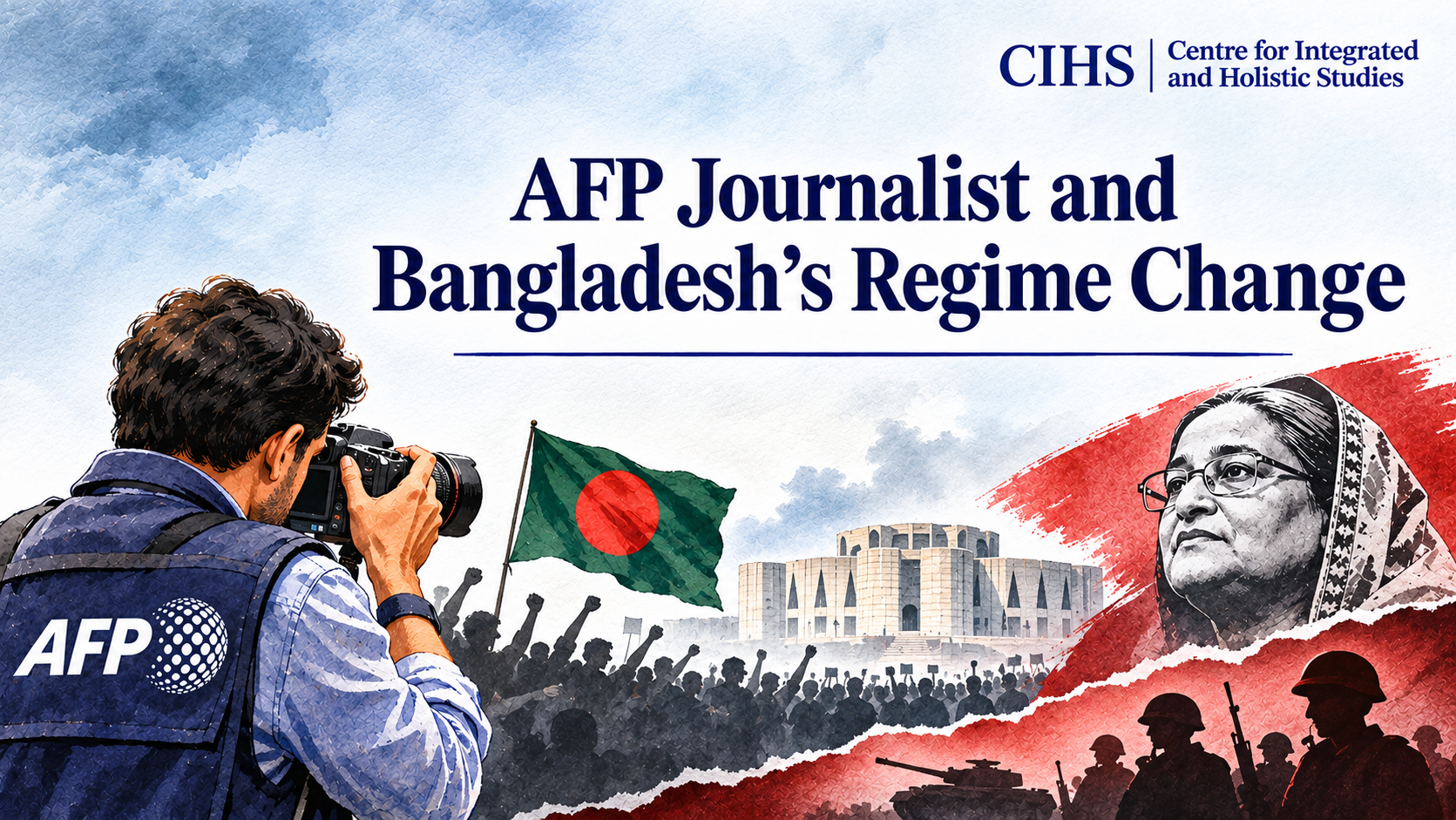
A news agency is supposed to break news and not to become one, but the latter seems to be the case with the French news agency, Agence France-Presse (AFP), whose role in the regime change in Bangladesh is under intense scrutiny.
Shafiqul Alam, former press secretary to the caretaker administrator of Bangladesh, Muhammad Yunus, spilled the beans when he wrote on social media that AFP journalist Qadaruddin Shishir was a link between Yunus and the protesting students orchestrating the ouster of the Sheikh Hasina government.
Alam’s silence then and revelation now have something more to them than meets the eye. It took him more than two years to disclose the matter, causing suspicion about his intentions. Apparently, he and the entire AFP team in Bangladesh were involved in the entire process or, at the least, they were sympathetic to the idea of regime change in the Indian neighbourhood.
Qadaruddin Shishir spoke to Yunus when he was in France. So, was Yunus in France with some plans, and did an AFP journalist facilitate their execution with the help of students? If so, the question further arises: was AFP aware of their activities? Or was AFP as such the facilitator? AFP has not issued any clarification so far, a common practice, which causes suspicion about its role.
The student protest that started in July 2024, after the Bangladesh Supreme Court reinstated a 30% quota for families of 1971 Liberation War veterans in government jobs, turned violent with invented allegations of rigged elections, resulting in Sheikh Hasina taking asylum in India. The reservation issue turned into an anti-India narrative and further into an anti-Hindu one, which was certainly not organic. The entire narrative building had the involvement of outsiders.
Those who swear by Qadaruddin Shishir for his so-called probity, objectivity and professionalism have no answer to the question of why such a well-informed journalist was unaware of the involvement of organisations like Bangladesh Jamaat-e-Islami (BJI) in the regime change. Was he too naïve to understand that BJI and its student wing, Islami Chhatra Shibir, played a major organisational role? Shishir initiated communication while being aware of the possibility of severe action, including detention in the Aynaghar secret prison, as many say. Taking such risks can’t be purposeless. Furthermore, has he done any fact-check on attacks on Bangladeshi Hindus, especially after fake allegations against them of disrespecting the holy book and many other such allegations they were victimised for?
There is something more to it. The entire development in Bangladesh had local, regional and global implications. To understand such developments in the wider geopolitical framework of media/foreign interference, there is a need to draw a parallel between the visits of Rahul Gandhi and Muhammad Yunus to France to show how global narratives are built to destabilise countries. French political scientist Christophe Jaffrelot’s diagnosis of Indian socio-politics, that India’s governance structure does not proportionally reflect its demographic realities, was borrowed by Rahul Gandhi to use in the 2024 Lok Sabha elections. Gandhi had met him on September 8, 2023, while visiting Sciences Po University in Paris. After his return, he became a champion of OBC rights and started talking about caste enumeration, which is causing enmity and social divide in India. Jaffrelot pushes his theory by writing not only in global newspapers/magazines but in Indian ones as well, causing social schism in India. Similarly, Yunus was in France when he was contacted by Shishir, as the student protesters needed a trusted bridge-builder. What kind of trust did they need from him? Afterwards, what happened to Bangladesh is a lesson to learn.
Now, there appears to be a sharp contrast in how the media covered Bangladesh. Western and regional media outlets focused selectively on human rights abuses and civilian deaths, but they mischievously ignored atrocities against Hindus and other minorities. The global media largely downplayed atrocities against and killings of minorities and political workers of the Awami League et al.
The role of rich and powerful countries too is in question. The Trump 2.0 regime’s MAGA initiative harmed the global community more than it benefited it, as the US meddled with the domestic politics of various countries for its geopolitical interests and hegemonistic approach. Sheikh Hasina, in no uncertain terms, alleged that the US engineered her removal for her refusal to cede control of Saint Martin’s Island for a US military or air base.
There was friction with Hasina’s administration, such as sanctions on the Rapid Action Battalion (RAB) in 2021 for alleged human rights violations. By making the so-called democratic backsliding and alleged rigged elections an alibi, the US continued its engagement with opposition political parties, radical Islamic groups and civil society players with initiatives, including through agencies like USAID and related foundations. As Assistant Secretary, Donald Lu visited Bangladesh multiple times, including in January 2023 and May 2024, to discuss bilateral ties, economic cooperation, labour reforms, climate initiatives and the importance of free and fair elections. The rigged elections theory was pushed by them, and the media narrative on it triggered violence in the country. This is corroborated by the fact that after the regime change in 2024 leading to Hasina’s ouster, Lu and other US officials engaged with the interim government during subsequent political transitions to stabilise relations and support governance and institutional reforms.
Besides the US, China and Pakistan represent alternative strategic poles in Bangladesh’s foreign policy. While Hasina balanced ties with Beijing, her administration’s chafing with the West created openings for regional manoeuvring. Pakistan’s ISI has historical as well as contemporary grudges against Bangladesh. The ISI wants Bangladesh to become an Islamic nation and not a liberal, secular and democratic country.
The 2024 political transition brought Tarique Rahman to the helm of affairs of the country in early 2026 from a self-imposed exile in the UK. This could be a case study to understand how foreign-intermediary networks amplify local anger to accomplish regime change in South Asia, which happened through a dynamic interplay of grassroots mobilisation, back-channel diplomacy and overt or covert external architectures. This was the case with Nepal and Sri Lanka too. In South Asia, various mechanics of regime change were played out, which also revealed distinct layers of informal and formal transnational connections.
Traces of substantial foreign funding were embedded within governance, democracy promotion and civic mobilisation channels. Transatlantic funding networks such as USAID, the National Endowment for Democracy (NED) and parallel UK governance initiatives channelled billions of dollars into Bangladesh and many other countries for decades. They facilitated the training of youth activists, built civil society networks and funded alternative digital media frameworks to amplify discontent against the ruling dispensation.
Foreign intelligence and diplomatic apparatuses operating within South Asia, specifically networks spanning the United States, Pakistan and China, capitalised on the domestic crises. While the anger was originally driven by internal economic grievances and anti-quota protests, regional intelligence operators actively manoeuvred to dislodge a government perceived as aligned with India due to New Delhi’s growing global influence.
However, a journalist acting as a mediator for factions seeking regime change raises serious ethical concerns. Meanwhile, numerous unanswered questions remain: Did the journalist merely connect two parties seeking a dialogue, or did he leverage his position, newsroom resources and professional access to actively orchestrate a political transition?
Alam’s disclosure has ignited debate over the boundaries between journalism and political advocacy. It is a conundrum whether assisting protesters in recruiting a future head of state, or something similar, breaches the limits of journalism and crosses over into active political involvement. Did the journalist act strictly as a facilitator of communication, or did his role extend to shaping political negotiations regarding the formation of a post-Hasina government? Furthermore, the fact that another journalist involved in these disclosures was subsequently appointed as Press Secretary to Muhammad Yunus suggests direct involvement in shaping post-Hasina political developments in Bangladesh.
Among the most significant strategic implications is the severe strain placed on bilateral ties between India and Bangladesh. Sheikh Hasina’s asylum in India, combined with targeted attacks by Islamic radicals on Hindus and other minority communities, has forced critical collaborative infrastructure and development projects to a halt.
This power shift has created diplomatic room for Bangladesh to deepen its engagement with China and Pakistan, altering the strategic balance in the region and directly challenging India’s regional influence. Simultaneously, the political transition has halved economic growth rates, crippled private investment and disrupted garment manufacturing hubs, leaving the post-Hasina leadership to navigate a fragile economic recovery.
Shishir’s role in facilitating the interim government illustrates how journalists are increasingly entering the political arena. Occupying a unique position of trust and objectivity, they are sometimes drawn into operational or logistical roles within movements for which they probably have ideological support. However, this blur between reporting and political participation challenges the perceived neutrality of international news bureaus in polarised settings. This has a larger implication too, which they are well aware of and misuse.
(Author is a senior journalist and associated with Centre for Integrated and Holistic Studies, a non-partisan think-tank based in New Delhi)

