

NC Bipindra
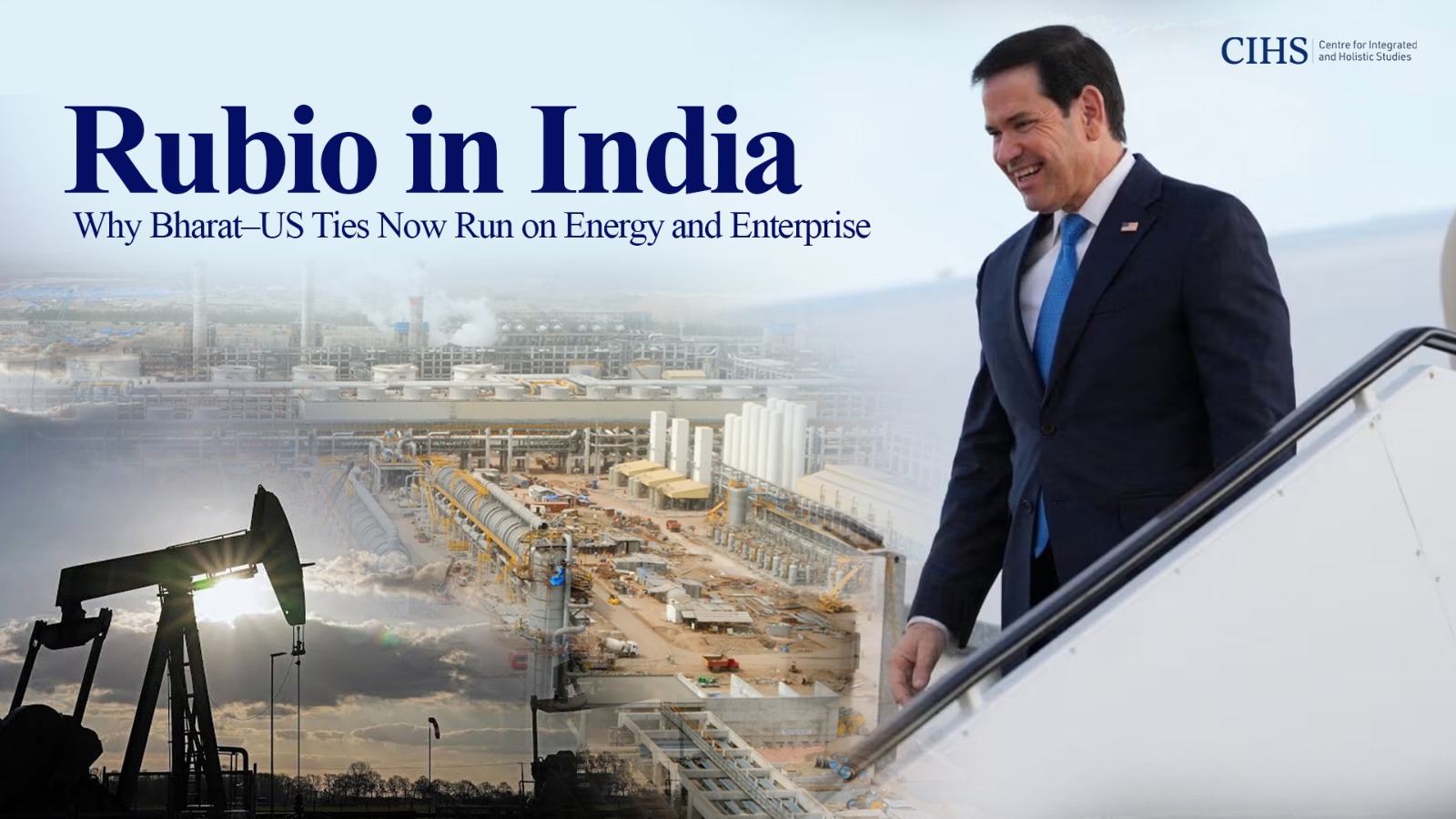
US Secretary of State Marco Rubio’s second visit to Bharat this year was remarkable for its destinations. He landed in Mumbai on October 20, 2026, for talks aimed at easing pressure on global energy markets and External Affairs Minister Dr S. Jaishankar greeted him. He never set foot in New Delhi. The itinerary offers Bharat genuine openings, but it also raises a harder question: is the partnership being redefined on terms that suit Washington more than New Delhi?
A capital bypassed
Rubio was last in New Delhi in May 2026 for the Quad foreign ministers’ meeting. This time the State Department framed the trip around energy and investment and opposition leaders called the arrangements humiliating. No official reason for skipping the capital has been given, so any explanation is interpretation. The backdrop, however, is not in doubt. Ties remain strained over tariffs, immigration policy and US outreach to Pakistan.
Boardrooms and a refinery
On October 21, Rubio met Adani Group Chairman Gautam Adani and Tata Sons Chairman N. Chandrasekaran in Mumbai and neither side released details. He then flew to Jamnagar. Reliance said the visit covered the global energy landscape and commercial partnerships across conventional and new energy. It was closed to the media.
The logic is not hard to read, though it remains analysis rather than announced policy. Rubio said Washington wants to work more closely with Reliance on refining Western Hemisphere energy, hinting at more Venezuelan crude, while US diesel prices climb ahead of the midterms. The complex processes about 1.4 million barrels a day, roughly 1.5 per cent of global refining capacity.
Adani’s ports and logistics and Tata’s semiconductor and manufacturing ambitions complete the picture. Bharat’s conglomerates are being treated as nodes in American supply chains. Bharat should welcome the investment, but a relationship that runs mainly through a few corporate groups is narrower than one anchored in institutions, defence-industrial cooperation and technology partnership.
The quieter trilateral
Potentially more durable was the Mumbai trilateral. Jaishankar, UAE Foreign Minister Sheikh Abdullah bin Zayed and Rubio exchanged views on energy, connectivity and contemporary developments. Officials say they also discussed West Asian security and the economic fallout of the Strait of Hormuz blockade. Reports name only foreign ministers at the table, with no finance ministers. The format suits Bharat. Gulf capital, Bharat’s scale and American strategic cover can underpin energy security and connectivity without tying New Delhi to a single supplier or bloc.
A trade deal that is “close”, again
Trade was the most watched subject. Rubio said the two sides were about as close as one can be without having executed the agreement. Commerce Minister Piyush Goyal said the first tranche was in its final stages, though Finance Minister Nirmala Sitharaman had said earlier this month that talks had plateaued. President Trump said Bharat wants a deal and that it would be “much different” from earlier ones, without discussing Bharat’s tariffs or trade surplus.
Caution is warranted. Trump used almost identical language about being close to a deal in November 2025. The phrase to watch is “much different”. It may signal a deal weighted towards energy, defence and technology purchases rather than a conventional exchange of tariff cuts for market access.
Russian oil, Pakistan and H-1B
Rubio was accommodative about Bharat’s Russian crude purchases and said Trump will weigh the global impact before enforcing a new law punishing them. A Trump–Modi meeting is likely in December. The administration has also entered a 60-day review period following the Russian oil tariff waiver. That is encouraging, but it is not a settlement.
On other irritants, Rubio offered explanations rather than changes. He defended engagement with Pakistan because it has nuclear weapons and said H-1B restrictions were not aimed at Bharat, even as Bharat’s IT firms such as Wipro, Infosys and TCS were suspended from a green-card sponsorship programme. Assurances must now become action. On the Quad, Rubio said he hopes a summit will take place before the end of the year.
What Bharat should do
The Diplomat argues that the relationship is being recast as a transaction built on trade and energy, with Bharat as buyer, refiner and market. That is one analyst’s reading, but the itinerary lends it weight.
A confident Bharat should engage on equal terms, welcoming the thaw while measuring it by outcomes such as tariff relief, visa certainty and technology access. It should protect energy sovereignty, because diversification is Bharat’s choice, made on price and security and not a directive to swap Russian barrels for Venezuelan ones. It should keep the state in the lead, since corporate diplomacy is useful but national interest should not be negotiated through a handful of groups. And it should pursue multi-alignment, treating the Bharat-UAE-US format, the Quad and BRICS as complements rather than rivals.
Questions that remain
Several questions merit scrutiny. What does a “much different” trade deal actually contain? What happens when the 60-day review ends? Was skipping New Delhi a deliberate signal? What did Adani and Tata discuss with Rubio? Will the Quad summit take place this year and will Trump travel to Bharat soon?
Conclusion
Rubio’s visit shows that Washington needs Bharat’s refining capacity, its market and its geography. That gives Bharat leverage. The task now is to convert it into a partnership that serves Bharat’s interests across trade, technology, security and energy and not only the American agenda of the moment.
(Author is Chairman, Law and Society Alliance, a New Delhi-based think tank, and guest columnist with CIHS

