

Dr. Aniket Pingley
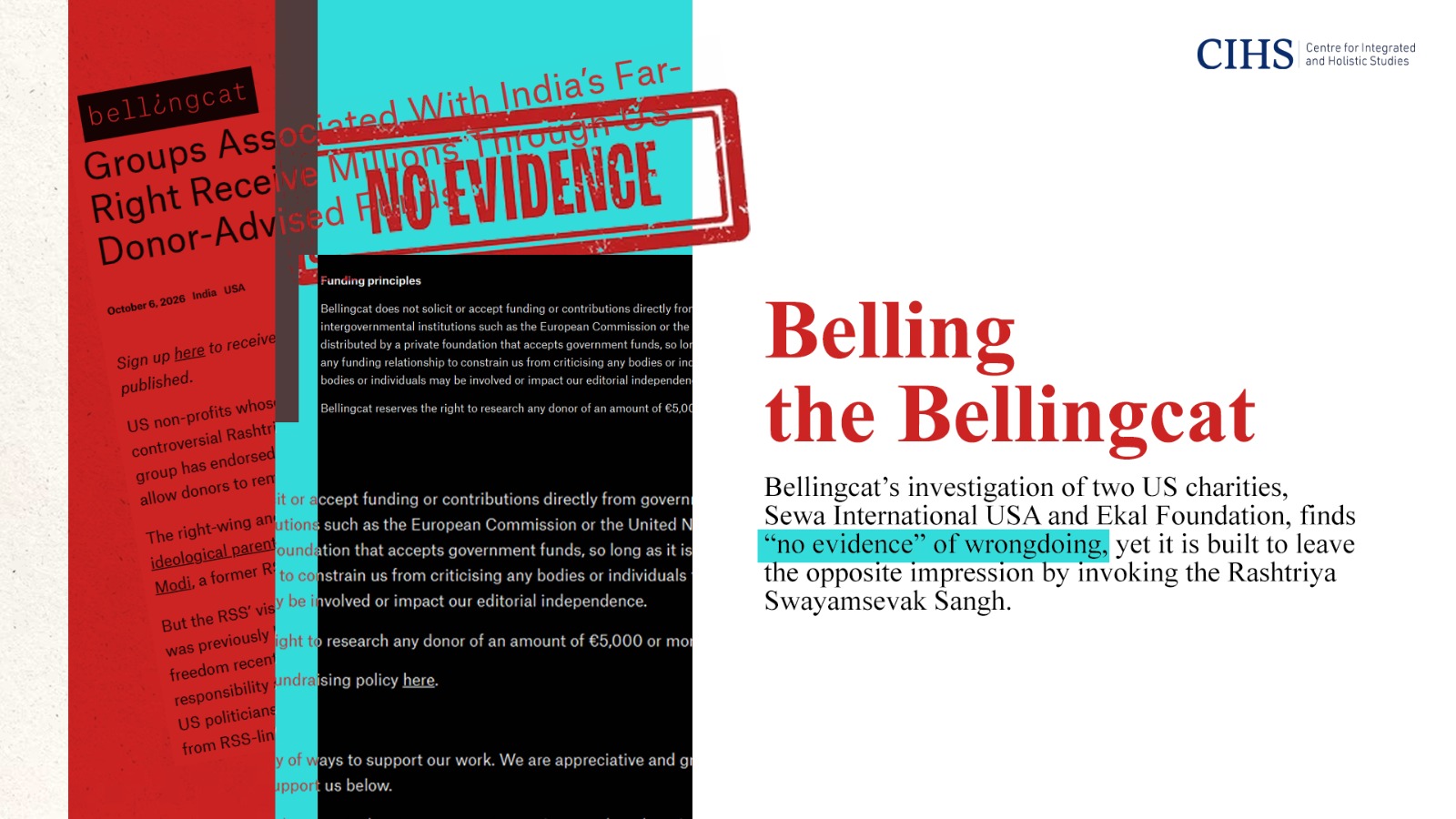
Bellingcat’s investigation of two US charities, Sewa International USA and Ekal Foundation, finds “no evidence” of wrongdoing, yet it is built to leave the opposite impression by invoking the Rashtriya Swayamsevak Sangh. This rebuttal reads that subtext line by line.
https://www.bellingcat.com/news/2026/10/06/dafs-india-rss-donations
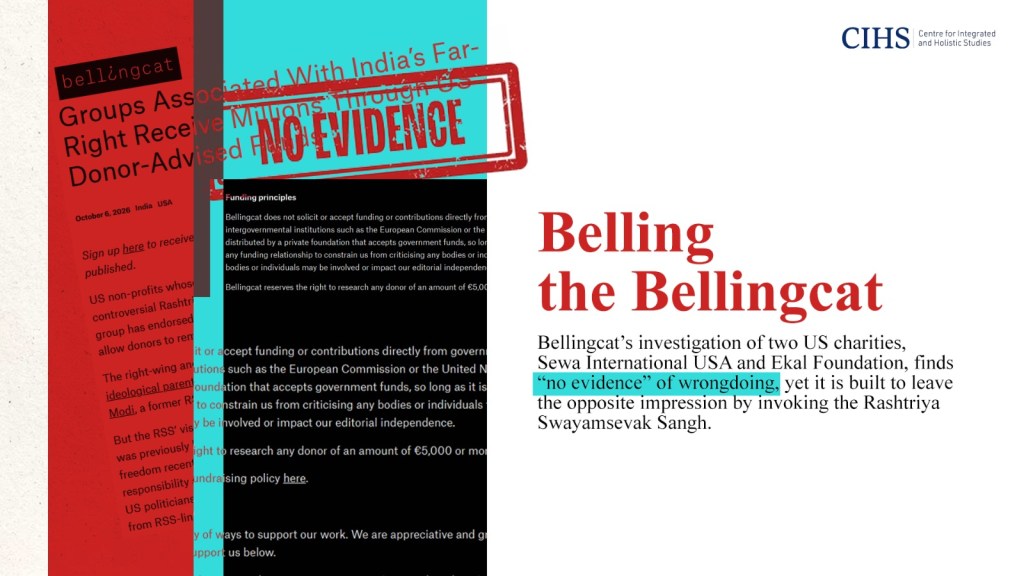
Before anything else, readers should hold two facts about the Bellingcat article in view. Its title is “Groups Associated With India’s Far-Right Receive Millions Through US Donor-Advised Funds.” A little way into the text, the authors write: “There is no evidence that DAF grants funded the RSS, only that they went to organisations that appear to have connections with the RSS.” I ask readers to keep that sentence in mind through everything that follows.
An organisation whose stated aim is to build people for constructive work in every field of life, and which has pursued that aim for a century, will naturally have a wide network of individuals. The diaspora, too, will carry that network abroad, sustained by strong cultural ties to India. Participation in many sectors is not infiltration; it is what service produces. The RSS is a body of individuals, not a registered entity, and Indian law permits that. It openly calls India a Hindu nation, as any civilisational movement may state its idea of itself. A US commission can call for sanctions, and the RSS will keep its course. What cannot be sustained is the practice of painting it as sinister, openly or through subtext, and then stigmatising everyone associated with it.
Bellingcat’s article follows a familiar method for raising alarm about the RSS. It first labels the organisation “far-right,” then brings in an expert’s opinion, and finally tells readers that nearly a hundred US politicians have pledged to refuse funding from RSS-linked groups. What it leaves out, however, is that the pledge was announced in the context of the RSS chief delivering the message of Universal Oneness at an interfaith gathering in New York.
Let me state my position at the outset. Bellingcat’s article is designed to unsettle the sponsors of donor-advised funds, and it does so through what I call advocacy by implication. Just as it deliberately leaves out the context of “Universal Oneness,” saying less than it knows, I will show how its broader hypothesis is itself out of context. The article masquerades as investigative journalism while employing a sophisticated form of dog-whistling. I will take it apart step by step.
A donor-advised fund exists to make charitable giving simpler, more consolidated and more sustained over time. One qualification the article leaves out is that a donor can attach a purpose to a grant recommendation. Such restricted grants are common and tend to be larger: the DAF Research Collaborative’s 2024 national study found that restricted grants were generally of higher value. In charitable giving, the donor’s conscience comes first. Can Bellingcat show that any of these donors was seeking out RSS-specific projects? It cannot, and the article says as much: “There is no evidence that DAF grants funded the RSS, only that they went to organisations that appear to have connections with the RSS.” That sentence is the escape hatch. The article reports that all of Ekal USA’s foreign grants during 2020–2024 went to the Ekal Vidyalaya school projects in India. So what does this insinuation offer the sponsors, whose business is to administer these funds for a fee?
The article analyses the period from 2020 to 2024 without addressing the context of those years: 2020 and 2021 were the pandemic years. It is reasonable to ask how much of the giving during that period went towards buying, shipping and installing oxygen concentrators in India. Oxygen has no ideological spectrum; it is the same for the far-right, the centre and the far-left. According to Sewa USA’s own reporting, more than 87% of the DAF funds it received during this period came in the two pandemic years. As I said earlier, in charitable giving, the donor’s conscience comes first, and bringing the RSS into the story will not change what moves a donor. If Bellingcat wants to invoke the RSS, it should also look at the record of how Indian law-and-order authorities enlisted RSS volunteers for last-mile delivery during the pandemic.
This is where the article’s coding is most refined. The passage reads: “Some DAF sponsor organisations have previously faced criticism for granting money to charities that have promoted homophobic, anti-immigrant or anti-Muslim views.” The article never says which charities those descriptions refer to. By placing this passage alongside its discussion of two charities it calls “linked” to the RSS, it invites readers to read the RSS into the list.
The advocacy by implication continues. The article quotes Professor Brunson as saying that DAF sponsors “absolutely have the right and ability” to halt the processing of donations to certain organisations. Placed here, the quote tells sponsors that, because their grants reach charities “linked” to the RSS, they are free to pause them. No sentence says so. The implication does the work. That is advocacy by implication.
So, what is Bellingcat’s article for? Not for the charities, which it accuses of nothing. Not for the reader, who is handed a set of figures and infographics without a basis for comparison. Its only remaining reader who can act is the sponsor. A label, an expert and a count of politicians tell these readers what to call the groups, how to feel about them, and that others have already taken a position. A passage about sponsors “criticised” for funding charities associated with hateful views, followed by a reference to the ability to halt DAF transactions, tells them that their peers have acted and that the decision is theirs.
The article’s gravest fault is not any single sentence. It is the kind of knowing it models. The Bhagavad Gita has a name for it. In the eighteenth chapter, Krishna describes three grades of knowledge. The highest sees one undivided reality running through all that appears divided. The lowest, tāmasa jñāna, is knowledge that “clings to a single fragment as if it were the whole, without sound reason, without grasping the real nature of the thing, and narrow” (18.22). Read the Bellingcat piece with that verse beside it. A label stands in for a definition. A handful of adjacencies stands in for a pattern. One expert stands in for a field, and a pledge stands in for a finding.
(Author is an accomplished computer scientist, educator and holds expertise in media content strategy)

