

Priyank Kanoongo
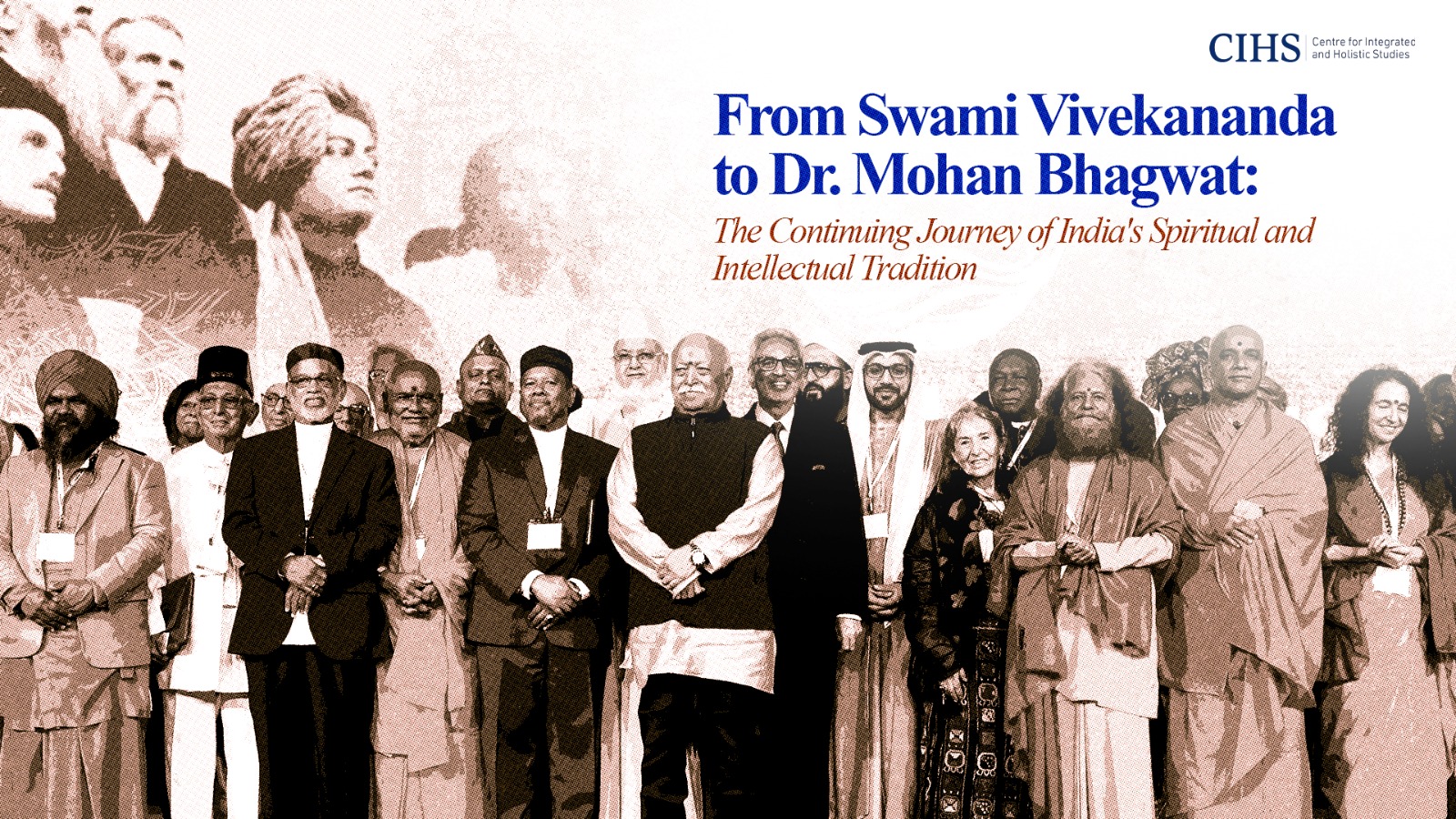
New York’s Madison Square Garden is not merely a vast auditorium; it is one of those prestigious platforms in the world where the presentation of an idea becomes, in itself, a part of global dialogue. The address delivered from such a platform by Dr. Mohan Bhagwat, Sarsanghchalak of the Rashtriya Swayamsevak Sangh, assumes special significance because it reflects not merely the message of an organisation, but the continuity of India’s long spiritual and civilisational tradition of thought—one of the most influential expressions of which in the modern world was Swami Vivekananda’s Chicago address of 1893.
In Chicago, Swami Vivekananda presented before the world an India whose spiritual consciousness possessed the ability to view diverse beliefs and faiths not as mutually conflicting, but as different paths leading towards the truth. He did not confine the Indian perspective merely to tolerance; rather, he connected it with the higher ideal of acceptance. He spoke of a civilisation that, throughout history, had provided refuge to communities fleeing religious persecution and had accommodated different faiths within itself.
In his address, India was not merely a geographical entity; it emerged as a civilisation whose strength lay not in eliminating diversity, but in carrying diverse identities together.
More than a century later, Mohan Ji’s address appears as a contemporary expression of that very civilisational vision.
It is here that the most important ideological connection between the two emerges. Swami Vivekananda introduced the world to India’s spiritual vision; Mohan Ji connects that same vision with the social and global questions of the present day. Swami Ji presented the coexistence of different religious traditions as one of India’s spiritual achievements, whereas Mohan Ji presents it as the Indian vision of “Unity in Diversity”—eliminating diversity is not the solution; what is necessary is to recognise the underlying unity within it.
This difference is not merely one of language; it also reflects the requirements of the two different eras.
During Vivekananda’s time, the question was how the world should understand an India viewed through a colonial lens, and with what confidence India itself should recognise its civilisational strength. Today, the question is different. The world is technologically more interconnected than ever before, yet divisions based on identity, religion, culture, race and ideology have also intensified in many societies. At such a time, the question is: what can India offer to the world from its thousands of years of experience of coexistence?
Mohan Ji’s answer appears to lie in this very civilisational consciousness of India.
His interpretation of Hindutva in the address also emerges within this broader context. Rather than limiting Hindutva to any single mode of worship or narrow religious identity, he associates it with a way of looking at life and society in which an individual looks beyond oneself towards society, understands duties alongside rights, and experiences a sense of oneness amid diversity.
In this context, his view that if someone believes that Muslims should have no place in India, such thinking does not understand the fundamental spirit of Hindutva, assumes particular significance. It points towards a conception in which India’s civilisational unity is not based upon the exclusion of any community or the denial of its identity, but upon the ability to carry different communities together.
Here, a clear resonance of Swami Vivekananda’s tradition of thought can be heard. For him too, India’s spiritual strength did not mean victory over another faith or its elimination. He saw India’s strength in the fact that this land had given space to different beliefs, maintained the possibility of dialogue among them, and did not restrict the search for spiritual truth to any single path.
Mohan Ji connects this very spirit with the contemporary questions of social harmony and human unity.
Another important dimension of his thought is his appeal to Indians living abroad. Remaining connected to one’s motherland and cultural roots while simultaneously demonstrating loyalty, honesty and responsibility towards one’s land of work are not contradictory ideas. It is equally necessary to fulfil one’s responsibilities towards the country and society in which one lives and with which one’s labour, life and future are connected.
This brings forth a broader element of the Indian perspective in which preserving one’s own identity and respecting the existence of others go hand in hand. “Vasudhaiva Kutumbakam” does not mean eliminating one’s distinct identity; rather, it means developing the capacity to view the world as one family while remaining rooted in one’s own identity.
The relevance of this idea has increased even further today. Technology has reduced geographical distances, but social and ideological distances have increased in many places. Identity-based conflicts, religious polarisation and cultural clashes have become major questions in global discourse. At such a time, India’s civilisational experience cannot remain merely a memory of a glorious past; it must be transformed into an idea that is useful for the present and the future.
It is here that the broader significance of Mohan Ji’s address becomes apparent.
The India that Vivekananda presented confidently on the world stage was politically subjugated. His challenge was to ensure that the world did not view India merely through the lens of poverty, colonial subjugation or backwardness, but also understood its profound philosophical, spiritual and cultural consciousness.
Today, circumstances have changed. India is independent, it engages with the world with confidence, and its role in global discourse has steadily increased. Therefore, the presentation of India’s civilisational vision can no longer remain confined merely to explaining itself to the world; it naturally also carries an aspiration to contribute towards finding solutions to contemporary global challenges.
This is the most significant transformation in the journey from Chicago to Madison Square.
Then, India was telling the world—understand us in the light of our reality and our civilisation.
Today, India can also say—understand our civilisational experience; perhaps it may contain answers to some of the questions confronting today’s world.
Yet, within this transformation, a profound continuity remains.
Swami Vivekananda carried India’s spiritual strength to the West, but he also urged India to learn from modern science, knowledge, organisation and self-confidence. His thought was not one of self-absorption, but of dialogue. A modern expression of that same dialogue can be seen in a thought process that presents Indian civilisational values before the world while simultaneously speaking of respect for other societies and responsibility towards one’s land of work.
In this sense, the Madison Square Garden address should not be viewed merely as a contemporary public speech. It can also be read as a modern chapter in that long intellectual dialogue which Swami Vivekananda established before the modern world with extraordinary confidence.
A monk introduced the world to the soul of India; today, a Swayamsevak belonging to that same broader civilisational tradition is expressing that soul in the language of his own time and in the context of contemporary challenges.
Times have changed, the platform has changed, circumstances have changed, and India’s position in the world has also changed—but the fundamental current of thought remains: unity in diversity, coexistence, duty, social harmony and human welfare.
Swami Vivekananda established India’s spiritual consciousness on the modern world stage. Mohan Ji appears to be carrying that same consciousness forward in a social and global context by connecting it with the questions confronting today’s world.
The journey from Chicago to Madison Square, therefore, is not merely a story of similarities between two speeches or two personalities. It is the continuing journey of an Indian thought that remains firmly rooted in its foundations while embracing the world as its own—and that possesses the courage to view diversity not as a problem, but as an expression of a broader oneness.
This is the most beautiful and meaningful link in the Indian spiritual and intellectual tradition that continues from Swami Vivekananda to Mohan Ji.
(Shri Priyank Kanoongo is a Member of the National Human Rights Commission (NHRC) of India.)

