


Smart borders management with several layers, underground optical fibre sensors, UAV surveillance to curb infiltration; Mission to deal with demographics, fence entire Bangladesh border.
Vinod Kumar Shukla
Nehru-Liaqat pact had provisions for Muslims migrating to East Pakistan (now Bangladesh) to return till December 31, 1950 if they wished to by offering them many norms that favoured them only. Dr Shyama Prasad Mukherjee resigned from Nehru government in protest. But this pampering combined with unabashed appeasement continued.
Infiltrators, illegal Muslims and Rohigyas have never witnessed in West Bengal what they have experienced ever since BJP came to power. For West Bengal, It took too long to realise the dream of Dr Mukherjee as people were deceived by three fallacious arguments:
First, if India behaves responsibly, majority in the neighbourhood would behave similarly; Second some concessions (privileges) to Muslims were necessary for confidence building and putting balm on their sores like retaining Muslim Personnel Law etc., especially by leaders like Jawahar Lal Nehru and pseudo-intellectuals who claim to be inheritors of his school of thought and Third that was subtle, unspoken but obvious that decision against Pakistan and Bangladesh even for protecting interest of Bharat may be seen as fretting Muslims impacting vote bank.
Against this backdrop, their activities were overlooked which had its maximum bearing on infiltration from Bangladesh. Though it has got nothing to do with Indian Muslims rather impacting them adversely, people not only shied away from speaking against it but deny any such thing happening. Most of the border districts of Bharat along Bangladesh have been witnessing upsurge in Muslim population which is certainly not organic. Situation has gone so bad that infiltrators can be found everywhere in Bharat.
On July 14, 2004, the then Minister of State for Home Sriprakash Jaiswal told Rajya Sabha that there were over 1.2 crores illegal Bangladeshis in Bharat. This was bound to create controversy, so numbers were withdrawn saying that they were ‘unreliable’. This was obviously done to save Muslim vote bank of the then Congress government.
The government changed in 2014 and in November 2016, the then Minister of State for Home Kiren Rijiju informed Upper House that there were approximately two crore infiltrators. The biggest worry is that these infiltrators are not only usurping resources, jobs but pose serious security threats to people and Bharat.
The impact of demographic change is endorsed by census data. Between 1951 and 2011, Muslims grew by 4.4 percentage points to 14.2 per cent while Hindus declined by 4.3 points to 79.8 per ccnt. Hindus were 84.1 per cent and Muslims 9.8 per cent in 1951.
Most frightening story is that the menace of border districts has now reached every nook and corner of Bharat from big cities to remote villages including reserve forests by encroaching government, forest, Railways, defence lands, river catchment areas and deserted historical monuments. It has made Hindus minority in nine states and Union Territories out of total 36; 200 out of 800 Tehsils and 1500 out of 6000 villages across the country. This was stated before Supreme Court through a public interest petition filed in 2020.
Military intervention and diplomatic support from Bharat led to carving out of Bangladesh as over one crore refugees were given shelter in Bharat. But, the bonhomie did not last and selfish intent was exposed sooner than later with relations deteriorating even in the mid-1970s due to military junta taking reins in Bangladesh with issues like border disputes, insurgency and infiltration and water-sharing cropping up.
The reason however was radical Islamic organisations especially Jamaat e Islami whose umbilical cord is still in Pakistan continued with its hate mongering. Bharat tried to improve relations by signing 2015 Land Boundary Agreement (LBA) which resolved decades-old border disputes.
Both the countries agreed on Coordinated Border Management Plans (CBMP) in 2011 to curb infiltration, human trafficking, cattle smuggling and cross-border crime. But issues like equitable sharing of waters from 54 common rivers, border management and trade issues remained inconclusive. Bilateral trade reached $13.51 billion with Bharat extending Lines of Credit worth $8 billion for development of infrastructure, railways and ports.
Enhanced connectivity included cross-border rail links between Agartala–Akhaura and the use of Bangladeshi ports, Chittagong and Mongla for cargo of Bharat. Besides, Bangladesh has a huge dependency, 1160 MW electricity required to be fed from Bharat’s grid.
Bharat helped East Pakistan to liberate itself from tyranny of Pakistan but the irony is that radicals are unwilling to recognize the historical facts leading to formation of mukti vahini and then the liberation. A statement issued by seven-party alliance on December 19, 1984 asserted that Bangladesh came into being through a bloody war waged by its valiant freedom fighters and people. The statement said that this heroic achievement was in no way the victory of the Armed forces of Bharat over erstwhile East Pakistan.
RNP Singh, a former Intelligence Bureau officer in his book ‘Bangladesh Decoded’, writes, “It is a surprise that within such a short time people of Bangladesh were swayed away by anti-India campaign without pondering over the facts that India had come to rescue them when they were virtually being butchered…”
Concessions given to Bangladesh and Pakistan appear to be mistake of the then government as infiltration and many other issues still persist. Field Marshal Sam Manekshaw’s observation on Shimla Agreement who had won the 1971 war for Bharat was, “Bhutto made monkey out of India.”
Whether democratic governments under Awami League or BNP or Martial Law, minorities in Bangladesh were constantly persecuted, temples desecrated, women raped, men killed and families converted as organisations like Jamaat e Islami always cocked a snook at law.
Probably to avenge 1971 humiliation, Z A Bhutto kept on trying to cause differences between Bharat and Bangladesh. Sheikh Mujibur Rahman was invited to attend heads of Muslim States conference at Lahore in Pakistan in 1974. For economic benefits, Awami League government started cultivating Middle-East countries.
Jamaat leader Ghulam Azam prevailed upon the Awami League government to remove Constitutional obstacles imposed against Islam. On June 9, 1988, the state religion of Bangladesh was announced as Islam allowing rampant loot, rape and arson against minorities resulting Hindu population to come down to less than nine per cent from 29 per cent in 1947.
Hindu population in Bangladesh fell due to persecution leading them to convert to Islam in fear of losing lives and women being sexually assaulted. Some of them managed to flee India. This has forced Bharat to adopt Citizenship Amendment Act (CAA) for citizenship to persecuted minorities of Afghanistan, Pakistan and Bangladesh.
Jamiat Ulema e Hind which has a strong influence over Muslims in Bangladesh had gone to Supreme Court and held protests against CAA but they remained silent on killings of Hindus in Bangladesh. When a coup happened against Sheikh Hasina, Hindus were and are targeted while even a venerated ISKCON priest was illegally arrested.
Not just Bharat’s people but even that of Bangladesh was set on West Bengal elections. But its results shocked them and they started threatening Bharat for decisions taken by the West Bengal government on fencing the long porous border by the BSF. The government gave land to BSF within the cut off limit of 45 days amid threats from advisor to foreign minister of Bangladesh M Humayun Kabir.
Dr Enayetullah Abbasi, a radical Islamists leader, bragged that Bangladeshi Muslims will not remain silent if Muslims in India are targeted. This is the real face of Bangladesh society as the country elected 68 Jamat and its constituents along Bharat-Bangladesh border constituencies with an intent of making greater Bangladesh a reality which seems to have been foiled by people of West Bengal.
Walking the talk by fencing, securing the future of West Bengal and its neighbouring states is definitely not a majority versus minorities’ issue. It’s got more to do with illegally overstaying foreign nationals versus the citizens of Bharat.
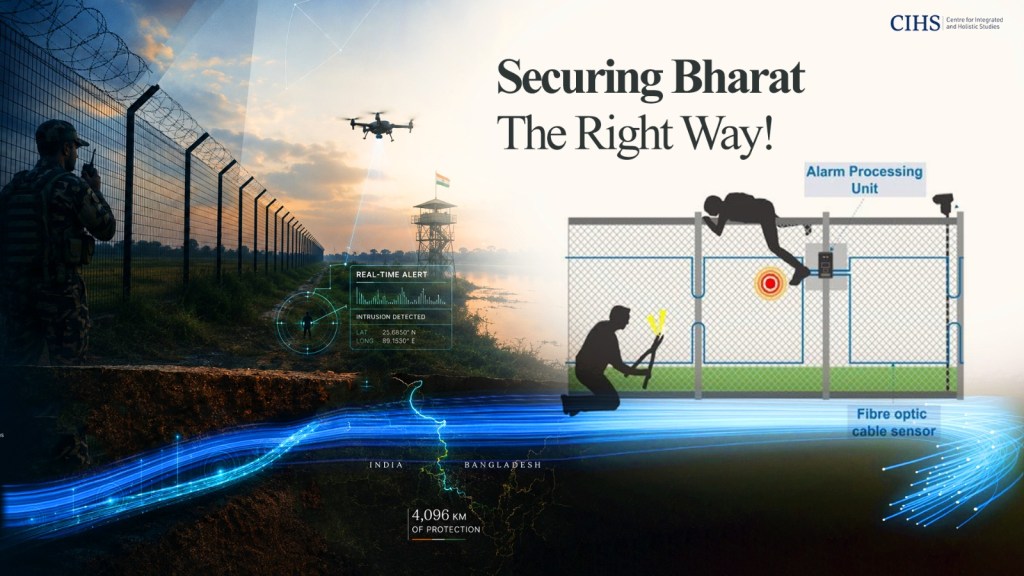
Bharat’s Home Minister Amit Shah seeking to deploy technology as a way to undertake border management is plausible. Technology framework in several layers coupled with real time air surveillance by unmanned aerial vehicles (UAVs) coupled with underground optic fibre sensors to detect human movement would be the way to go forward.
Setting up a high powered demography mission to identify challenges posed to demographics in the country and provide rapid responses apart from putting in place an institutional mechanism should be the beginning to manage our borders more scientifically.
(Author is a senior journalist and associated with Centre for Integrated and Holistic Studies, a non-partisan think-tank based in New Delhi)

