


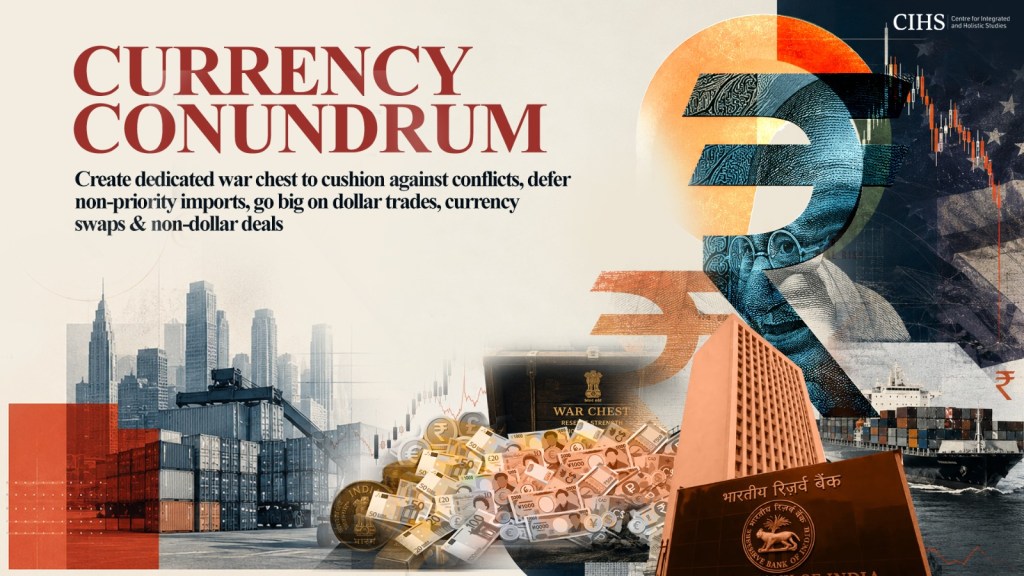
Create dedicated war chest to cushion against conflicts, defer non-priority imports, go big on dollar trades, currency swaps & non-dollar deals.
K.A.Badarinath
Is Bharatiya Rupee under attack? Will conversion ratio cross the psychological barrier of Rs 100 per one US dollar? Would that mean Bharat’s economy gets more susceptible or vulnerable to external currency market churns? Or, will it be oil and war?
How does one make sense of rupee valuations that fluctuate wild these days? There’s a vertical divergence in Bharat on Reserve Bank of India (RBI) strategy to stem continued slide in rupee.
One big section led by sixteenth finance commission chairman Dr Arvind Panagariya argue that crossing Rs 100 mark against one US dollar should not be viewed too seriously. “It’s just a number” is what Dr Panagariya wrote in his column earlier this week pushing for free fall or depreciation of rupee.
Owing to continued shortages in crude oil, forward market rate to dollar was pegged at Rs 100 a piece triggering a big debate on future of Bharatiya currency.
Dr Panagariya advised RBI not to defend the rupee with its huge foreign currency reserves by intervening in markets. Oil shortages and higher inflation at retail level coupled with healthy interest rates were causing free fall of rupee that crossed 97 per dollar.
There’s a significant group that recommended a more conservative approach to rupee valuation. Swadeshi Jagaran Manch, an RSS inspired organization has asked RBI not to allow rupee depreciation further and touch 100 per dollar.
SJM’s argument is simple: imports for domestic industry and trading community would become expensive. Cost of products and services would move up swiftly thereby impacting consumption demand and eventually hit growth. Make in India for the world campaign with self-reliance or swadeshi as motto would be hampered if rupee depreciated beyond 100 per dollar.
Further slide in rupee may not be tenable politically also given that in forward markets, US dollar is already being quoted beyond Rs 100. Soaring prices of crude oil in Bharat’s diversified energy basket also had its impact.
For instance, crude oil prices surge of beyond 70 per cent during April 2025 and April 2026 is something which has seriously impacted Bharat’s energy import bill. Aggregate price of crude during the period was US $ 114.48 as against US $ 67.62 per barrel in previous year. Every dollar increase in crude oil per barrel translates to over US $ one billion in import bill for Bharat.
Even an aggregate US $ 85 per barrel could put pressure on budget projections for 2026-27 given that fiscal deficit would expand, subsidy bill on fuel would spike and capital investments as well as development projects spending may have to be curtailed.
This provides the logic, reasoning and rationale for Prime Minister’s call for belt tightening measures that have been rolled out over last two weeks.
In this backdrop, liberalists led by likes of Dr Panagariya have opposed measures like floating dollar denominated government paper or mobilization through high cost NRI deposits in dollars to shore up the reserves. Deferring payments against currency value spikes or transferring currency gains to NRIs was not an option, they argued.
Better option would be to attract long term investments, defer non-priority imports and make goods and services industry in Bharat attractive in terms of ‘ease of doing business’.
During financial year ending March 2026, Bharat attracted gross foreign direct investments of US $ 95 billion. But, the net inflows which discounts investment outflows, profits repatriation, disinvestments etc and interest payments was pegged at a very modest US $ 7.7 billion. Quickly expanding net FDI inflows needs to be attempted. For starters, can we target net FDI inflows at US $ 25 billion this financial year?
Secondly, currency swaps in medium to long term is an idea that bankers and policymakers cannot ignore. Leveraging volatility in the currencies market and taking positions is something that needs to be done in a calibrated way.
Already, currency traders have reported that RBI booked healthy margins on sale of US dollars over last one year. Apart from swaps that spread currency risks, dollar trade is something that RBI and top Indian banks must continue to minimize the adverse impact of volatility in the markets. In last one year ending April 1, 2026, RBI sold US $ 53 billion to either defend rupee or book profits. As on date, Bharat’s foreign exchange reserves are reported at US $ 688.9 billion.
Expanding and diversifying Bharat’s foreign currency basket moving away from US green back is an option. President Donald J Trump may be averse to the idea of developing countries especially India ‘de-dollarizing’ its economy. But, settling trade deals in local currencies could be a big opportunity. Merchandise and services trade settlements in respective currencies can be considered beyond BRICS group.
Deferring gold and silver imports by a year is not a bad option either. During 2025-26, gold import bill had crossed a whopping US $ 71.98 billion on 702 tonnes. A 24 per cent increase in gold import bill over 2024-25 is something that stares in the face. There’s no harm whatsoever for families to stagger out their gold and silver purchases given the big economic cost.
Resetting or revisiting priority areas for foreign exchange deployment may be considered seriously. For instance, pharmaceutical sector is one big consumer of foreign exchange especially for ingredients to undertake production of end-use formulations. Here again, without restrictions, priority may be assigned to life saving drugs, those intermediates and formulations that are produced for re-export purposes.
One big idea could be to create dedicated ‘war chest’ of currency reserves to tide over conflict situations. On lines of strategic oil reserves why not build conflict currency reserves? Only recently, during Prime Minister Modi’s brief stopover, an agreement was concluded to shore up strategic oil reserves by 36 million barrels.
Each year, a chunk of RBI surpluses can be contributed to the war chest reserves. This is in addition to general foreign exchange reserves that RBI maintains like crude stocks. For instance, Rs 2.87 lakh crore surplus funds will be transferred by RBI to government as dividend. In case Rs one lakh crore out of RBI surpluses are transferred to a dedicated war chest each year, perhaps this can be utilized to meet conflict related contingencies.
Narendra Modi government may have to take recourse to multiple options on the currencies front.
(Author is a veteran journalist, director & chief executive of non-partisan think tank based in New Delhi, Centre for Integrated and Holistic Studies)

