


Self-styled Christian lobbyists’ campaign against Hindus outreach in US & Europe has not worked even with scaremongering and demonization tactics.
Aniket Pingley
There is a genre of writing immune to journalistic standards in gathering evidence, retaining balance and complete disclosure. It is the opinion piece. In its honest form, it declares a position and argues it. In its dishonest form, it uses the opinion format as legal exemption, a space where alarming assertions are made, dehumanising imagery deployed and contested allegations stated as settled fact, all under the protective cover of “these are merely my views.”
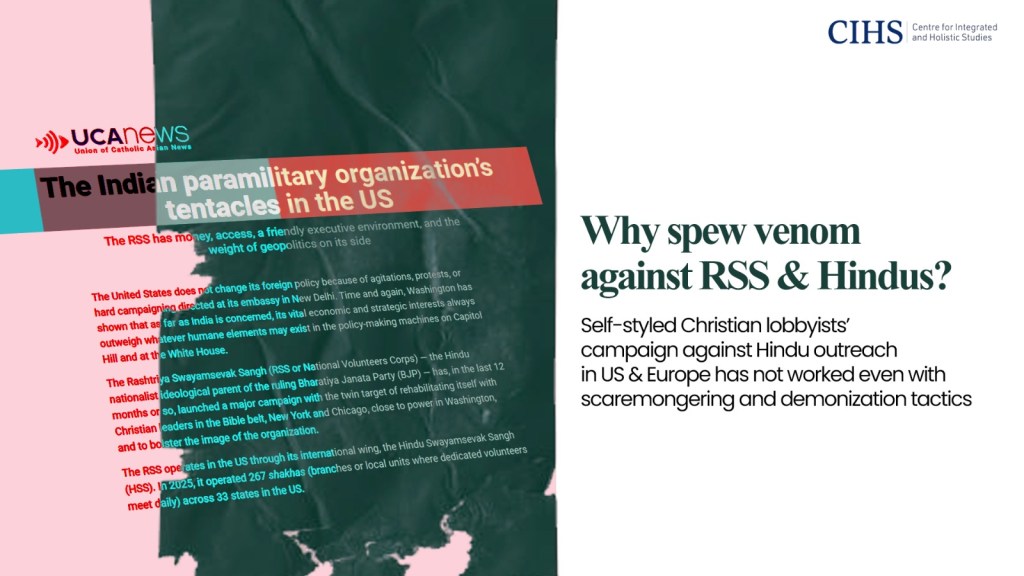
John Dayal’s piece in UCA News, headlined, “The Indian paramilitary organization’s tentacles in the US,” is a distinguished specimen of the dishonest form. It is tactical scaremongering – calibrated to produce a specific emotional and political effect amongst a specific audience at a chosen moment in Washington lobbying calendar.
The article makes claims about the RSS, Gujarat, lobbying firms, FCRA and about Indian-origin officials in the US government. I will not engage those claims here. They are matters of public record, available to any reader willing to search. Readers are capable of forming their own opinions about Gujarat 2002, Modi visa episode, Squire Patton Boggs and India’s FCRA regime. They do not need me to defend the RSS against Dayal’s version of events.
What I will do is more useful: identify what this article actually is, what it is attempting at and why its final sentence, the most revealing sentence in the piece, tells the reader everything they need to know.
Confession in last sentence
Dayal ends his article with, “The RSS has money, access, a friendly executive environment, and the weight of geopolitics on its side, and for the moment seems able to counter the evangelical campaign.”
Read it slowly. Counter the evangelical campaign. Not “respond to criticism.” Not “defend itself against allegations.” Counter the evangelical campaign.
Dayal told his readers, in his own words, what this is actually about. There is an evangelical campaign, organised, funded and directed, targeting RSS in Washington DC. And, what is Dayal lamenting is that this campaign is not working. RSS is successfully countering it.
This is the most important fact in the entire article and it appears in the last line, almost as an afterthought. Everything before it, the alarming language, assembled allegations, USCIRF references, lobbying firm drama, is the infrastructure in that evangelical campaign. The article is a dispatch from one side of an active lobbying contest, written by one of its participants, lamenting that the other side is holding ground.
And, RSS has every right to hold its ground.
USCIRF’s annual report is not scripture. It is not axiomatic truth. It is not a judicial finding. It is the output of an advisory commission whose India recommendations the US State Department has declined to act upon for six consecutive years, a fact Dayal buries in his final paragraph as if it were a footnote, rather than the most consequential sentence in his piece. American foreign policy operates on classified intelligence, diplomatic relationships and a comprehensive picture of the world that an advisory commission does not possess.
What’s this Evangelical Campaign?
The campaign Dayal laments, RSS is successfully countering, is a coordinated effort to have United States designate India as a Country of Particular Concern on religious freedom, impose targeted sanctions on RSS and restrict its members from entering the US. It runs through USCIRF, Congressional testimony, UN Special Rapporteur submissions and in coordination with International Christian Concern, National Association of Evangelicals and the Southern Baptist Convention’s Ethics and Religious Liberty Commission.
Its substance: Christian organisations in India are being persecuted, FCRA restrictions choke Christian churches and anti-conversion laws are religious oppression.
Each of these claims deserves a question Dayal never asks: why are there so many foreign-funded Christian organisations operating in India and what precisely are they doing?
The answer is not theoretical. It is on the record.
Compassion International (CI), a major US-based Christian child sponsorship charity that operated in India for 48 years, provides the most precise forensic answer available. In 2017, Indian Government placed CI on “prior permission” list under FCRA, requiring explicit case-by-case approval for every financial transaction, effectively halting flow of approximately $50 million annually. The government’s case rested on CBI First Information Report and Income Tax investigation into CI’s primary Indian affiliate, Chennai-based Caruna Bal Vikas (CBV). CBV was registered under FCRA with its legally declared nature of association as “economic, educational and social.” The CBI found it had, in its own documents, “invariably indulged in religious activities.” More precisely, in CBV’s own stated long-term organisational objective, the goal was “converting poor children into fulfilled Christian adults.”
That is not a characterisation by the Indian government. It is what the organisation wrote about itself.
Furthermore, CI was identified as part of an organised international missionary industry focused on what its own practitioners call “10-40 Window”, a geographic band encompassing majority of the world’s Hindus, Muslims and Buddhists, deliberately targeted as a conversion frontier.
This is what the FCRA regime was responding to. Not the practice of Christianity, the Saint Thomas Christians of Kerala have worshipped in this land since the first century, and nobody has targeted them. What was being regulated is a specific, documented, foreign-funded, institutionally organised project of converting economically vulnerable children using charitable cover. When an organisation tells CBI investigators, through its own documents, that its goal is to convert poor children, it is not a policy concern. That is evidence.
India’s state governments have enacted anti-conversion laws through elected legislative assemblies using constitutional procedures with clear majorities. These laws do not prohibit practice of Christianity. They regulate coercive, fraudulent or inducement-based conversions. Twelve states have enacted such legislation. That is Indian democratic federalism functioning as designed. Whether those laws are sound policy is a matter for Indian courts and voters, not for an American advisory commission whose mandate derives from US domestic legislation with no jurisdiction over a sovereign parliament.
FCRA regime applies to all foreign-funded organisations in India, secular NGOs, Hindu organisations, Muslim outfits and Christian evangelists alike. Over 20,000 organisations of all types have had registrations cancelled or not renewed. To frame this as a campaign against Christians specifically requires ignoring the thousands of non-Christian organisations affected. That is not analysis. That is advocacy.
Hindu are a Security Threat!
Dayal writes: “The RSS has also reached out to the Trump administration’s unprecedented number of Indian-origin officials in senior positions, Kash Patel at the FBI, Harmeet Dhillon heading the Civil Rights Division at the Department of Justice, Sriram Krishnan, the Senior AI Policy Advisor and Jay Bhattacharya at the National Institutes of Health. None of them speaks for the RSS, but their collective presence creates an environment in the executive branch that is instinctively sceptical of campaigns targeting Hindu nationalist organizations.”
Dayal concedes “none of them speaks for the RSS” and then proceeds as if he had not. He names four Indian-origin officials and implies that their collective presence is a structural problem because it creates an environment sceptical of campaigns targeting Hindu nationalist organizations.
Let us be precise. Dayal is not even alleging improper conduct. He is not citing a specific decision that benefited RSS. He is simply saying that their very existence in senior government roles creates wrong environment for his campaign. He wants an executive branch more receptive to campaigns targeting Hindu nationalist organisations. And, he is cut up with Hindu Americans have made it to senior positions purportedly turning things harder for his campaigns.
Strip away the policy vocabulary and the argument is simple: the wrong kind of people is in the room and it is making my campaign against their community more difficult.
This is what religious and ethnic prejudice looks like when it learns to speak the bureaucratic language. The moment you suggest that a person’s background makes them unsuited to objectively evaluate campaigns targeting their community, you have made an argument every civil rights tradition rejects. Not wanting people of a particular background in government, because their presence inconveniences a campaign against their community, is the definition of discriminatory exclusion.
The instinctive scepticism Dayal laments is not bias. It is the reasonable response of people who know from personal and community experience, that not every allegation against a Hindu organisation is true, that not every USCIRF finding reflects ground reality and that India is a large, diverse, sovereign democracy that deserves to be treated as one.
Lobbyist sees lobbies all over…
John Dayal has testified before US Congressional human rights bodies as a representative of Indian Christians on multiple documented occasions spanning over 25 years, as early as September 2000 listed in USCIRF’s own records as a witness and as recently as 2025, publicly commenting on USCIRF’s annual report.
He served as Secretary-General of All India Christian Council from 1998 to 2014. He is a past president of the All India Catholic Union. He coordinates with the same American evangelical organisations, International Christian Concern, the National Association of Evangelicals, whose campaign his article is designed to advance.
John Dayal is not a US national. He is an Indian citizen, operating in India, providing testimony to foreign government bodies and actively working to shape the foreign policy of a country he does not belong to, in ways that would constrain policy space of the country he belongs to.
Christian lobbies that he seeks to represent wants the going tougher for RSS, a civilizational, cultural societal movement operating within India’s legal and constitutional framework, never charged with a crime by any Indian court, to engage with the world. He wants USCIRF’s findings acted upon. Christian lobbies are pushing for sanctions, visa restrictions and asset freeze.
Dayal calls RSS’s engagement with Washington as spread of “tentacles.” Then, how do we frame his and Christian lobbies?
RSS has taken recourse to civic engagement, normal activity of people and organisations that use available democratic mechanisms to pursue their interests. RSS has every right to engage Washington DC. So does Dayal. But, Dayal presents his engagement as legitimate advocacy and RSS as sinister infiltration and paramilitary. That asymmetry requires an explanation he does not provide as none exists.
What do US know about RSS?
The most telling detail in Dayal’s article is not lobbying drama, USCIRF recommendations or the list of Indian-origin officials.
After USCIRF recommended in 2026 report that RSS be targeted with sanctions, the article describing RSS Washington presence as a network of alarming tentacles, Dattatreya Hosabale, RSS General Secretary, was entered United States. He spoke at the Hudson Institute. He was interviewed by NPR. He addressed academic roundtables including researchers from Oxford, UCL, LSE, Cambridge and SOAS.
United States government, with full knowledge of USCIRF 2026 report, with full access to its intelligence services, full awareness of everything Dayal assembled in his article, issued a visa (or did not revoke an existing one) to RSS General Secretary and allowed him to conduct a speaking tour of the country’s most prestigious institutions.
American statecraft does not operate on USCIRF’s bogus recommendations alone. It operates on strategic assessment, intelligence and a comprehensive evaluation of interests. The State Department has declined to designate India as a Country of Particular Concern for six consecutive years. These are not oversights. They are decisions made by professionals with access to far more information than John Dayal, USCIRF or this writer.
RSS is what it has always been, world’s largest voluntary civil society movement with over 83,000 daily shakhas and 150,000 service projects. A century of disaster relief, tribal education, blood banks and community health work is what defines RSS saga of service. A movement that predates Indian state by 22 years and outlasted every attempt to frame it as a threat as people who live alongside it know what it is.
It is a movement that believes Bharat’s civilizational legacy should be preserved for the humanity. That coexistence, not conversion, is the foundation of a diverse society. That a Hindu who maintains his dharma, a Muslim who maintains his and a Christian who has hers can all be Indian and that no external campaign, however well-funded and Washington-connected, should destabilise that compact.
That is the message RSS and its general secretary Hosabale carried to Washington DC. Dayal’s campaign, for the moment, has not worked.His final sentence tells us he knows it.
(Author is an accomplished computer scientist, educator, and holds expertise in media content strategy)

