


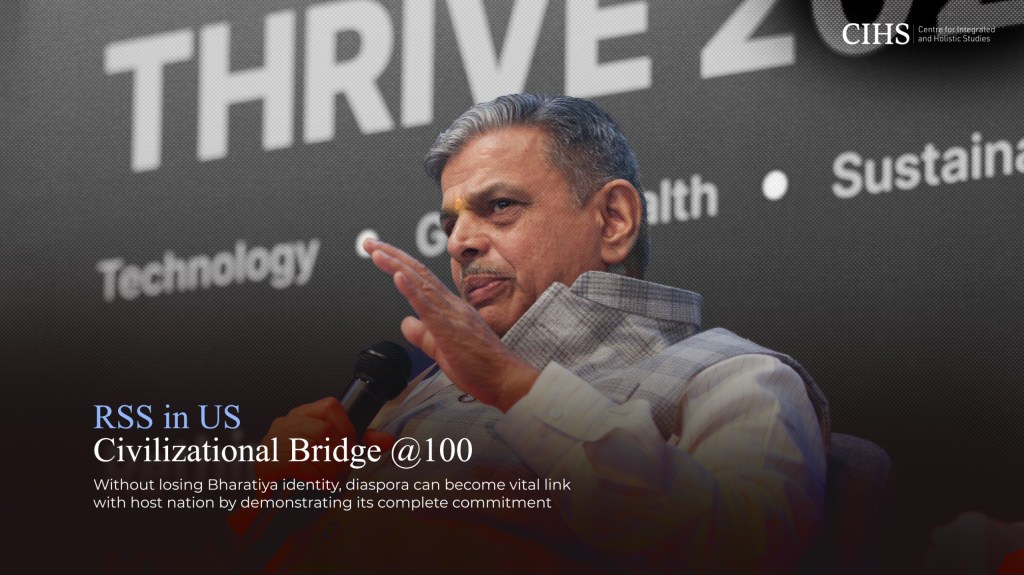
Without losing Bharatiya identity, diaspora can become vital link with host nation by demonstrating its complete commitment.
Arun Anand
Commemorating its centennial, Rashtriya Swayamsevak Sangh has begun a serious conversation with a bevy of stakeholders in the West especially the United States and Europe.
As part of its global outreach, RSS General Secretary Dattatreya Hosabale undertook a significant visit to United States in April 2026. It’s more than a routine diaspora engagement. This tour represented a carefully crafted civilisational outreach—one that combined reflection on a hundred-year journey with a forward-looking articulation of Bharat’s intellectual and cultural role in a rapidly transforming world.
At a time when global discourse is increasingly shaped by technology, geopolitics and identity debates, Hosabale’s visit sought to position the RSS not merely as an Indian organisation but as a participant in a wider philosophical conversation about humanity’s future.
Civilizational Dialogue in Silicon Valley
The intellectual centre piece of the visit was Hosabale’s address at Stanford University during the Thrive 2026 conference. Speaking before an audience comprising technologists, entrepreneurs and members of the Indian diaspora, he framed his intervention around a central proposition: that modern technological advancement must be guided by deeper ethical and civilisational wisdom.
Drawing from Indic traditions, he argued that knowledge systems in India have historically refused to separate the spiritual from the scientific. Ancient texts, including the Upanishads, were presented not merely as theological works but as repositories of inquiry into the nature of the human mind, the cosmos, and existence itself. In this view, the fragmentation of knowledge into rigid categories science versus spirituality is a relatively recent phenomenon.
Hosabale suggested that this integrated approach offers valuable insights in an age defined by artificial intelligence, ecological stress, and social inequality. He advocated what he termed a “holistic lifestyle,” contrasting it with excesses of consumerism and unchecked technological ambition. The emphasis was not on rejecting modernity, but on anchoring it within a broader ethical framework.
At the heart of this framework lies the idea of Vasudhaiva Kutumbakam, the belief that the world is one family. Hosabale presented this not as a rhetorical flourish, but as a practical principle for navigating global fragmentation and conflict.
Science, Knowledge & Civilisation
A key theme that ran through his address was the need to revisit and revitalise Indic knowledge systems. Centuries of disruption particularly during protracted periods of foreign rule led to erosion and marginalisation of indigenous intellectual traditions, he averred. As a result, many scientific ideas embedded within cultural and spiritual texts were either forgotten or dismissed as superstition.
Today, he argued, there is a renewed effort in India to recover and systematise this knowledge. Education, in this context, becomes central, not merely as a means of economic advancement but as a tool for reconnecting society with its intellectual heritage.
Hosabale emphasised that scientific inquiry and spirituality were not opposing forces. Rather, they complement and enrich each other. Historically, scholars engaged in both domains simultaneously, integrating empirical observation with philosophical reflection.
This integrated approach also carries ethical implications. He proposed that any technology intended for human welfare must be evaluated on three touchstones: economy, ecology and ethics. Technological progress that generates inequality, exploits nature or violates moral norms, he warned, ultimately undermines both society and the environment.
Equally significant was his emphasis on democratization of knowledge. While knowledge production has accelerated globally, access to it remains uneven. A truly equitable world, in his view, requires insights from all civilizations that be shared widely, enabling a more balanced and inclusive global order.
Redefining Diaspora Role
Beyond intellectual discourse, Hosabale’s engagement with Indian diaspora carried a clear and pragmatic message. Addressing gatherings in Silicon Valley, he urged Indian-origin communities to demonstrate complete commitment to countries they inhabit.
For the diaspora, he stated, contributing to progress and well-being of their host nation is basic dharma. This articulation is significant in contemporary debates around identity and belonging. Rather than encouraging a divided loyalty, Hosabale advocated a model of integration rooted in responsibility and participation.
At the same time, he encouraged diaspora to remain connected to Bharat’s cultural and civilisational values. This dual identity, being fully American while retaining an Indian cultural consciousness was presented as strength rather than a contradiction. In effect, the diaspora becomes a bridge: grounded locally, yet carrying a global civilisational perspective.
Path Ahead: Balancing Extremes
A recurring thread throughout the visit was call for balance. Hosabale warned against dangers of an unrestrained race for technological dominance, one that prioritises speed and scale over sustainability and human well-being.
He argued that traditional Indian thought offers a corrective: a worldview that emphasises harmony with nature, respect for all forms of life and an understanding of interconnectedness of existence. This perspective, he suggested, is particularly relevant in addressing contemporary challenges such as climate change and social fragmentation.
The concept of “knowledge guided by wisdom” emerged as a central motif. Knowledge, when divorced from ethical judgment, can lead to arrogance and exploitation. When guided by discernment, viveka, it becomes a force for collective good.
Conclusion
Dattatreya Hosabale’s 2026 visit to the United States was not merely a commemorative exercise marking RSS centenary. It was an attempt to articulate a vision, one that situates Indian civilizational thought within global debates on technology, ecology and human coexistence.
By engaging with Indian diaspora and intellectual communities in Silicon Valley, RSS signalled its intent to participate more actively in shaping global narratives.
The emphasis on loyalty to host nations, cultural rootedness and ethical balance reflects a nuanced approach to globalisation, one that seeks integration without loss of identity.
(Author is a senior journalist & columnist. He has authored more than a dozen books)

