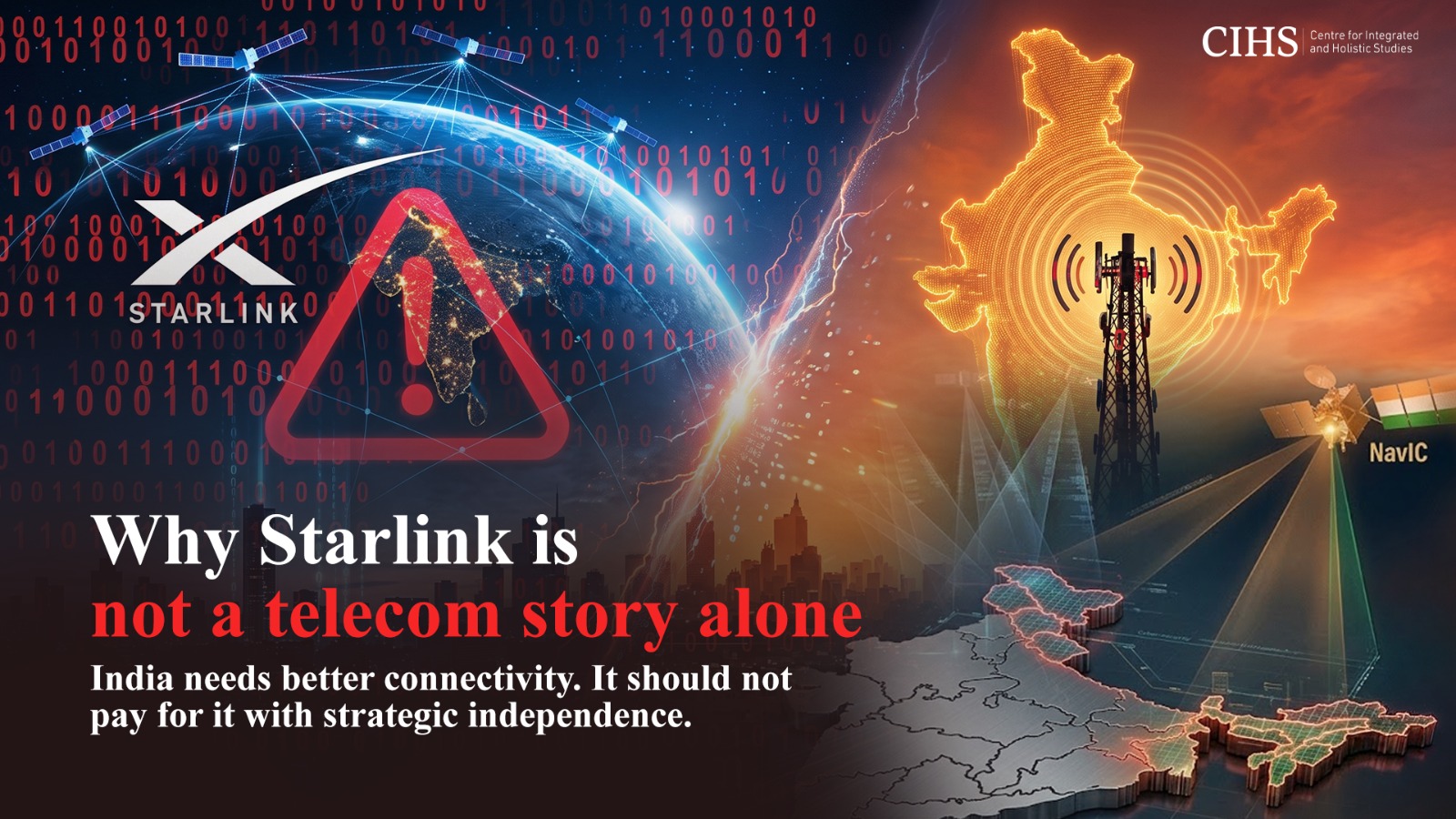


India needs better connectivity. It should not pay for it with strategic independence.
Dr. Nitin Sharma
India is at a crossroads. It must now take tough decisions and take them without bowing to pressure from anyone. Satellite internet can reach remote villages, mountain regions and underserved communities. But one question has got far less attention than it deserves. Who will control that connectivity? Starlink has secured a key regulatory foothold in India. Commercial services still need spectrum assignment and security clearance. While we wait, the debate is about speed, price and competition. Those matter. They are not the most important issues. India has sensitive borders. It faces complex internal security challenges. Satellite communication cannot be treated as just another telecom service.
The real question is not whether Starlink can deliver faster internet. It probably can. The question is whether India should let a strategic layer of its communications depend on a foreign private company. Its satellites, technology and final decisions sit outside our control. We have faced this dilemma before.
The lesson of Kargil
In 1999, during the Kargil war with Pakistan, India sought GPS data for the region from the United States. USA took the side of Pakistan and refused to make the GPS data available. Indian side was left in dark, and it became even harder for us to win that war. The exact details remain a subject of debate. The lesson was clear. A country cannot assume that technology owned by another nation will be there when its security is at stake.
India responded by building its own regional navigation system, NavIC (Navigation with Indian Constellation). That was not just a science project. It was a strategic decision. It was the first step becoming “Atmanirbhar Bharat”. Navigation in war cannot depend on another country’s goodwill. Now the same question arises in communications. We spent years and public money to reduce dependence on foreign navigation. Why should we accept a similar dependence on satellite communication now? Off course this is a different time and different technology, but principle of Self-reliance and sovereignty is still the same.
When one company holds the switch
Starlink is an impressive achievement. Its low-earth-orbit satellites connect places where ordinary networks are hard to build or easy to damage. In Ukraine, it kept people and forces connected when networks failed. That experience also raised hard questions. Public controversies over coverage near Crimea, limits on military use and terminal activation showed how much power a private provider can hold in a conflict. The point is not that Starlink failed Ukraine. It helped a great deal. The point is who decides.
Imagine India’s security relying on a network where a company’s leadership, foreign rules or another government’s interests can shape decisions. Could India guarantee uninterrupted service? Could it stop remote restrictions? If there is a dispute, whose instructions prevail? A commercial contract cannot answer these questions. National security needs real control over critical capabilities.
Even Europe wants its own network
India is not alone in this thinking. The European Union is close to the United States. Yet it is building its own secure satellite networks, IRIS² and GOVSATCOM. The aim is communications under European control for government and strategic use. Brussels has said the system is “Built in Europe, operated in Europe, under European control.”
If allies of Washington want that independence, India has even more reason to examine its own position. Strategic autonomy is not distrust. It is the recognition that national interests are supreme in all situations. Governments change. Policies change. Even commercial ties can become tools of pressure. A mature country plans for that before a crisis.
The security risk is real
This is not only about future wars. In late 2024, Starlink equipment was recovered in the Andaman and Nicobar Islands and in Manipur. Security agencies took notice. India deals with cross-border infiltration, insurgency and trafficking. Unauthorised satellite terminals entering through porous borders deserves serious scrutiny.
Elon Musk said Starlink beams were switched off over India. Questions remain unanswered then how these devices found in Manipur actually was working. Some reports suggested they could have connected through services available in neighboring territory. Those claims are not conclusively established.
The incidents still exposed a real challenge. A satellite network does not rely only on towers and cables inside our territory. The satellites are overhead. The control systems may be thousands of kilometers away. Software, terminal approvals and service limits can be managed remotely. There is more. Reports said Indian authorities struggled to get ownership details for a seized terminal. In normal times, that is a privacy dispute. In a sensitive border zone, delay can be dangerous. India cannot be unsure who is using a terminal in a border area. India should be able to switch off a rouge device quickly and decision and real control should lie in India. We cannot be unsure about these matters.
A license is not control
The government has seen these risks. Conditions reportedly include data localisation, lawful interception, local monitoring, terminal identification and limits on sending sensitive data abroad. These are necessary. But rules on paper do not guarantee results. A company can open an Indian office, hire Indian staff and run gateways in India. The satellites, software and final authority can still sit with the parent company abroad.
That difference matters. If a security agency needs data on a rogue terminal, will it get it under Indian law, without foreign approval? If connectivity must be cut in a border area, will the restriction hold across the network? If an international crisis pressures the provider, what protection does India really have? Approval should depend on these answers. Declarations of compliance are not enough. In strategic technology, capabilities must be tested independently. A condition is only as strong as the power to enforce it.
Policy must not bend to pressure
There is another issue. Independent policymaking. Musk recently attacked what he called monopolistic practices in India’s telecom market. The Ministry of Communications immediately rejected the claim. It defended its satcom framework as fair. Competition is welcome and we should not shield incumbents just because they are established. New players can bring innovation and lower costs.
But competition and national security are different matters. No foreign company, however powerful, should expect India to dilute security rules for faster market access. Regulators must stay free of both domestic business interests and global corporate pressure. The same rules must apply to everyone. They must be transparent, proportionate and enforceable and Starlink and Elon Musk also cannot be an exception.
What India should insist on
We should need not reject Starlink only because it is foreign. That would be neither practical nor wise. Foreign investment and technology have helped India grow. Satellite broadband can support schools, hospitals, disaster response and remote economies. The task is to welcome progress without giving up control. Five safeguards should come before any commercial launch.
- Domestic control. India must control the network functions needed for enforcement, emergencies and security. A local control centre needs real authority, not just a liaison role. Data should stay in India and a full control, not only on volume but on layer beneath of coding, is expected.
- Terminal accountability. Every terminal in India must be identifiable and lawfully authorised. Rogue units, especially near borders, must be detectable and removable by Indian authorities.
- Independent audits. Data localisation and interception duties must be audited by Indian agencies. Compliance cannot rest on what the operator reports.
- Continuity planning. Government and security communications need tested backups. No foreign provider can guarantee against every geopolitical or technical disruption.
- Indigenous capability. India must build its own satellite communication strength. ISRO, industry, space start-ups and defence research all have potential. What is needed is a long-term plan that treats secure satcom as critical infrastructure.
This will not happen overnight. Not every component must be made in India from day one. But control over essential functions should be a clear national goal.
Connectivity matters. Sovereignty matters more
It is tempting to judge technology by its immediate benefits. Faster internet. Wider coverage. Lower cost. Those benefits are real. India should pursue them. But strategic weaknesses grow quietly in peacetime. By the time a crisis comes, dependence is deep and alternatives are hard to build.
Kargil taught India about the limits of foreign-controlled systems. NavIC was one answer. Satellite communication is the next test. The choice is not between technology and no technology. It is between adopting it on terms that protect our independence or letting convenience create a dependence we may regret. Starlink may well have a role in India’s digital future. But that role must be set by Indian law, Indian security needs and Indian priorities. In a national crisis, the key question will not be how fast the internet is. It will be, who has the power to keep it running.
(Author is an expert in data centers, technology and director with a prominent global MNC and leading its business in Indian subcontinent)

