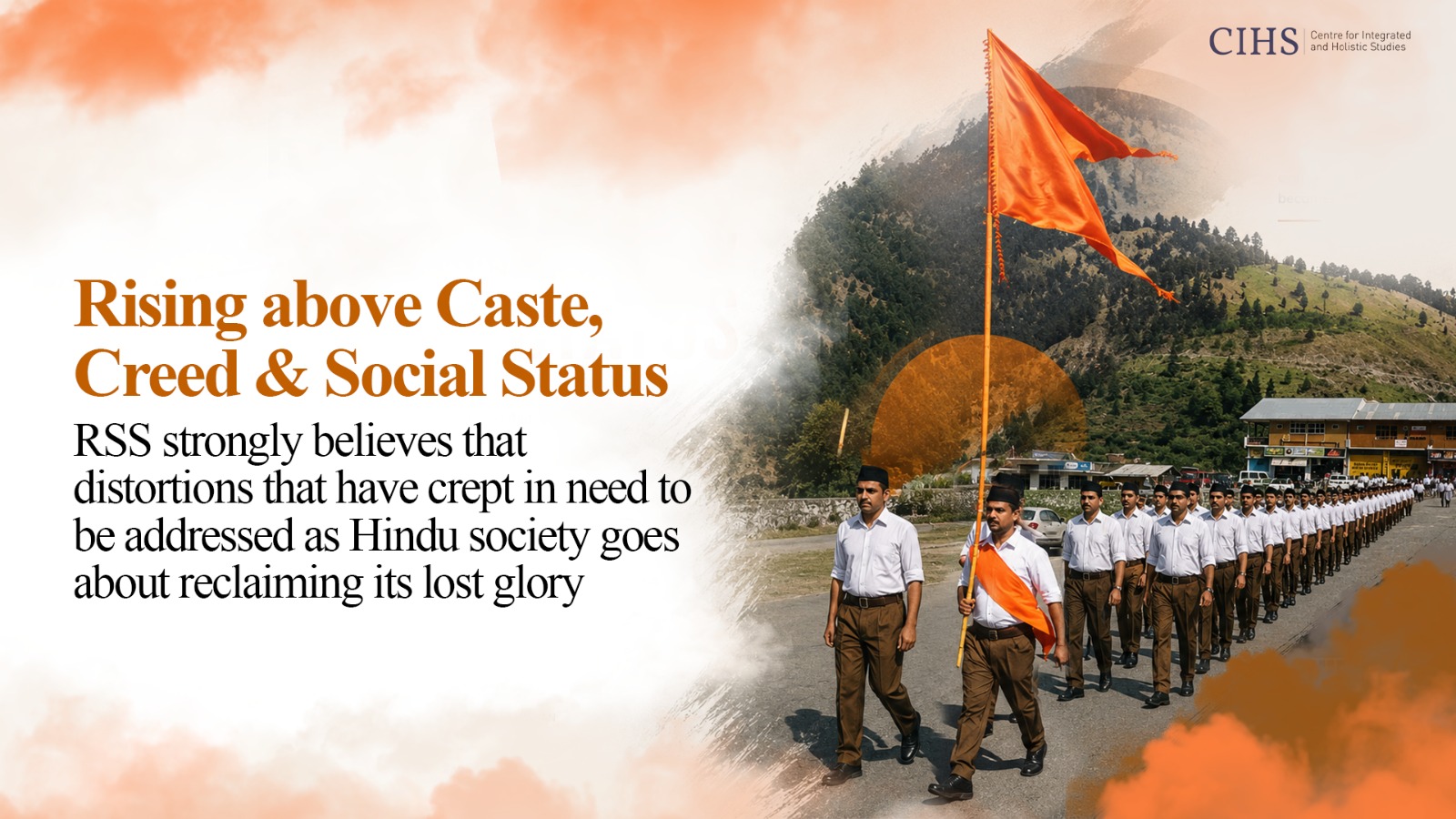


RSS strongly believes that distortions that have crept in need to be addressed as Hindu society goes about reclaiming its lost glory
Vinod Kumar Shukla
Bharat that holds Vasudhaiv Kutumbakam (world is one family) as its philosophical foundation frequently faces accusations of being oppressive, unjust and regressive towards certain sections of its own people.
But, how far does this charge hold true? To argue that Bhartiya society is innately regressive is historic mischaracterisation. Claims that its civilizational pathway inherently denies equal rights are unfounded.
It is true, however, that Bharatiya society lately fractured along caste lines due to a rigid, hereditary system that crept in is a distortion that is neither correct nor intrinsically Indic.
Throughout civilizational history spanning over 5,000 – 7,000 years, institutional aberrations were bound to occur across different eras and regions. Yet, Bhartiya society not only recognised these flaws at certain period of time but proactively corrected them from within.
Emergence of Mahatma Gautam Buddha, Mahavir Swami, Adi Shankaracharya, Sant Kabir, Guru Nanak and innumerable other saints and social reformers demonstrate a robust internal tradition of reform and corrective processes operating under larger Sanatan umbrella.
But it is foreign interventions that profoundly impacted both social fabric and collective psyche of Bharat. While Islamic invasions brought existential threats to life, faith and dignity, European colonizers deployed strategic narratives designed to divide and disintegrate Hindu society.
Modern concept of ‘caste’ was one such foreign intervention manufactured by drawing a false parallel with ancient concept of Varna. English word “caste” is derived from Portuguese and Spanish word ‘casta’ which means race, lineage or breed.
This European construct is being used to demonize Varna by Breaking Bharat brigade which was not hereditary. Most of ancient Bhartiya treatises explicitly state that Varna is determined by work profile, merit, conduct rather than birth.
As Skanda Purana, the largest one, notes:
जन्मना जायते शूद्रः संस्काराद् द्विज उच्यते।
वेदपाठात् भवेत् विप्रः ब्रह्म जानाति ब्राह्मणः।। (Book VI, Nagara Kanda, Chapter 239, Verses 31-34)
“By birth, everyone is a Shudra (an ordinary person). By undergoing purificatory rites and moral education, one becomes a Dwija (twice-born). By studying Vedas, one becomes a Vipra (learned), and one who realizes Brahman (the Ultimate Truth) is known as a Brahmana.”
This clear distinction is reinforced in Srimad Bhagavad Gita, where Lord Krishna reveals to Arjuna:
चातुर्वर्ण्यं मया सृष्टं गुणकर्मविभागश: ।
तस्य कर्तारमपि मां विद्ध्यकर्तारमव्ययम् ॥ 4.13॥
“Four categories of occupations were created by me according to people’s qualities and activities. Although I am the creator of this system, know Me to be the non-doer and eternal.”
Srimad Bhagavad Gita further dwelves that varna system is not by birth but by action when it says:
ब्राह्मणक्षत्रियविशां शूद्राणां च परन्तप ।
कर्माणि प्रविभक्तानि स्वभावप्रभवैर्गुणै: ॥ 18.41॥
Duties of Brahmins, Kshatriyas, Vaishyas, and Shudras—are distributed according to their qualities, their guṇas (and not by birth).
But contemporary discourse around caste has been heavily shaped by colonial interventions, Western framing and specific ideological agendas by falsely equating it with Varna.
Both external and internal forces working against interest of Bharat have weaponized the caste narrative to delegitimize Hindu tradition, value system and civilization, blaming it for systemic discrimination while ignoring historical distortions introduced by the British. Clearly birth-based caste system finds no support in Vedic traditions.
All these distortions were done with a purpose. To disrupt the social harmony of a self-sustaining Bhartiya society, colonial administrators used censuses and codifications to institutionalize and freeze fluid social groups.
Communities that once enjoyed social mobility were boxed into rigid hereditary categories. The first all-India census was conducted in 1871, followed by classifications under H H Risley in the 1901 census that formalized these divisions.
Risley operationalized theory that varna, however ancient, could be rigidly applied to all modern occupations and groups in Bharat. Thrusted upon the society and repeated for generations, this artificial classification became a major impediment to social harmony.
In present context, companies like Cisco and some state legislatures in United States continue to drive the narrative of caste as an impediment to social and economic progression in Bharat and hence identified caste as an issue of concern.
Against this backdrop, Samajik Samrasta (Social Harmony) initiative of Rashtriya Swayamsevak Sangh (RSS) gains significance aiming to counter these distortions and restore the original spirit of civilization.
In modern digital age, where social media often exacerbates social fractures, targeted grassroots intervention becomes even more vital. Samajik Samrasta is intensified in centenary year of the RSS which ideated on five core social transformative ideas as ‘Panch Parivartan’ (Five Transformations). Samajik Samrasta is one of them.
Anticipating threat posed by caste divisions, many of which were legacies of the colonial era and aberrations within the Bharatiya society, RSS initiated its anti-discrimination work decades ago.
Dr Keshav Baliram Hedgewar, founder and first Sarsanghachalak (chief) of RSS included erasing internal divisions within Hindu society as one core vision of the organisation, believing that national strength could not be built on a divided Hindu society.
Way back in 1925, he emphasized that every Swayamsevak (volunteer) must embrace shared civilizational identity as Hindu first, transcending caste lines.
Second Sarsanghchalak M S Golwalkar while defending the functional philosophy of the varna system, strongly criticized its degeneration into a rigid, birth-based hierarchy renamed as Caste by the British. He also denounced untouchability as a historic deviation from true Hindu principles and called for its total elimination.
Even M K Gandhi advocated for original concept of Varna while Dr B R Ambedkar, in his seminal work ‘Who Were the Shudras?’ posited that Shudras were originally part of the Kshatriyas (the second Varna). He quoted several scriptures to suggest that there were three Varnas at some places and four elsewhere. However, his quest remains that who were modern days Shudras?
Subsequent RSS leadership accelerated these social integration efforts. The third Sarsanghchalak, Balasaheb Deoras, placed equality and social harmony at centre of organization’s outreach, famously declaring in 1974: “If untouchability is not wrong, then nothing is wrong in the world.”
Current Sarsanghchalak, Mohan Bhagwat, continues to bridge these gaps by championing the practical principle of “one temple, one well, and one cremation ground” for all members of society.
These efforts extend beyond rhetoric into concrete fieldwork by RSS and its inspired organizations. By 2020, Vishwa Hindu Parishad (VHP) had trained over 5000 dalits as priests, a number that continues to grow. This trajectory stems from the 1969 VHP’s Udupi conference, where Hindu seers declared that “all Hindus are brothers and no one is untouchable.”
Landmark outreach events followed, including VHP leaders visiting and dining at home of ‘Dom Raja’ in Kashi in 1994 and choosing Kameshwar Choupal, a low caste Hindu leader to lay foundation stone for Ram Temple in Ayodhya in 1989.
Concurrently, Vanvasi Kalyan Ashram operates extensive educational and support networks including the Ekal Vidyalaya initiative for tribal communities. The organisation is working in Metro, urban, semi-urban, rural and remote forest areas to eradicate caste discrimination and empower the isolated brethren.
At the grassroots level, practice of Samuhik Bhojan (collective dining) during RSS gatherings and training camps (Shiksha Vargas) serves as an exercise in equality.
During major festivals like Makar Sankranti, Vijayadashami, and Raksha Bandhan, Swayamsevaks from all backgrounds sit side-by-side on the floor to share simple meals brought from their respective homes, deliberately dissolving socioeconomic and caste hierarchies.
These activities are part of Samajik Samrasta programme which is to promote unity and eliminate discrimination based on caste, creed or social status and to build an inclusive society.
RSS believes that a strong and united Bharat needs a society free from any internal divisions. Hindus faced challenges from casteism and discrimination in the past. To overcome this, the RSS established Samajik Samarasata Manch in 1983 to bring people of all backgrounds together.
The initiative focuses on three core operational areas: Equal Access: Ensuring all communities share common water sources, participate in community feasts, and worship at the same temples. Mutual Respect: Cultivating institutional dignity and equality for every individual, regardless of social background. Seva (Selfless Service): Running health camps, disaster relief, and educational programs in marginalized areas.
For RSS, Samajik Samrasta is an essential ideological pillar aimed at eradicating untouchability and caste discrimination to foster an inclusive society based on fraternity.
Ultimately, the project is about reclaiming civilizational dignity. By asserting that contemporary casteism is a historical distortion rather than a spiritual inevitability, it seeks to restore foundational principles of guna (merit) and karma (action) over birth, offering a structured path to correct historical injustices and counter divisive narratives.
(Author is a senior journalist and associated with Centre for Integrated and Holistic Studies, a non-partisan think-tank based in New Delhi)

