

Brig Brijesh Pandey
The 1999 Kargil War is remembered as a war India won despite fighting under self-imposed restrictions of ground as well as Air Force not crossing the Line of Control (LoC). That framing, while accurate in terms of the triumph of the brute infantry courage and artillery firepower, screens the uncomfortable question as to what then, prompted the Kargil Review Committee (KRC) in the first place. The answer to this, lies in the fact that India was strategically surprised by the gravity of the intelligence failure along the front that the forces had occupied for decades. Pakistani forces had intruded at a massive scale, occupied the heights above Dras, Kargil, Batalik and Turtuk, and had remained there for weeks before they could be detected.
The KRC was chaired by K. Subrahmanyam, and its findings were carried forward by the Group of Ministers (GoM) report of 2001, together constituting the most substantial defence-reform exercise in independent India’s history. More than a quarter-century later, three questions remain worth asking honestly: whether the KRC’s recommendations actually mattered in practice, whether India’s defence reforms have kept pace with a changing security environment, and whether the strategic, geopolitical and energy-security landscape has already outrun the assumptions of 1999-2001.
Kargil as an Institutional Failure, Not Merely an Intelligence One
The central insight of KRC not limited to Kargil simply being an intelligence failure, but the failure of systems. The report broadly identified:
- Non-unified intelligence assessment due to Research and Analysis Wing (R&AW), Intelligence Bureau (IB) and Military Intelligence (MI) working in silos. There was no mechanism to ensure synthesis.
- Absence of a joint integrated approach to threat assessment across the three services.
- Weak intelligence surveillance along the front that was perceived to be settled rather than continuously verified.
- There was no single point of military advice to the political leadership, leaving civil-military coordination adhoc and personality oriented.
- Slow import dependent procurement that left forces scrambling for critical equipment, even during the conflict itself.
Six Pillars of Reform: Progress and Limitations
- Higher Defence Organization.
Creation of the Integrated Defence Staff (2001), Defence Intelligence Agency (DIA), a reinforced National Security Council Secretariat (NSCS) and the post of Chief of Defence Staff (CDS) along with the Department of Military Affairs (DMA) reflect the most critical components of the success of the reforms. CDS as India’s first one-point military advisor duly supported by DMA and DIA closes the vital gap identified by KRC. The long-time of 21 years taken to appoint the CDS in 2020, illustrates the complexities involved in the institutional reforms against the entrenched service interests. Establishment of theatre commands, the operational payoff of having a CDS, remains unimplemented years after they were targeted for rollout. It is held up due to the disagreements between the three services over the allocation of command and order of battle of these commands. The capstone institution exists but its operational integration is not even half finished.
- Intelligence Reforms
The Multi Agency Centre (MAC) along with its state components, the DIA, substantial enhancement in satellite reconnaissance, long endurance UAVs as well as airborne early warning have measurably improved India’s technical intelligence base since 1999. However, the 2008 Mumbai attacks, the periodic border stand-offs and other terrorist initiated incidents suggest that fusion of multi-source intelligence into timely, actionable intelligence is harder to institutionalise. Buying sensors or raising infrastructure is easier to achieve than building the analytical culture and inter agency trust, the KRC actually called for.
- Defence Procurement and Indegenization
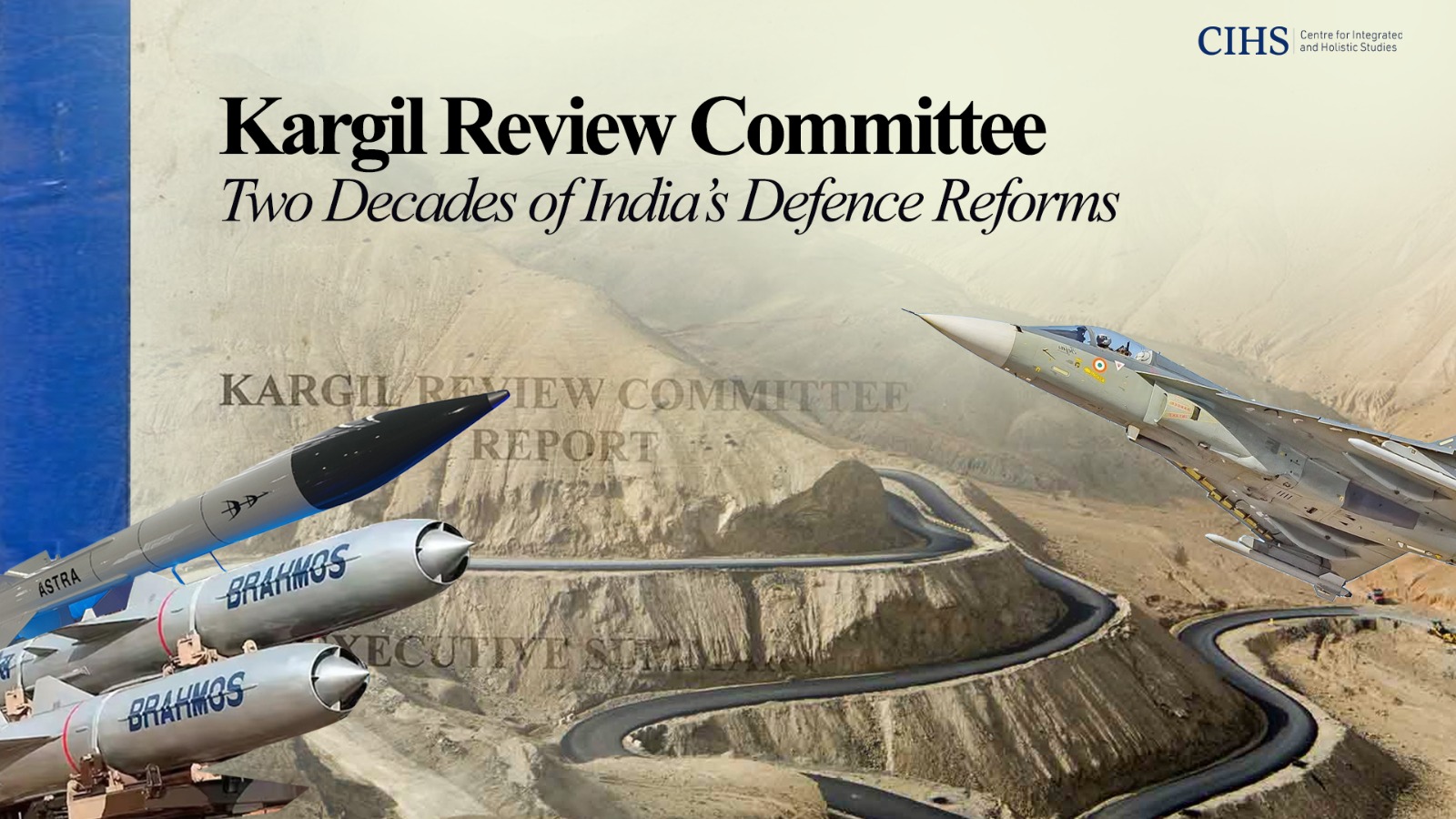
Defence procurement is the area that has seen tremendous change in form, though substance is little mixed. Acceptance of Necessity for equipment worth close to rupees 10 Lakh Crores in last two years under the road map of Atmanirbharta, Defence Acquisition Procedure, positive indigenization list, iDEX and defence industrial corridors are actively shifted the discourse from import led procurement to the domestic designs. Platforms such as Tejas, Brahmos, Aksah, Pinaka, Astra and Prachand demonstrate genuine domestic capability. The unresolved core problem, however, is one the KRC-era reforms did not anticipate. Dependence has changed forms; it has not disappeared. India remains import dependent for propulsion systems, semiconductors and rare earth magnets. India’s lack of sovereign design capacity in these areas dwarfs the achievements recounted previously. Another challenge that remains to be fully addressed is the procurement timelines. There have been instances when the time lag between “wanting to procure” to the “actually procured” was stretched to over two decades. This does not suit the era in which technology is changing so rapidly.
- Jointness and Multi-Domain Operations
Tri-service exercises, integrated ISR, space and cyber have advanced considerably. Operation Sindoor demonstrated that India can synchronise land, air, sea, information, space and cyber effectively in a live contingency. But jointness at the exercise or a single-operation level is not the same as jointness permanently embedded into the command structures. This is precisely why the creation of theatre commands matters most.
- Border Infrastructure and Northern Deterrence
Post Kargil and particularly post Galwan, investment in road, rail, tunnel and forward basing infrastructure along the northern borders has been substantial, addressing the KRC-era logistics deficiency directly. This remains one of the most unambiguous successes of the last decade, the stage of infrastructural parity with China is still some distance away.
- Institutional Follow through: Naresh Chandra and Shekatkar Task Force
KRC was not left to operate in silence. Naresh Chandra Task Force (2012) revisited many of the same higher defence management questions eight years before the post of CDS was finally created in 1920. Likewise, Shekatkar Committee (2016) targeted force restructuring and cost rationalization. The very fact that in the period of 17 years, India needed three successive high-level committees to arrive at the reforms first envisioned by KRC, highlights the “resistance to change” which exists within India’s defence establishment.
Geopolitical Ground has Shifted ever since the KRC
In 1999, the KRC’s entire frame of reference was Pakistan. That frame is now inadequate. The People’s Liberation Army’s aggression of 2020 at Galwan, infrastructure built across Tibet, naval expansion into the Indian Ocean confirm that China, not Pakistan, is now India’s principal long-term military concern. This means that reforms designed around Pakistan’s intrusion centric scenario cannot be assumed to translate into readiness against much larger, better resourced adversary across much larger frontier.
China-Pakistan Collusion and Two front Planning
Pakistan’s growing reliance on Chinese missiles, aircraft, radar and electronic warfare systems raises the prospect of coordinated contingencies on two fronts simultaneously. India’s shift towards integrated theatre operations, multi-domain and network centric warfare is a response to this threat. However, as long as the theatre commands remains a “held in abeyance” dream, the two front problems will remain unaddressed.
Energy Security: An Unacknowledged Dimension of KRC
Energy security is the sharpest gap between the KRC’s 1999-2001 frame and today’s reality. Energy security was absent from the KRC vocabulary. It is now inseparable from it. India imports close to 90 percent of its total oil requirements and much of it transits through the choke points such as Strait of Hormuz and Bab el-Mandeb. Recent West Asian conflicts have shown how quickly attacks on shipping and energy infrastructure translate into economic disruption at home. This calls for India developing a Blue Water Navy which does not only defends its shores but is also capable of projecting force across oceans, protecting SLOC as well as strategic petroleum reserves, countering choke point denials and so on. Acquisition of CATOBAR based Aircraft Carriers, building strong submarine force, adding more fleets of modern destroyers, frigates and landing crafts are non-negotiable needs. These capabilities should not be read as an extension of KRC’s logic but as new pillars of national security. The reform architecture had to grow to accommodate these dimensions.
Road Ahead
Any credible next phase reform has to move beyond the institutional architecture and gravitate towards integration and speed:
- Completion of theatre commands.
- Build AI enable intelligence fusion, not just additional sensor platforms.
- Close the propulsion and semiconductor dependency gap.
- Treat cyber and cognitive resilience as the core defence functions, not adjuncts.
- Formally integrate energy security and SLOC protection into national defence planning documents, rather than treating them as navy specific concern.
- Shorten procurement-to-induction timelines specifically for software defined and rapidly evolving technologies.
Conclusion
KRC’s lasting achievement was diagnostic. It correctly identified that India’s vulnerability in 1999 was institutional, not merely military. It named the problems such as fragmented intelligence, absence of jointness, compartmentalised higher defence management with immense clarity. Given the circumstances obtaining then, KRC report did not consider the challenges posed by China. It also did not anticipate the China-Pakistan military fusion, energy security concerns, and the emerging forms of warfare based on drones, cyber and information operations. The honest verdict on 25 years of “Kargil Reforms” is therefore mixed. Substantial institutional progress, real but partial indigenization and a persistent gap between reforms announced and reforms fully completed. India’s defence reform agenda, thus remains a work in progress, not a completed transformation.
(Author is a defence analyst, former military advisor and commanded an artillery brigade)

