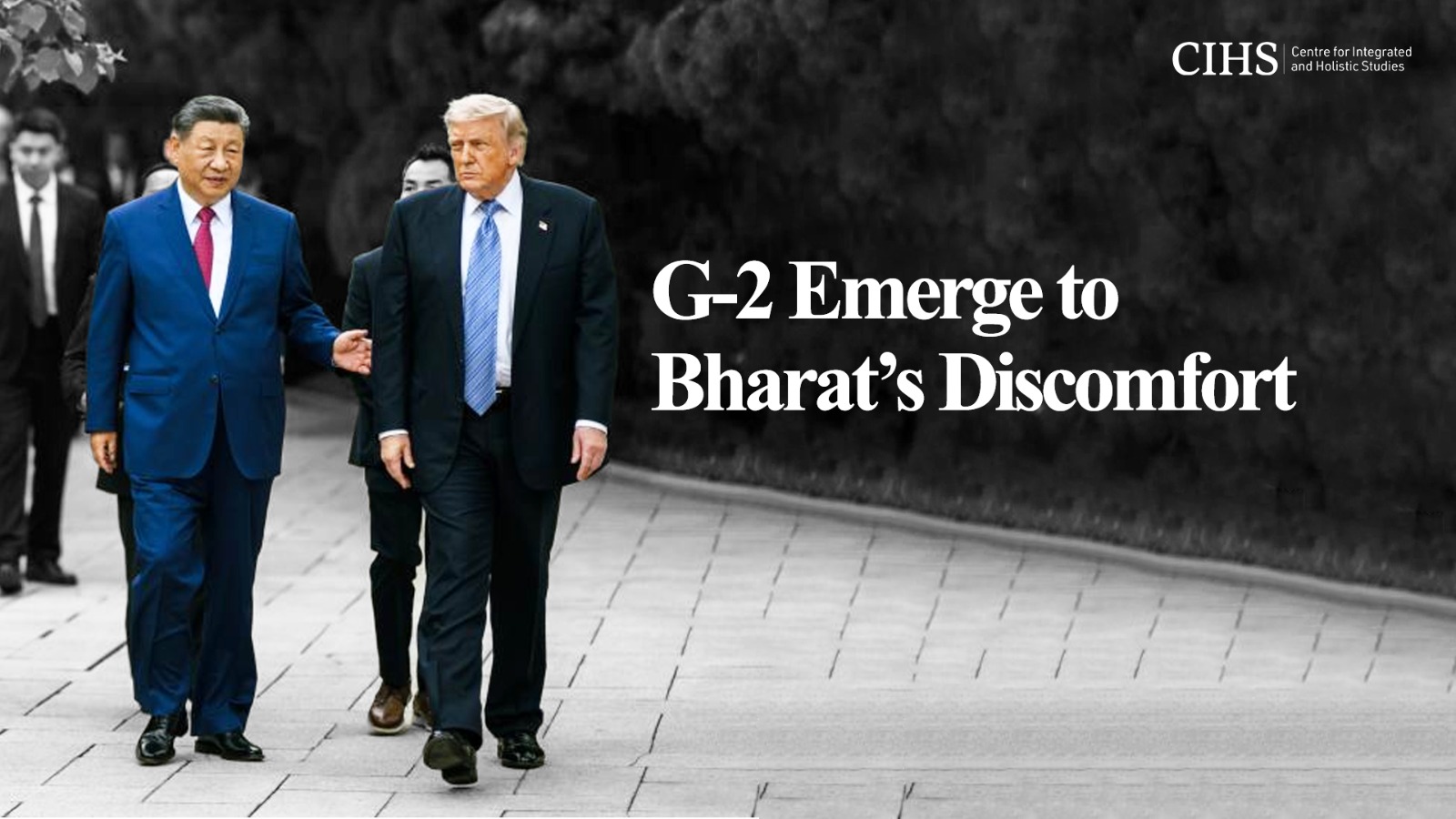


Trump – Xi Beijing Summit 2026 resets US – China ties, calibrates business deals involving Boeing & chips pushing Bharat to look for its own rhythm.
N. C. Bipindra
The two most powerful leaders on earth met in Beijing on May 14 and 15, 2026. The world watched. So did New Delhi.
This was only the second face-to-face summit of Donald Trump’s second term and first US presidential state visit to China since Trump himself made the trip in 2017.
Trump-Xi summit was billed as a potential turning point in one of the most consequential bilateral relationships in modern history. In the end, the outcome was largely characterised as stabilising rather than transformational, heavy on symbolism and light on substance.
But for India, even a modest recalibration between Washington and Beijing carries profound strategic implications.
Most significant conceptual outcome of the summit was the agreement by both sides to build a “constructive China – US relationship of strategic stability,” according to Beijing’s official readout.
Xi Jinping framed this as a governing framework for next three years, a deliberate attempt to convert Trump’s transactional deal-making instincts into a more durable operating baseline for US-China relations, one that would constrain even the next American president.
On the economic front, the leaders agreed to preserve and extend the fragile trade truce brokered in South Korea in October 2025.
In Beijing, China committed to purchasing at least $ 17 billion in US agricultural goods annually through 2028 along with soybean purchase commitments made in October 2025.
China agreed to buy 200 Boeing aircraft, notably fewer than 500 planes Trump had floated ahead of the visit contributing to four per cent drop in Boeing shares.
The US readout mentioned Chinese commitments to address shortages of rare earth elements including yttrium, scandium, neodymium, and indium. Beijing’s readout was conspicuously silent on this.
Reports also emerged that US approved around ten Chinese technology companies to purchase Nvidia’s advanced H200 chips sending tech stocks higher though the sales may not fully materialise given China’s push for domestic semiconductor self-sufficiency.
Xi reserved his sharpest language for Taiwan, warning that mishandling the issue would put the US – China relationship into “great jeopardy.”
While American readout of the summit did not mention Taiwan at all which in itself is a striking omission, Trump later revealed an in-depth conversation with Xi about potential US military involvement in a possible Taiwan Strait crisis.
Taiwan, meanwhile, has been watching nervously for any signs that Trump might soften US policy commitments in exchange for Chinese concessions elsewhere.
Regarding Iran war which had delayed the summit by over a month, both sides agreed that the Strait of Hormuz must remain open and that Iran must never acquire nuclear weapons. Xi expressed China’s willingness “to be of help” in brokering a resolution and pledged not to send military equipment to Iran.
However, Beijing’s public readout declined to echo many of these commitments and no breakthrough framework regarding Iran emerged.
China may exert quiet influence on Tehran in the coming weeks but little will be visible publicly.
Perhaps most concrete outcome was the agreement to meet again. Xi is invited to Washington for an official state visit on September 24, his first in more than a decade.
Further meetings in Shenzhen in November and at G-20 in Miami in December are also on the calendar suggesting both sides see the diplomatic channel as worth maintaining, even if the substantive gaps remain wide.
For India, the Beijing summit is not a bilateral event happening at a comfortable distance. It is a direct variable in New Delhi’s most sensitive strategic calculations.
India has long benefited from US-China tensions. Washington’s pivot to position India as a counterbalance to China in the Indo-Pacific brought strategic partnerships, defence technology transfers, and elevated India’s role in the Quad alongside the US, Japan, and Australia.
But India now has a different worry: the revival of a so-called “G2” dynamic, a Washington-Beijing axis that sidelines middle powers like India.
The three-year “strategic stability” framework agreed in Beijing feeds this anxiety precisely.
One of the most tangible economic stakes for India is its emergence as an alternative manufacturing and sourcing destination for Western companies seeking to reduce China exposure.
If US – China tensions ease significantly and particularly if American firms are incentivised to re-engage with China through summit-level deal-making, the urgency for supply-chain diversification toward India could diminish.
The Nvidia chip deal and Boeing order, if they solidify, signal willingness in Washington to deepen commercial ties with Beijing rather than decisively redirect them.
The relationship between Washington and New Delhi has itself been under strain. Trump’s administration imposed punitive secondary tariffs on India over its purchases of Russian oil even as China continued buying the same oil without an equivalent penalty.
The diplomatic fallout pushed India’s Prime Minister Narendra Modi to engage more openly with Beijing and Moscow including at the Shanghai Cooperation Organisation summit.
Xi’s declaration that it is “time for the dragon and elephant to dance together” was not just rhetoric. It was a strategic signal that Beijing sees an opportunity in India’s alienation from Washington.
China’s dominance over rare earth processing remains one of India’s most pressing concerns. Beijing controls the midstream supply chains for minerals critical to semiconductors, defence systems and clean energy technology.
The summit’s ambiguous outcome on rare earth access, acknowledged by Washington, ignored by Beijing leaves this leverage firmly in Chinese hands.
For India, which is developing its own rare earth processing capacity but remains years from self-sufficiency, a US – China deal that quietly restores Chinese mineral exports to American firms could undercut the very supply-chain diversification argument that benefits Indian industrial ambitions.
The South China Sea, a flashpoint that directly concerns India’s maritime interests and regional partners in ASEAN, was largely absent from public summit readouts.
The lack of any strong US statement on freedom of navigation or territorial integrity in the region may embolden Chinese assertiveness, directly affecting Indian interests in maintaining a rules-based Indo-Pacific order.
India’s long-standing position has been to support an open and free Indo-Pacific; a US pivot toward managed equilibrium with China complicates that posture.
The Trump-Xi Beijing summit of May 2026 was underwhelming as a diplomatic breakthrough but consequential as a signal.
The signal is one of managed coexistence, a Washington and Beijing that prefer predictable rivalry to open conflict and are willing to exchange modest concessions to sustain it.
For India, this is a moment of strategic discomfort. New Delhi thrives in a world where US – China competition creates room for agile, multi-aligned powers. A stabilising US – China relationship, however incomplete, narrows that room.
India must now recalibrate, deepening its own bilateral engagements with both Washington and Beijing, accelerating its domestic manufacturing and technology ambitions and ensuring that its Indo-Pacific role is defined not merely as a function of great power rivalry, but as an independent strategic weight in its own right.
The dance between the dragon and the eagle has not ended. But the tempo has changed and the elephant will have to find its own rhythm.
(Author is Chairman, Law and Society Alliance, a New Delhi-based think tank, and guest columnist with CIHS)

