


Big wins in state assembly polls especially in West Bengal would hasten pace of economic, governance reforms and spreading the growth story. Bharat continues to be brightest star.
K.A. Badarinath
West Asia conflict, Russia-Ukraine war notwithstanding, Bharat will continue to be the brightest spot globally on economic front. It will continue to be the fastest growing large economy next three years and bring tangible prosperity to Indians and contribute a large chunk to global communities.
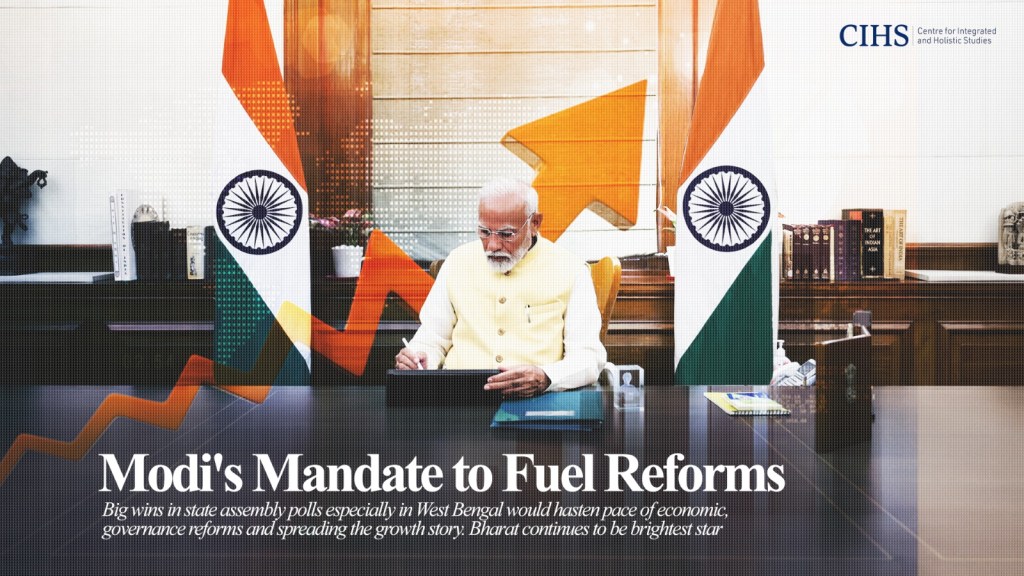
Thanks to a stable government headed by Prime Minister Narendra Modi and BJP heading 80 per cent states, union territories, this economic consolidation and expansion will continue into 2029, beyond.
A big show of expanding political strength in five states legislative assembly elections would only bolster pace of economic reforms in the country.
There’s virtually no stopping despite global uncertainties throwing intermittent challenges to Bharat’s sweepstakes as an economic behemoth.
A recent Morgan Stanley report has projected Bharat’s economy to expand beyond US$ 5.7 billion in two years from now. The report released a week ago also talks about continued foreign investment flows during next five years. A whopping US$ 800 billion is expected to be invested in Indian projects, markets and paper by foreign companies spread over 5 years.
If we go by the report, at a time when key stakeholders were complaining of uncertainties bogging down the market sentiment, Bharat seems to be the only big exception.
What’s more likely is that while domestic demand in India continues its upward swing, export markets may contribute an additional US$ two trillion.
Energy, infrastructure, data centres and rural economy will be the biggest drivers of this new growth cycle even as Bharat tests its ‘strategic autonomy’ framework for its global engagement.
Till date this framework has delivered handsomely as Bharat continues to carve out its own space internationally without getting bogged down in cliques.
For instance, doing energy business with US, Europe, Russia, Iran and engaging both Israel and Palestine have been hallmark of this policy framework. Getting access to energy in gallons of hydrocarbons, Bharat has played its cards deftly to keep its business communication open. Balancing competing forces, holding on its aces and pro-actively pursuing its goals is something Bharat has done amazingly well.
It’s not energy front alone. Concluding a raft of free trade and investment agreements with over a countries or unions proves Bharat’s dogged perseverance.
From European Union, United Kingdom to signing these agreements with Oman and New Zealand, free trade, investment and economy pacts have demonstrated Bharat’s widest arc of economic engagement. In 2025-26 alone, nine such agreements were concluded while such arrangements are in place with 38 countries. Initial apprehension on such agreements seems to have been set aside while Bharat’s leadership confidently moves forward.
Differences notwithstanding, Bharat continues to engage two largest economies internationally, United States and China. Geo-political, border issues, security and perspective continue to be limiting factors. But, that has not stopped Bharat from doing business with these powers that be.
Only a couple of days back, companies like Sun Pharma, JSW Steel, Sterlite group and nine others have committed to invest over US$ 20.5 billion in pharmaceuticals, steel, advanced manufacturing, artificial intelligence and infrastructure. At the Select US Invest summit the investments flummoxed markets as it demonstrates the resilience and confidence with which Bharat goes ahead doing business.
One would not have imagined targeting US$ 500 billion worth economic engagement between US and Bharat notwithstanding the quixotic Republican White House led by President Donald J Trump. Today, these are the kind of figures being discussed as part of on-going trade talks.
Definitely, China is a tricky customer on business front and a difficult northern neighbour from strategic point of view. But, the two uneasy neighbours have been doing business while China has emerged as the largest trading partner for Bharat with bilateral trade of over US$ 151 billion in financial year ending April 1, 2026.
There’s no denying the fact that this trade engagement is completely lopsided and in favour of China by many times over. While New Delhi works hard to balance out the trade, go up the value chain and enhance exports to China, the two continue to talk, invest and do business. It does not mean that border disputes with China can be wished away.
Out of the US$ 863 billion, services account for about half at US$ 421.32 billion during financial year ending April 1, 2026. Also, the massive trade surplus from services has been making up for huge deficit on merchandise trade.
While this anomaly gets corrected, US$ two trillion services exports are something that Bharat is working towards. While there are no shortcuts, artificial intelligence is bound to impact the IT services exports in particular. As the rejig in strategy happens with short term adverse impact staring in the face, Bharat’s biggest bet may be to expand merchandise exports market, go for high value products while retaining the small ticket items.
Strengthening agriculture and farm-based rural economy, expanding the allied agricultural services is yet another area that Bharat has been working for long term. Given that economic expansion has shifted to sub-urban, semi-urban and rural areas, the government in Bharat seems to have changed track to capitalize on the opportunities.
When the Narendra Modi government announced US$ 26.5 billion credit guarantee fund for micro, small and medium enterprises, it was one way of addressing the West Asia impact on both businesses and jobs.
Political stability with the massive mandate that Prime Minister Modi and his party got in West Bengal, Assam, Puducherry, things could not have been better for India.
Analysts expect economic reforms apart from politically nuanced policy issues like delimitation of constituencies and bringing in more women into governance would gain pace.
While that happens, Bharat continues its economic expansion and prosperity spread drive.
(Author is veteran journalist, Director & Chief Executive of New Delhi based non-partisan think tank, Centre for Integrated and Holistic Studies)

