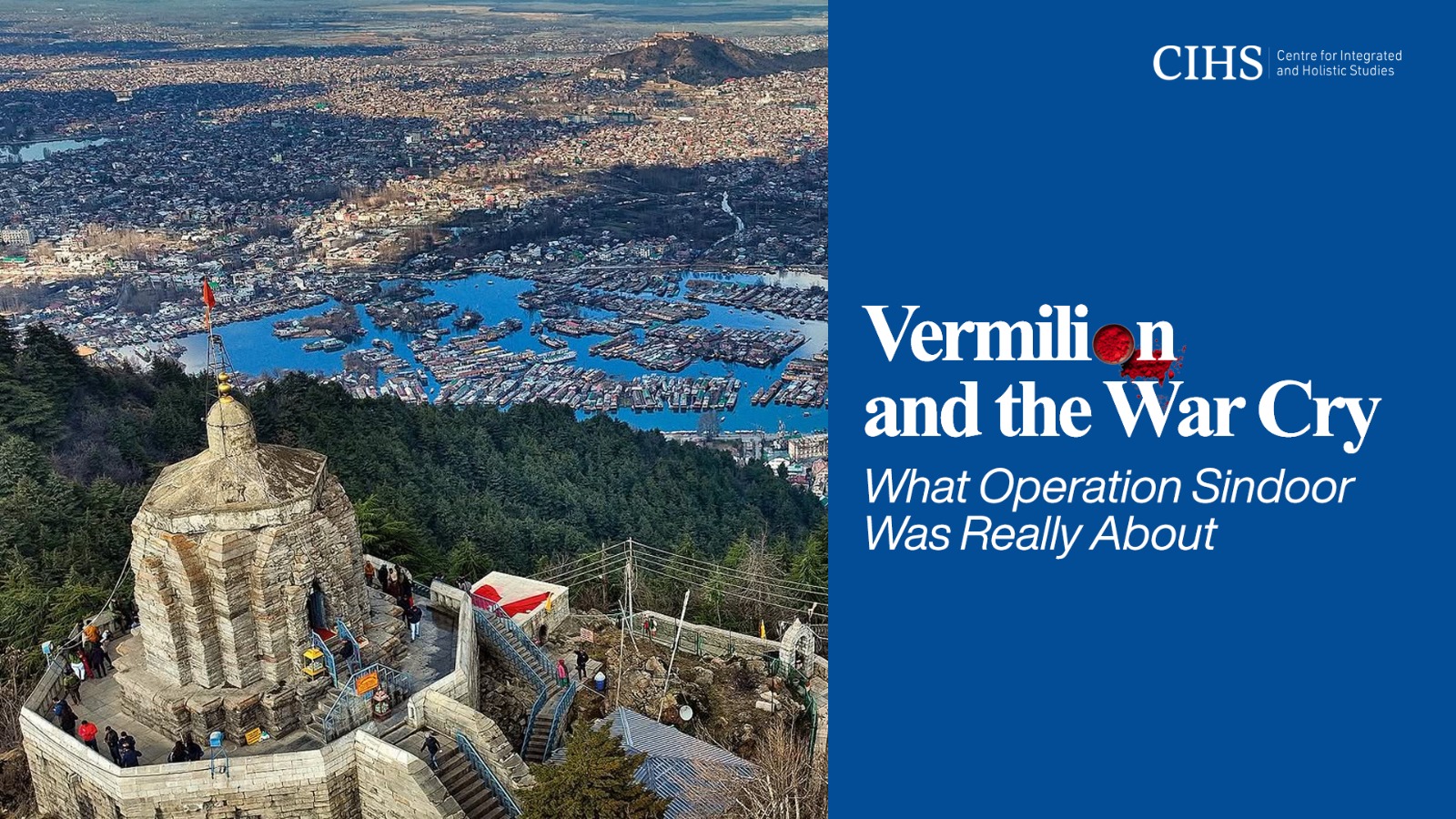


Every analyst who measured Operation Sindoor in airbases missed the war. Operation Sindoor was not just a reply to an attack. It was a reply to a narrative.
Rahul PAWA | x- @iamrahulpawa
To understand Operation Sindoor, begin not in 2025 but in the ideological soil from which Pakistan itself was carved, a two-nation theory that turned faith into geography. Its first armed expression on Jammu and Kashmir came in October 1947, when Pakistan launched Operation Gulmarg, an invasion by the Pakistan Army alongside tribal raiders rallied under the cry that “Islam is in Danger.” Behind it sat a second inherited fallacy, the colonial martial race theory, which had convinced Pakistan’s officer class that they were born soldiers and Hindus were not. That sentence was not a slogan of the moment. It became the operating system of every campaign Pakistan would run on Jammu and Kashmir for the next eight decades.
By the 1990s, the cry had gone international. Regional terrorists merged with foreign fighters drifting east from the Soviet-Afghan war. Between 1991 and 1999, Indian forces neutralised roughly 1,379 foreign terrorist fighters and arrested 142, men from Pakistan, Afghanistan, Bangladesh, Sudan, Bahrain, Saudi Arabia, Yemen and Chechnya, operating through outfits such as Harkat-ul-Ansar and Lashkar-e-Taiba. The invasion was no longer regional. It was a franchise.
The narrative that justified it abroad was a fiction. Kashmir Valley takes its name from the Hindu rishi Kashyapa, after whose Kashyapa-mira, the valley was settled. Thousands of years of Hindu heritage still stand in plain sight, from the Naranag temples to the ruins of the Martand Sun Temple, from the caves of rishis once revered by Hindus and Muslims alike to folklore still shared in valley villages. Yet through the late 1980s and 1990s, more than four hundred thousand Kashmiri Hindus were driven out of their homes in an internal displacement campaign that successive governments preferred not to name.
In August 2019, India amended Article 370 of its own constitution. For Pakistan’s terror economy this was a structural blow: funding networks frayed, separatist leaders faced courts, and the long-cultivated story of an essentially Islamic valley began to lose its global gloss. Two months later, in October 2019, The Resistance Front was launched, a new face on an old body, an offshoot of Lashkar-e-Taiba which Indian agencies traced without difficulty.
Since its founding, TRF has been at the centre of a campaign of targeted killings whose names are on record. Makhan Lal Bindro, a Kashmiri Hindu chemist, was shot dead in his Srinagar shop on October 5, 2021. Two days later, Supinder Kaur, a Sikh school principal, and Deepak Chand, a Hindu teacher, were lined up and killed inside their school in Srinagar. In 2022, Kashmiri Hindus Sunil Kumar Nath and Puran Krishan Bhat were gunned down in Shopian, both among the few who had stayed in the valley. On New Year’s Day 2023, seven villagers, including two children, were massacred at Dhangri in Rajouri. In June 2024, nine Hindu pilgrims were killed when a TRF attack sent their bus off a gorge in Reasi. Through all of it, migrant workers from Bihar, Uttar Pradesh and Punjab, daily-wage labourers and street vendors who had come from across India to make a living, were shot at point blank. The principle was always the same, what TRF itself called the “outsider-insider” line. Domicile certificates issued to resident and returning Kashmiri Hindus, were reframed in their literature as demographic invasion.
The script was adapted, with little edit, from the Hamas playbook. In February 2025, Hamas’s Iran-based representative Khalid Al-Qadoumi shared a stage at Rawalakot in Pakistan-Occupied Jammu and Kashmir with Lashkar-e-Taiba and Jaish-e-Mohammed commanders at a conference titled “Kashmir Solidarity Day and Al-Aqsa Flood.” Two months later a Hamas delegation visited JeM’s Bahawalpur headquarters. The ideological alignment had a name: Ghazwa-e-Hind, the Islamist project of conquest in India. The same vocabulary had by then surfaced inside India’s elected politics. In January 2025, Srinagar MP Aga Syed Ruhullah Mehdi of the National Conference described tourists visiting Jammu and Kashmir as a “cultural invasion,” warning in a separate interview that the 1990s-style exodus of Kashmiri Pandits “could be repeated.” Former Chief Minister Mehbooba Mufti, leader of the Peoples Democratic Party, has for years framed domicile certificates and resettlement policy as engineered “demographic change,” most recently in February 2026 describing a forty-township plan as a “demography plan for Hindu settlement.” Her daughter Iltija Mufti has spoken of the Centre’s “rush to appropriate our land.” By July 2025, Lieutenant Governor Manoj Sinha said the quiet part aloud: those claiming “cultural invasion” and “demographic invasion,” he warned, were echoing “the same narrative as the terror outfit TRF.”
Three months later, on April 16 and 17, 2025, Pakistan’s Chief of Army Staff General Asim Munir spoke at an Overseas Pakistanis Convention in Islamabad. He reasserted the two-nation theory, declaring Muslims “different from Hindus in every possible aspect of life,” “better and more civilised,” with “nothing common” between the two. He revived the old line that Kashmir is Pakistan’s “jugular vein,” and instructed parents to raise children who would never “forget the story of the creation of Pakistan.” Indian security officials and the Chief of Defence Staff General Anil Chauhan have since identified that speech as the catalyst for what came next.
What came next was Baisaran. On April 22, 2025, terrorists at the Pahalgam meadow separated Hindu men from their wives and shot them at point blank, sparing the women so they could carry the message home. This is the detail most international coverage missed. Sindoor, the vermilion a Hindu wife wears, marks the life of her husband. Wiping it off was the message. The message that Kashmir is not theirs. TRF claimed the attack on Telegram, citing “demographic changes” and residency permits to “outsiders,” repeated the claim with photographs the next day, and on April 26 retracted it, blaming a “cyber intrusion”, a retraction widely read as an attempt to dodge scrutiny once gravity of Indian response was clear.
On May 7, 2025, India launched Operation Sindoor. The targets were the family tree of the war cry. Lashkar-e-Taiba facilities at Shawai Nallah, Markaz Taiba at Muridke, Sarjal at Sialkot and Maskar Raheel Shahid Gulpur at Kotli. Jaish-e-Mohammed facilities at Markaz Subhan Allah in Bahawalpur, Markaz Abbas at Kotli, and Syedna Bilal at Muzaffarabad. Hizbul Mujahideen and others at Mehmoona Joya in Sialkot and Markaz Ahle Hadith at Barnala.
Pakistan widened the conflict, targeting Indian civilians and military outposts with Turkish drones and Chinese missiles. Its police, army and politicians were publicly filmed at the open-street funerals of UN-proscribed terrorists India had eliminated, images broadcast globally. Centre for Joint Warfare Studies has since read the operation as a case study in limited war below the nuclear threshold, fought across air, land, sea, cyber and information domains, with Indian, Pakistani, American, Russian, Turkish and Chinese technologies all engaged at once. It ended with Pakistan requesting cessation of hostilities. By then eleven Pakistan Air Force bases, Sargodha, Nur Khan, Rafiqui, Bholari, Jacobabad, Murid, Sukkur, Sialkot, Pasrur, Chunian and Skardu, had sustained heavy damage, reportedly some twenty per cent of the PAF’s total infrastructure.
Pull the thread back.
The war cry never changed. “Islam is in Danger,” shouted by tribal raiders in 1947, is the same sentence General Munir read aloud in 2025, the same one Lashkar carries forward, that TRF dressed up as “outsider-insider” politics, that Kashmiri politicians softened into “cultural invasion,” and that gunmen at Baisaran translated into a bullet that left a wife with vermilion still on her forehead. The thread runs unbroken from the raiders of Gulmarg to the foreign terrorist fighters of the 1990s, to the architects of TRF after Article 370, to the operators borrowing the Hamas playbook for Ghazwa-e-Hind, to the army chief of a terrorist-sponsoring state. They are all riding the same bus.
Every analyst who counted only airbases missed it. Domicile certificates were not demography, they were record. The “cultural invasion” was never the tourist; it was the rishi who refused to leave. The martial race did not survive contact with the operation. Operation Sindoor was not escalation. It was overdue. And the vermilion the Baisaran terrorists tried to wipe off was the mark of a civilisation that refused to be told to disappear.
The author is an international criminal lawyer and director of research at New Delhi based think tank Centre for Integrated and Holistic Studies (CIHS).

