


From addressing perceptions in Washington DC to articulating civilizational framework in Silicon Valley, RSS General Secretary Dattatreya Hosabale’s US visit signals the organization’s evolving global engagement.
Arun Anand
As the Rashtriya Swayamsevak Sangh (RSS) marks its centenary, its General Secretary Dattatreya Hosabale used his April 2026 visit to the United States to engage not just the Indian diaspora, but also influential global policy circles.
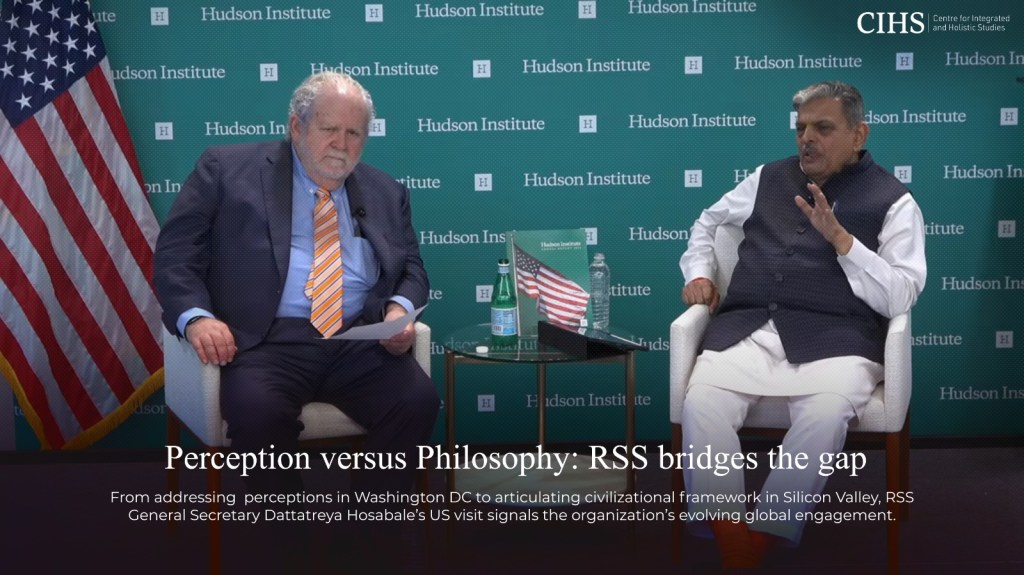
A key moment in this outreach came on April 24 at the Hudson Institute, where Hosabale participated in a fireside chat with Walter Russell Mead—an interaction that set the tone for the broader visit.
In a candid exchange, Hosabale addressed long-standing perceptions about the RSS. He firmly rejected comparisons with organisations such as the Ku Klux Klan, calling them fundamentally flawed and rooted in misunderstanding.
According to him, such narratives have historically portrayed the RSS as anti-minority, anti-Christian, anti-modern or supremacist labels he argued do not reflect its philosophy or practice.
Citing thr organisation’s ideological foundation, he emphasised that Hindu thought is anchored in the principle of oneness rather than supremacy.
He described RSS as a voluntary cultural organisation rooted in India’s civilizational ethos, where identity is understood in a civilizational, not narrowly religious, sense.
Hosabale also highlighted the organisation’s grassroots work, from daily and weekly shakhas aimed at character-building and discipline to large-scale contributions in education, healthcare, rural development, environmental initiatives, and disaster relief.
On the question of minority relations, he suggested that tensions often stem from political factors and historical interpretations rather than ideological hostility, advocating dialogue as the path forward.
Significantly, he underscored that modernisation and cultural values are not contradictory. Instead, he argued, they can coexist and reinforce each other, a consistent through his engagements in the US.
A Civilisational Dialogue in Silicon Valley
One of the intellectual cornerstones of the visit was Hosabale’s address at Stanford University during the Thrive 2026 conference. Speaking to technologists, entrepreneurs, and the Indian diaspora, he argued that rapid technological advancement must be guided by deeper ethical and civilisational wisdom.
Drawing from Indic traditions, he pointed out that Indian knowledge systems have historically integrated the spiritual and the scientific. Ancient texts such as the Upanishads, he noted, explore questions of consciousness and existence that remain relevant even in the age of artificial intelligence.
This integrated worldview, he suggested, offers a necessary corrective in an era marked by ecological stress, social inequality, and unrestrained technological ambition. His call for a “holistic lifestyle” was not a rejection of modernity, but an attempt to anchor it within ethical boundaries.
At the heart of this framework lies the idea of Vasudhaiva Kutumbakam, presented as a practical principle for navigating global fragmentation.
Science, Knowledge, and Civilisational Leadership
Hosabale emphasised the need to revitalise Indic knowledge systems, many of which were marginalised during periods of historical disruption. He argued that contemporary India is witnessing a renewed effort to recover and systematise this intellectual heritage.
In his view, science and spirituality are not opposing forces but complementary modes of inquiry. Historically, scholars often engaged both simultaneously, combining empirical observation with philosophical reflection.
He proposed three touchstones for evaluating technological progress, economy, ecology, and ethics, warning that development divorced from these principles risks deepening inequality and environmental degradation.
Equally, he stressed the importance of democratising knowledge globally, ensuring that insights from diverse civilisations contribute to a more balanced world order.
Redefining the Role of the Diaspora
Engaging with Indian-origin communities, Hosabale articulated a clear message: complete commitment to the host nation is essential. Contributing to the progress and well-being of their adopted country, he said, is a form of dharma.
At the same time, he encouraged the diaspora to remain connected to India’s cultural roots. This dual identity, fully integrated yet culturally anchored, was presented as a strength.
He also emphasised the importance of strengthening India-US relations through trust and people-to-people ties, while addressing persistent misconceptions about India by highlighting its role as a major economy and a global technology hub.
The Path Ahead: Balance in an Age of Extremes
A consistent theme across Hosabale’s engagements was the need for balance in an age of excess. He cautioned against an unrestrained race for technological dominance that overlooks sustainability and human well-being.
Indian civilisational thought, with its emphasis on harmony, interconnectedness, and respect for nature, offers an alternative framework, one particularly relevant in addressing climate change and social fragmentation.
The idea of “knowledge guided by wisdom” remained central: knowledge without ethical grounding can lead to exploitation, while guided by discernment, it can serve the collective good.
Conclusion
Dattatreya Hosabale’s US visit during the RSS centenary was both reflective and forward-looking. Through his engagement with a candid dialogue at the Hudson Institute and extending it to technological and diaspora platforms, he positioned the RSS within a broader global conversation.
The emphasis on civilisational identity, ethical modernity, dialogue, and global cooperation reflects an evolving outreach, one that seeks to engage the world not defensively, but with a sense of intellectual confidence and cultural continuity.

