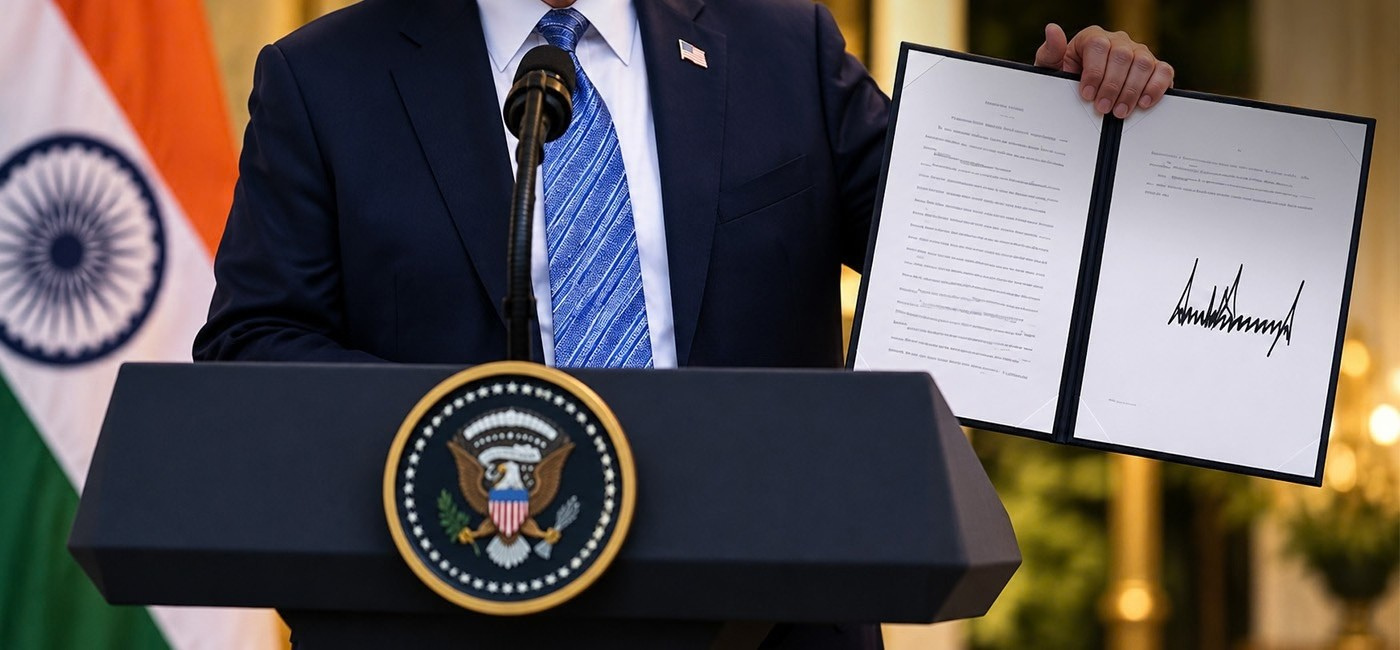


Bharat has too much at stake with President Trump signing the Sanctioning Russia and Iran Act. It is bound to impact free trade deal.
N. C. Bipindra
President Donald Trump signed Lindsey O. Graham Sanctioning Russia and Iran Act of 2026 into law on September 18, 2026 at a White House ceremony expanding statutory sanctions, tariffs, and prohibitions targeting Russia and extending existing sanctions on Iran.
Named after late Republican senator who championed it prior to his death in July, the bill had been a long journey since Graham introduced an earlier version in the Senate in April 2025 and was eventually co-written with Democratic Senator Richard Blumenthal to secure bipartisan backing.
US Senate cleared it 86-11 in August before the House passed it 262-159. The law’s most consequential provision for New Delhi: it allows President Trump to impose tariffs of up to 100 per cent on goods from each of the top five importers of Russian oil and natural gas, a group in which India figures prominently.
Will Trump Pull the Trigger?
Crucially, the tariff is discretionary, not automatic. The measure does not automatically impose 100 per cent tariff on any specific country, and legal analysts note the United States may impose a lower rate, providing India with diplomatic space to negotiate a reduced tariff, an exemption, a transition period, or a formal presidential waiver.
This is not Trump’s first use of tariffs as coercive leverage against India over Russian crude. He had already raised India tariffs to 50 per cent adding 25 per cent penalty tied to Russian oil purchases, framing India as “directly or indirectly importing Russian Federation oil” despite calling it a friend with unusually high tariffs.
Given that history, most trade analysts expect Trump to use the new authority as a negotiating cudgel rather than a blunt instrument, deploying the threat to extract further concessions in the ongoing Bilateral Trade Agreement (BTA) rather than triggering an immediate 100 per cent duty that could derail a deal both sides say is nearly finished.
While India’s foreign minister Subramanyam Jaishankar flagged the tariff issue with his US counterpart Marc Rubio, Bharat’s Commerce and Industry Minister Piyush Goyal said that the trade deal with US was a ‘done deal’.
If key provisions of US Free Trade Agreement have already been frozen, then the new anti-Russia law may not have a bearing on India.
Impact on US-India FTA
The timing is delicate. Just days before the Act’s signing, Indian Commerce Minister Piyush Goyal said the two countries were “about 99 percent” done with first tranche of a trade deal, with a US delegation led by Assistant USTR Brendan Lynch holding three days of talks in New Delhi. Bharat’s Ministry of External Affairs separately described the latest round as “positive and forward-looking,” covering a broad range of issues aimed at reaching an early agreement, while reaffirming India’s commitment to comprehensive global strategic partnership with Washington.
The new sanctions law effectively hangs a sword over that near-final text: New Delhi now has to weigh how any energy-related concession might be legally required to keep the tariff dormant, even as Commerce Secretary-level officials examine how recent legal changes should be reflected in the final agreement text. A prolonged standoff could push the interim deal’s signing further into 2027, jeopardising the two countries’ shared target of boosting bilateral trade to $ 500 billion by 2030.
Wider Implications for US-India Ties
India’s official response has been measured but firm. Ministry of External Affairs said it had noted the Act’s passage. It reiterated its commitment to ensuring energy security for 1.4 billion people through diversified sourcing, adding that the issue had been discussed at high levels with US interlocutors and that India would take necessary measures to protect its trade and economic interests.
That “people-first” framing, echoed in Hindi-language coverage describing India’s insistence that energy security for its citizens is the priority, signals New Delhi will not publicly capitulate, even as it continues quiet diplomacy. The exposure is real: Russia supplied more than 51 per cent of India’s crude-oil imports in July 2026, up sharply from roughly a third of imports before the Ukraine war intensified price arbitrage in Russia’s favour.
Analysts warn that repeated coercive tariff threats, layered atop the earlier 50 per cent duties, risk eroding trust in the “Comprehensive Global Strategic Partnership,” pushing India to hedge harder towards BRICS, Shanghai Cooperation Organisation, and its own strategic autonomy doctrine, even as defence and technology cooperation, such as iCET and jet-engine co-production, continue on a separate track.
Russia-Ukraine Dimension
Beyond India, the law is squarely aimed at blocking financing Russia’s war machine. It imposes sanctions on Russian officials, financial institutions, defence-related networks and “shadow fleet” of vessels used to evade Western restrictions, while extending the Iran Sanctions Act for five years.
Senator Katie Britt called it a message that “the United States stands unified in our opposition to their acts of aggression against Ukraine”. Democratic senators have taken an even harder line: Richard Blumenthal reportedly warned India to “better clean up your act” on Russian oil purchases.
Moscow, for its part, has dismissed the law as an unfriendly act, while Beijing called it “long-arm jurisdiction” lacking authorisation under international law or the UN Security Council, both countries signalling they will not bow to pressure.
The standoff between Washington DC and Moscow notwithstanding, US has extended an invite to President Putin to participate in the G-20 summit it would host later in the year. Putin acknowledged the invite but has not yet decided on his participation.
Global Implications
The law’s five-largest-importer trigger effectively targets China and India simultaneously and the Atlantic Council has noted it could authorise tariffs of up to 100 per cent on Chinese imports on national-security grounds if Beijing continues buying Russian oil.
That dual exposure could push Beijing and New Delhi, usually rivals, toward tactical coordination on sanctions-evasion workarounds, alternative payment rails and diversified crude sourcing from the Gulf, West Africa, and the Americas.
A blanket 100 per cent tariff regime, if actually triggered, would also reverberate through global oil markets, shipping insurance and “shadow fleet” ecosystem, potentially pushing crude prices higher worldwide.
Trade Leverage to Strategic Friction
If Trump does exercise full authority, the consequences for India would be severe. Evidence from earlier 50 per cent tariff period shows some Indian exporters absorbed part of additional cost to retain American buyers, a cushion that would vanish at 100 per cent.
MSMEs would face reduced margins, order cancellations, cash-flow problems and employment pressure, even as India’s merchandise exports had still grown nearly 18 per cent during April-August 2025, partly from pre-tariff front-loading.
Strategic risk is that trade leverage curdles into lasting friction, undermining a partnership built over two decades on shared Indo-Pacific interests, just as both governments insist the underlying relationship remains, in New Delhi’s words, headed “to newer heights.”
Does the new law mean that neither Democrats nor Republican regimes be trusted as true friends of India?
(Author is Chairman, Law and Society Alliance, a New Delhi-based think tank, and guest columnist with CIHS)

