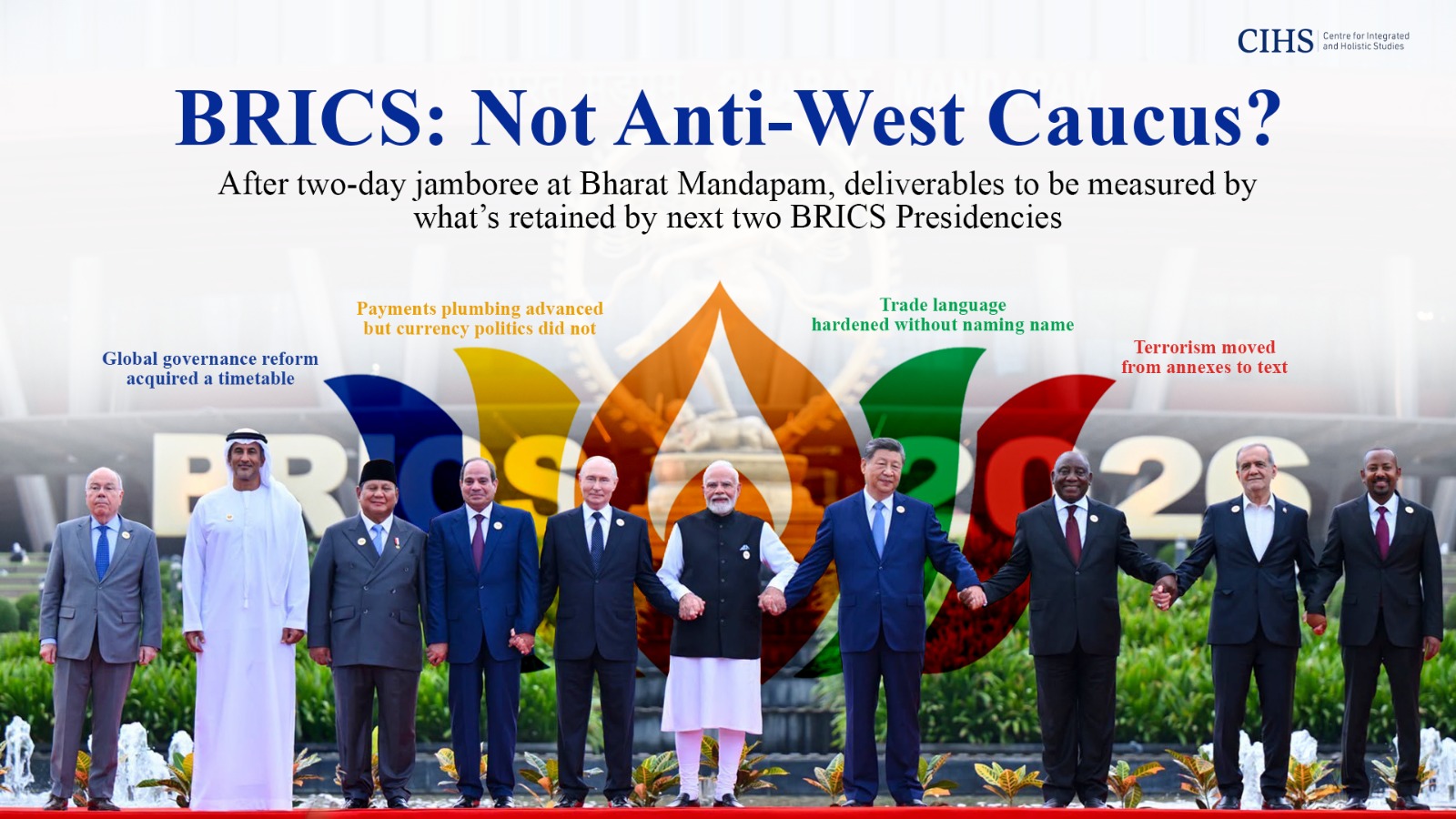


After two-day jamboree at Bharat Mandapam, deliverables to be measured by what’s retained by next two BRICS Presidencies
N.C. Bipindra
When eleven governments that disagree on almost everything sign the same 140-paragraph document, the achievement is procedural before politics took over. That is the fairest first reading of 18th BRICS Summit held at Bharat Mandapam in New Delhi on September 12-13, 2026 with Bharat in chair.
Four months earlier, the same grouping’s foreign ministers had left the same city without even semblance of a joint communique, forced to settle for a chair’s statement after failing to bridge positions on the war involving Iran.
That the leaders’ summit closed with a consensus declaration, adopted unanimously, with Iran and the United Arab Emirates both signing, is the single most important thing that happened in Delhi.
How India shaped the agenda
India assumed the presidency on January 1 this year with the theme “Building for Resilience, Innovation, Cooperation and Sustainability,” and ran it as a work programme rather than a summit sprint: more than 400 meetings across 30 Indian cities, feeding Sherpa-level text upward through the year. The strategic choice underneath was deliberate.
New Delhi used its year in the chair to resist framing BRICS as an anti-Western caucus in formation, and, instead loaded the calendar with cooperation that is hard to characterise as confrontational: digital public infrastructure, start-up ecosystems, MSMEs, supply-chain logistics, health, and agriculture. This was not neutrality. It was agenda control.
By crowding the docket with deliverables, Bharat narrowed the space available for members who would prefer BRICS to function as a bloc. The Financial Times noted that the summit avoided any sharper push away from US dollar; that absence was not an oversight.
Key outcomes
Four outcomes matter beyond the communique language:
Global governance reform acquired a timetable:
The declaration reiterated familiar call for UN Security Council reform with explicit reference to African aspirations under Ezulwini Consensus; Chinese and Russian support for Brazil and India playing a larger role. More usefully, Prime Minister Narendra Modi proposed a roadmap of ten reforms to be pursued before the next summit. Deadlines are how rhetorical positions become negotiating positions.
Payments plumbing advanced but currency politics did not:
The declaration endorsed continued work by BRICS Payment Task Force on interoperability between national payment and financial-messaging systems and on local-currency settlement, while encouraging New Development Bank to expand local-currency lending. It did not commit to create a common BRICS currency, and studied vagueness around a New Investment Platform reflects genuine disagreement about how far to go.
Trade language hardened without naming names:
Members criticised rising use of unilateral tariff and non-tariff measures, opposed coercive measures unauthorised by the Security Council and backed a WTO-centred trading system reweighted toward developing economies. Washington was never mentioned. Everyone understood.
Terrorism moved from annexes to text:
The declaration condemned 2025 Pahalgam attack in India’s Jammu and Kashmir in April 2025 by name and reaffirmed zero tolerance for terrorist financing, safe havens and cross-border movement, a direct Indian priority secured in a room that includes Beijing.
Add the institutional deliverables: a BRICS Incubator Network, a Start-up Innovation Fund, an MSME portal, a logistics cooperation framework, a DPI repository, a healthy-lifestyle mission and a mental-health centres-of-excellence network anchored by NIMHANS. And the shape of India’s pitch becomes clear: BRICS as a delivery platform for the Global South rather than a grievance forum.
Bridge-builder & its limits
The summit’s side-lines told their own story. Modi met Vladimir Putin, reaffirming $100 billion bilateral trade target by 2030 and Xi Jinping, on the Chinese president’s first visit to India in seven years, for talks on border stability and market access. Iran’s president met UAE representative in highest-level exchange between the two since war began.
Outreach seats went to African Union, ASEAN, CELAC and Eurasian Economic Union. Few other capitals could have convened that room. But convening power is not converging power and three constraints should discipline any triumphalism.
First, consensus was bought with ambiguity. A 140-paragraph text that satisfies Tehran and Abu Dhabi, Moscow and Brasília, is necessarily a document of carefully unresolved positions. On Ukraine – Russia war, the declaration simply recorded that members differ.
Second, India-China competition remains the structural ceiling. A cordial bilateral meeting does not settle a contested border or a lopsided trade balance, and Beijing’s conception of BRICS diverges from Delhi in terms of purpose, not detail.
Third, the expanded grouping’s coherence is unproven. Saudi Arabia, listed as a member by Indian and BRICS materials, again participated in New Delhi Summit as an invitee, an unresolved ambiguity that says something about how much BRICS label is now worth to a state managing ties with Washington.
What world should watch next
Watch whether ten-point reform roadmap produces a named sequence and owners, or evaporates in the handover.
Watch payments track: interoperability pilots between two or three central banks would matter more than any declaratory de-dollarisation.
Watch whether Troika, the outgoing, current and the incoming chairs, is strengthened into a genuine continuity mechanism, which is the only way Indian initiatives survive contact with China’s 2027 chair-ship.
Watch Grain Exchange and NDB’s local-currency book for evidence that BRICS finance is becoming operational.
And watch whether Beijing next year reframes the platform as a counterweight rather than a convening space.
Measure of success
The right test for India’s presidency is not the declaration. It is what exists twelve and twenty-four months from now: an incubator network with members and money, an MSME portal with users, payment rails carrying real settlement volume, and a reform agenda that outlives the chair that wrote it.
Declarations are the easiest thing BRICS produces. Execution is the scarce commodity, and it is the only one that will determine whether September 2026 is remembered as a turning point or a well-organised photo opportunity.
(Author is Chairman, Law and Society Alliance, a New Delhi-based think tank, and guest columnist with CIHS)

