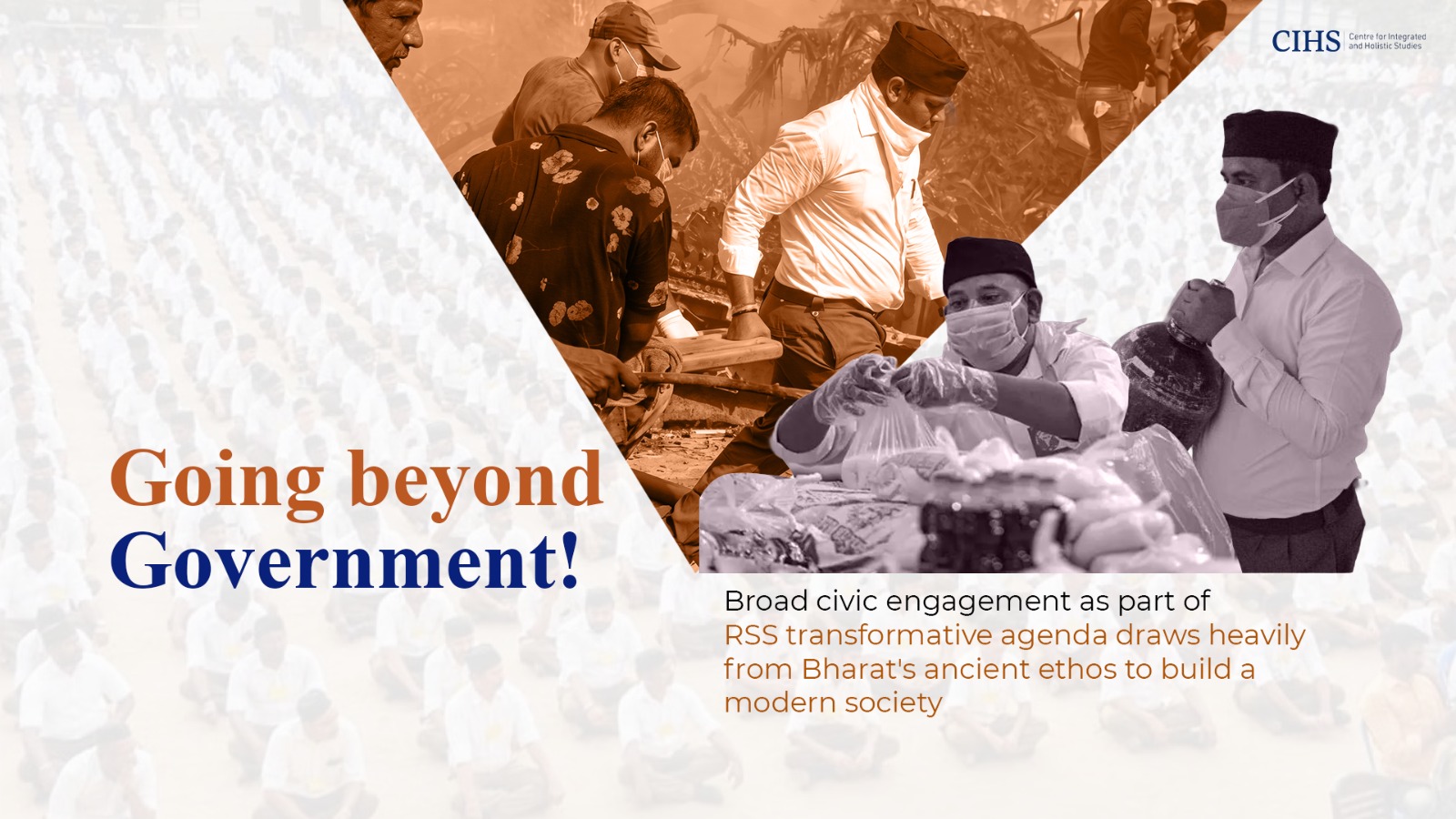


Broad civic engagement as part of RSS transformative agenda draws heavily from Bharat’s ancient ethos to build a modern society.
Vinod Kumar Shukla
Foundational philosophy of Rashtriya Swayamsevak Sangh (RSS) posits that Vyakti Nirman (individual / personality development), coupled with Charitra Nirman (character building) and Samaj Nirman (social development) naturally culminates to Rashtra Nirman (nation-building).
These core tenets have guided the organization since its inception. This enduring commitment stems from a deeply held conviction that true societal progress requires awakening citizens to their fundamental duties toward society and nation for greater collective good.
By systematically undertaking symbiotic tasks of Vyakti Nirman and Charitra Nirman, RSS facilitates a widespread consciousness of Nagrik Kartavya (civic duty). This emphasis forms one of the five essential pillars of social transformation, collectively termed Panch Parivartan, introduced by RSS as part of its centennial agenda.
These five transformative imperatives comprise Samajik Samrasta (social harmony), Kutumb Prabodhan (family enlightenment), Paryavaran Sanrakshan (environmental conservation), Nagrik Kartavya (civic duties) and Swa or Swadeshi (self-reliance). Through this framework, RSS endeavours to construct a disciplined, self-reliant and ethically grounded society that redounds to benefit of all citizens.
Core principles of civic duty advocated within this vision encompass full compliance with law of the land, alongside a concerted effort to encourage citizens, particularly the younger generation, to study and comprehend Constitution of India, its Preamble, and its Fundamental Duties.
Civic responsibility manifests in maintaining cleanliness in shared public spaces, curbing unnecessary noise pollution and upholding decorum in public conduct. It further demands exercising restraint and dignity in public discourse, practicing personal discretion in everyday actions, honouring elders while mentoring younger generations, prioritizing national interests and civic obligations over individual privileges and consistently conserving precious resources like water to uphold civic order across public life.
In contrast to predominantly materialistic Western paradigms, traditional Indian society remains inherently value-based, with ancient Indian scriptures consistently elevating duty (Kartavya) above rights. From foundational wisdom of Vedas to comprehensive codes of Dharmasutras and diverse philosophical treatises, classical Indian literature prescribes detailed guidelines for social conduct.
These texts established explicit norms for civic behaviour and codified specific penalties and fines for non-compliance. A prime illustration is found in Chanakya’s Arthashastra, a treatise written approximately 2,400 years ago. In Book II, Chapter XXXVI, Chanakya stipulates: “Whoever throws dirt in the street shall be punished with a fine of 1/8th of a pana; whoever causes mire or water to collect in the street shall be fined 1/4th of a pana; whoever commits the above offences in the king’s road (rajmarga) shall be punished with double the above fine.”
This exhaustive chapter outlines rights, responsibilities, and civic obligations binding common citizens, skilled professionals, and state officials alike. Consequently, concept of a structured societal order is deeply rooted in Bharat’s ancient heritage and has been practiced throughout its history.
However, as unbridled materialism and consumerism assume dominance in modern life, moral ethics, traditional values, and personal duty often recede into background. In such a climate, written statutes and constitutional frameworks become necessary instruments to delineate fundamental rights and duties, causing external rule of law to supplant internal moral regulation.
Yet, if every citizen conscientiously fulfils their intrinsic duties, the transformation will extend far beyond individual lives to enrich the broader social fabric and enhance national pride. Furthermore, widespread self-regulation inevitably alleviates the heavy strain placed upon overburdened law enforcement agencies and judicial systems.
When citizens proactively fulfil their civic responsibilities, state intervention is minimized. Meaningful improvement in the public sphere often hinges upon adherence to relatively simple, everyday habits.
Consider, for instance, water conservation. Although Earth is designated as ” Blue Planet ” because water covers approximately 71 per cent of its surface, nearly 97 per cent of that volume consists of saline ocean water.
Of the remaining three percent of global freshwater, less than one percent is readily accessible for human consumption. While certain regions of Bharat enjoy an abundance of potable water, this availability should never be treated as license for waste. In practice, however, squandering water remains widespread; thus, water conservation directly correlates with sustaining life. Curbing waste and cultivating active water preservation must be recognized as essential civic obligations.
Similarly, energy security represents a crucial global concern, particularly for developing and underdeveloped nations. Rationalizing energy consumption, spanning petroleum products to electrical power, helps preserve foreign exchange reserves, protects the natural environment, and mitigates financial strain on individual households.
Addressing energy waste requires fundamental behavioural adjustments. It is common to observe individuals conversing by the roadside with vehicle engines idling, or leaving air conditioners, lighting, and electrical appliances operating in vacant homes and offices where they serve no purpose whatsoever.
Related challenges manifest daily on the roads, where responsible driving is vital to ensuring safe transit for everyone. Hundreds of thousands of lives are lost annually in road accidents due to widespread disregard for traffic regulations, a tragedy that could be dramatically curtailed through a heightened sense of civic compliance.
Across society, everyday infractions abound: drinking water is mindlessly squandered to wash vehicles and clean floors, traffic laws are flagrantly flouted whenever law enforcement is absent, tax evasion is routinely sought, taxpayer-funded public property is vandalized by anti-social elements, protesters, and addicts, and food is carelessly wasted at immense scale.
Enacting ever-more stringent legislation cannot solve these challenges alone; real progress depends upon cultivating an internal ethical consciousness within the general citizenry.
Civic duty equally encompasses a citizen’s democratic obligation to participate actively in elections across all tiers of governance. In this realm, the efforts of RSS to boost voter turnout across various electoral cycles have been noteworthy, serving to significantly complement official government initiatives.
Swayamsevaks actively engage in voter awareness drives, urging citizens to exercise their franchise while providing practical assistance, such as helping elderly and infirm voters reach polling booths, thereby setting a powerful example of civic engagement for the younger generation.
These persistent lapses highlight areas where citizens of Bharat are frequently criticized for a perceived deficit in civic sense, a quality indispensable for societal advancement. In response, the RSS seeks to instil a profound sense of duty among citizens, motivating them to respect rule of law, honour their constitutional obligations, maintain public decency, and participate constructively in community governance.
Where widespread cynicism leads many to decry “the system,” the Panch Parivartan initiative urges citizens to reform the system from within through proactive duty rather than passive complaint.
By engaging individuals who are reluctant or recalcitrant to abide by national laws and municipal regulations, the movement strives to foster a deeper understanding of why civic discipline is vital to collective prosperity.
This emphasis on self-directed civic responsibility is by no means novel to Bharat. Both formal legal codes and informal social norms have governed life on the subcontinent since time immemorial. Traditionally, community elders bore the primary responsibility for instructing individuals on proper societal conduct, relying on moral authority long before punitive state enforcement and coercive legal apparatuses became the primary mechanisms of social control.
In championing civic duty, RSS aligns its mission with the timeless principles enshrined in Sanatan scriptures. Chapter 9, Verse 23 of the Yajurveda proclaims, “Vayam Rashtre Jagriyam Purohitah,” which translates to: “We, as enlightened leaders and guardians, shall keep the nation awake, vigilant, and vibrant.”
This ancient mandate underlines that the onus rests upon conscious, responsible individuals to educate and inspire their fellow citizens to adhere to social norms and legal principles. Within this traditional paradigm, the state serves as a secondary resort, stepping in only when individual conscience and community guidance fail to move the reluctant.
(Author is a senior journalist and associated with Centre for Integrated and Holistic Studies, a non-partisan think-tank based in New Delhi)

