


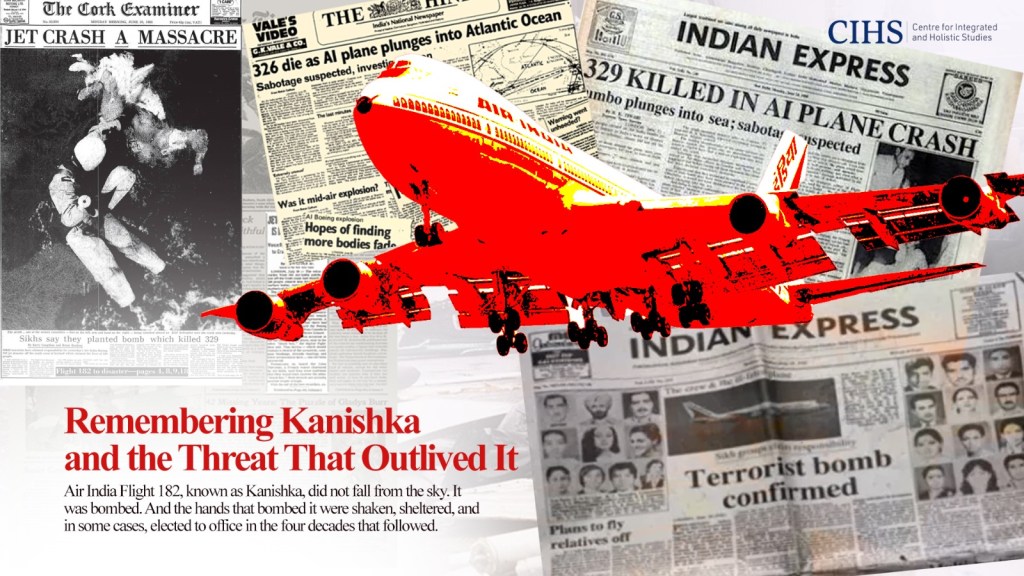
Air India Flight 182, known as Kanishka, did not fall from the sky. It was bombed. And the hands that bombed it were shaken, sheltered, and in some cases, elected to office in the four decades that followed.
Rahul PAWA
On 23 June 1985, Air India Flight 182, operating on the Montreal-London-Delhi route, was blown up by a bomb at an altitude of 30,000 feet and crashed into the Atlantic Ocean while in Irish airspace. All 329 people on board were killed, among them 268 Canadians. There were 82 children under the age of thirteen. Families waiting at Heathrow received no arrivals. Relatives in Delhi received no calls. What they received, eventually, was confirmation that a bomb planted in Vancouver had ended every life on that aircraft before it crossed the Irish coast.
Forty-one years have passed. Today, Canadian Prime Minister Mark Carney issued a statement on the National Day of Remembrance for Victims of Terrorism, acknowledging that the bombing remains the deadliest terrorist attack in Canada’s history. The words are appropriate and overdue. But remembrance divorced from accountability is ritual without purpose. The Kanishka bombing was not a closed chapter. It was an opening one, and the story it began has not ended.
Despite the fact that most victims were Canadian citizens, the bombing was largely treated at the time as an Indian matter. That framing shaped four decades of institutional inaction. It allowed the networks responsible to reconstitute themselves under different names, in different cities, with different organisational structures but the same ideological core.
Khalistanis or the proposed Khalistani ideals have no meaningful support base inside India itself. What it has is a diaspora infrastructure spread across Canada, the United Kingdom, the United States, and Australia, and a state patron with a documented strategic interest in keeping that infrastructure operational. Hudson Institute research documents available evidence of support received by US-based Khalistan groups from entities and individuals linked to Pakistan, and confirms that ISI backing for the Khalistani movement has not stopped. Pakistan lost four conventional wars against India. Sponsored extremism in the diaspora is the continuation of that competition by other means.
Canada’s CSIS 2025 Annual Report formally designates Canada-based Khalistani extremists a national security threat, noting that some are well connected to Canadian citizens who leverage Canadian institutions to promote their violent extremist agenda and divert funds from unsuspecting community members toward violent activities. This formal designation, tabled before Parliament forty years after the Kanishka bombing, is significant. It is also a measure of how long democratic governments can defer an honest reckoning when the political costs of clarity feel immediate and the costs of ambiguity feel abstract.
Those costs ceased to be abstract on 3 November 2024. Khalistani extremists attacked worshippers outside the Hindu Sabha Mandir in Brampton, Ontario with flag poles and sticks. Three men were subsequently charged. A serving Peel Region police officer was suspended after it emerged he had participated in the protest outside the temple. Parallel violence erupted the same day in Surrey, British Columbia. That a sworn officer of a Canadian police service attended a demonstration that turned on worshippers inside a house of worship is not, in isolation, a human resources problem. It is a signal about how deeply these networks have embedded themselves in western civic life.
In March 2026, Nancy Grewal, a Canadian Sikh critic of Khalistani extremism, was fatally stabbed in LaSalle, Ontario. She had told CBC the week before her murder that she was receiving death threats for speaking publicly against Khalistani extremists. A social media account associated with Khalistani extremism claimed responsibility. She was not a diplomat, not a government official, not a symbolic target. She was a woman with a social media platform who said what she believed. That is sufficient, in the logic of this movement, to warrant killing.
Four of the nine Khalistani extremists designated as terrorists by the Indian government in 2020 are based in Pakistan. SFJ’s websites have been linked to Pakistani addresses, and its spokespeople have participated in events organised by the Pakistani embassy in the United States in collaboration with groups with close links to the Pakistani regime and proscribed jihadist organisations.
In December 2025, the United Kingdom government imposed sanctions on pro-Khalistan entities linked to Babbar Khalsa. Babbar Khalsa was the terrorist organisation whose Canada-based operatives planted the bomb that destroyed the Kanishka. That it required forty years for a close democratic partner to sanction its affiliates is a precise measure of how poorly calibrated the collective response has been.
Khalistani extremist networks do not respect borders. They exploit financial systems, punjabi music and film industry, charitable structures, asylum routes, and diaspora politics across multiple jurisdictions simultaneously. A response that operates jurisdiction by jurisdiction, each government managing its own domestic political sensitivities around a diaspora community, is structurally inadequate to a threat that has always operated across those boundaries.
The 329 people aboard the Kanishka on 23 June 1985 were travelling between countries that share values, institutions, and treaty commitments. They were killed by an terrorist group that understood, correctly, that those countries would not coordinate their response effectively enough to matter.
The legacy of Air India Flight 182 demands remembrance and vigilance. Vigilance, in 2026, means coordinated terrorist designations, disruption of Pakistan Army and ISI-linked financial channels, and an end to the political and social accommodation that has functionally kept this threat viable across four decades. The families of 329 people and many more around the world have been waiting long enough.
(Author is Director of Research at the Centre for Integrated and Holistic Studies, New Delhi, and formerly a Research Fellow at the Parliament of India. He writes on international law, frontier technologies and global security.)

