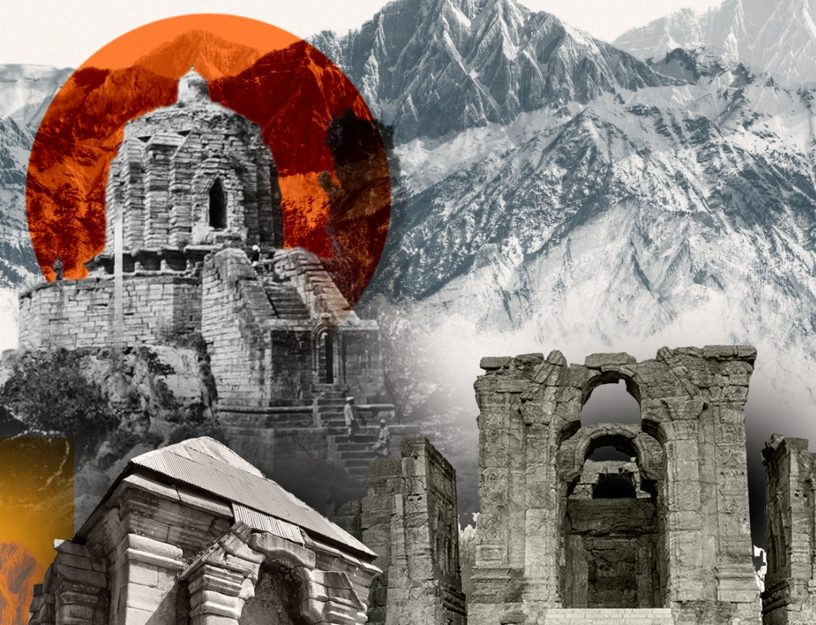


The history of Kashmir is a tale of culture rather than just geography. The Valley fostered a distinctive intellectual, spiritual and cultural history for thousands of years that significantly influenced Bharat’s civilisational terrain. Kashmiri Hindu community consisting of intellectuals, philosophers, saints, poets and custodians of sanatan/dharmic knowledge whose presence established Kashmir’s cultural identity over centuries, stood at the heart of this legacy.
For a displaced Kashmiri Hindu minority community, Kashmir Valley’s topography represents a sacred map of the spirit rather than just a set of physical coordinates. A 5,000-year-old civilisational continuum can be found in every mountain peak, freshwater spring (nag) and weathered stone facade.
As opposed to “being seen as” two distinct geographies linked only by political boundaries, Kashmir and Bharat are integral parts of a single civilisational and dharmic ecosystem. Ideas, philosophies, texts, scholars, pilgrims and cultural customs moved freely between Kashmir and the rest of Bharat for millennia, enhancing a common civilisational consciousness. Kashmir Valley produced significant contributions to Shaivism, Sanskrit scholarship, aesthetics, philosophy and religious learning; it was not a peripheral frontier but rather one of the leading hubs of Bharatiya spiritual thinking. As a result, the history of Bharat and Kashmir are intricately interwoven, and the preservation of Bharat’s larger civilisational memory is inseparably related to the preservation of Kashmir’s legacy.
Hundreds of ancient temples, shrines and historic sites were abandoned to stillness, overgrowth and the gradual deterioration of time when this link/bond was shattered by the mass ethnic cleansing and exodus of early 1990s.
Temples of Kashmir, which are tucked away in the region’s breath-taking scenery, are timeless representations of spirituality, religion and cultural legacy. These hallowed locations serve as centres of devotion, meditation and cultural continuity while providing a deep link to Kashmir Valley’s historical past.
Preserving historic neighbourhoods, sacred shrines, old temples and cultural landmarks connected to Kashmiri Hindu’s past has become an urgent priority. However, this endeavour is more than just preserving stones, buildings or archaeological remains; it is a crucial, emotional link that connects and preserves collective memory, reconnects identity and fulfils the long-term goals of a community committed to reclaiming its history and re-establishing ties between displaced generations and their ancestors.
In this brief, CIHS is exploring the rich history, stunning architecture and profound spiritual importance of some of Kashmir’s most revered Hindu temples.
Background
One of the most amazing manifestations of Kashmir Valley’s long-standing spiritual and cultural legacy are its temples. Their multi-century history reflects the development of religious customs, artistic brilliance and innovative architecture in the Kashmir Valley. Many of these hallowed buildings date back to the early Common Era and some historians believe that the Kushan dynasty is when the first temples were built. Over time, Gandharan, Gupta and Central Asian artistic schools combined with rishi/sanatan customs, created a unique character of Kashmiri temple building.
The ruins of a prosperous and long-lasting civilisation can be found all over the Valley. A living archive of Kashmir’s civilisational history is made up of ancient temples devoted to Shiva, Shakti, Vishnu and other deities; sacred springs and pilgrimage sites; traditional settlements; educational institutions and locations connected to well-regarded saints and scholars.
Major Dynastic Contributions to Kashmiri Temple Architecture
| Dynasty | Period | Contribution |
| Kushan Dynasty | 1st–3rd century CE | Early foundations of religious and artistic traditions in Kashmir. |
| Karkota Dynasty | 7th–9th century CE | Golden age of temple construction; Martand and Naranag (or Naran Naag) temples. |
| Utpala Dynasty | 9th–10th century CE | Construction of Avantiswami, Avantisvara and other major temples. |
| Lohara Dynasty | 10th–12th century CE | Continued patronage of temples and religious institutions. |
Known as the “golden age” of Kashmir’s architectural and cultural accomplishments, the Karkota dynasty (7th–9th centuries CE) was a pivotal period in the development of temple architecture. Several large temples were built during this time, the most well-known of which being the Martand Sun Temple. A marvel of ancient Indian architecture, the temple was constructed in the eighth century by King Lalitaditya Muktapida and features a distinctive fusion of Gandharan, Gupta and regional Kashmiri design elements. The wealth and creative sophistication of the time are reflected in its enormous size and fine craftsmanship.
Subsequent Utpala dynasty (9th–10th centuries CE) substantially enhanced Kashmir’s sacred landscape by building and supporting significant holy sites. Shankaracharya, one of the most treasured temple, is situated on a hilltop with a view over Srinagar. This historic shrine, devoted to Bhagwan Shiva, has long been a hub of spiritual devotion and pilgrimage, providing both religious importance and expansive vistas of the Valley.
Shadipur in Kashmir Valley, also known as “Chota Prayagraj,” is a spiritual reflection of Prayagraj, the sacred confluence of the Ganga, Yamuna and Saraswati. Nestled amid the serene landscapes, Shadipur marks the sacred confluence of Jhelum and Sind rivers, mirroring the spiritual significance of the Triveni Sangam at Prayagraj. Similar to pilgrims at the Kumbh in Prayagraj, Kashmiri Hindus have flocked here for generations to carry out religious observances, ancestral rites and holy dips. Every twelve years, the place holds the Dashar Maha Kumbh, a distinctive Kashmiri custom that attracts people not only from Kashmir but all over Bharat. Shadipora’s “Chota Kumbh” highlights Kashmir Valley’s unique spiritual legacy, signifying the Valley’s deep-rooted connection to Hindu civilisation and pilgrimage network. From the Vitasta-Sindh Sangam in Kashmir to the Ganga-Yamuna Sangam in the center of Bharat, they collectively exhibit a common cultural continuum.
Shaivite academics, priests and saints who worshipped at the holy Chinar island and Shiva Lingam at the sacred confluence have long been connected to the place. Shadipora Prayag has been a respected pilgrimage site for centuries, from ancient Kashmiri sages and Shaivite intellectuals to Maharaja Hari Singh and generations of Kashmiri Hindus. The mortal remains of national luminaries like Jawaharlal Nehru, Indira Gandhi and Atal Bihari Vajpayee have also been found at the sacred confluence, demonstrating its special place in Kashmir’s spiritual and cultural legacy.
Numerous temples in Kashmir have suffered ravages of invasions, natural disasters and political upheavals throughout history. They remain timeless representations of the region’s robust cultural and spiritual heritage despite these difficulties. Historians, archaeologists, pilgrims and tourists from all over the world are still drawn to their unique stone architecture, elaborate carvings, sacred iconography and historical significance.
These temples, in addition to being places of prayer, now function as living reminders of Kashmir’s rich cultural and civilisational heritage. They preserve a legacy that is essential to the cultural memory of the Kashmiri Hindu community and to the larger historical legacy of Bharat. They provide priceless insights into the artistic, religious and intellectual traditions that have moulded Kashmir Valley for millennia.
Below is a list of prominent spiritual leaders, academics, philosophers, saints and religious leaders who have been connected to Kashmir, whether as locals, tourists, educators, pilgrims or significant thinkers, throughout history.
| Period | Name | Tradition/Field | Connection with Kashmir |
| c. 3rd century BCE | Majjhantika | Buddhism | A Buddhist monk from Varanasi who, during the reign of Ashoka, was deputed to spread Buddhism in Kashmir and Gandhara. He is traditionally credited with introducing and establishing Buddhism in Kashmir, playing a key role in the region’s early Buddhist history. |
| 1st-2nd century CE | Nagarjuna | Mahayana Buddhism | Associated by tradition with Kashmir and its Buddhist intellectual centres. Ruins of ancient Buddhist monastery complex in Harwan, on the outskirts of Srinagar, are traditionally believed to be the site where Nagarjuna lived and taught. |
| 2nd century CE | Vasumitra | Buddhism | A native of Gandhara, Buddhist monk of Sarvastivada school, presided over the Fourth Buddhist Council held in Kashmir under Kanishka I. |
| 4th-5th century CE | Kumarajiva | Buddhist Studies | A renowned Buddhist scholar born into an aristocratic family with roots in the Gandhāra, Kashmir region. After receiving a rigorous Buddhist education in Kashmir from a young age, he emerged as a major intellectual bridge between India and East Asia. His life and work, including his association with the kingdom of Kucha (modern day Xinjiang, China), highlight the far-reaching influence of Kashmir’s ancient Buddhist traditions across Asia. |
| 7th century CE | Xuanzang | Buddhist Pilgrimage | Chinese Buddhisht monk, visited Kashmir and spent nearly two years studying Buddhist philosophy and vital historical documentation of the region; established Kashmir as a renowned intellectual powerhouse and a key junction linking India to Central Asia. |
| 8th century CE | Padmasambhava | Vajrayana Buddhism | Travelled through Kashmir; influenced by Kashmiri Buddhist traditions before moving to Tibet. |
| 8th century CE | Shantarakshita | Buddhism | Studied traditions connected to Kashmir’s renowned Buddhist learning centres. |
| 8th-9th century CE | Vasugupta | Hindu Philosophy | Founder of the Shiva Sutra tradition in Kashmir. |
| 9th century CE | Anandavardhana | Aesthetics & Poetics | Developed the influential Dhvani theory in Kashmir. |
| 10th century CE | Abhinavagupta | Philosophy, Tantra, Aesthetics | One of India’s greatest philosophers; lived and taught in Kashmir. |
| 10th-11th century CE | Kshemaraja | Kashmir Shaivism | Principal disciple of Abhinavagupta. |
| 11th century CE | Al-Biruni | Comparative Religion | Recorded information about Kashmir’s intellectual traditions; highlighted Kashmir as a major centre for Hindu sciences, philosophy, and Sanskrit literature |
| 12th century CE | Kalhana | History | Author of the famous chronicle Rajatarangini. |
| 14th century CE | Mir Sayyid Ali Hamadani | Sufism | Travelled to Kashmir multiple times; profoundly influenced its spiritual and cultural life. |
| 14th century CE | Lal Ded | Shaivism & Mysticism | Revered spiritual figure whose teachings, known as Lal Vakhs shaped Kashmiri spirituality. |
| 15th century CE | Nund Rishi | Sufism | Founder of the Rishi tradition in Kashmir. His life and works shaped Kashmir’s spiritual and cultural identity for over six centuries |
| 15th century CE | Sayyid Muhammad Nurbakhsh | Sufism | Visited Kashmir and influenced Islamic spirituality in the region. |
| 16th century CE | Mulla Shah Badakhshi | Qadiri Sufism | Spiritual guide whose teachings attracted seekers across Kashmir. |
| 17th century CE | Dara Shikoh | Comparative Mysticism | Visited Kashmir and engaged deeply with Hindu and Sufi thought. |
| 17th century CE | Mulla Mohsin Fani | Comparative Religion | Studied diverse religious traditions in Kashmir. |
| 19th century CE | Swami Vivekananda | Vedanta | His visits to Kashmir in 1897 and 1898 marked a profound spiritual turning point, he travelled extensively; inspired by Kashmir Valley’s spiritual heritage, a deep devotion to the Divine Mother and shifting his focus from universal Vedantic teachings to a more personal and mystical spiritual path. |
| 19th century CE | Anagarika Dharmapala | Buddhism | His connection with Kashmir was rooted in his mission to revive Bharat’s Buddhist heritage through the reclamation and distribution of sacred relics. During this period, he showed a keen interest in the Kashmir Valley’s rich pre-Islamic Buddhist legacy, including ancient sites such as the 3rd-century Harwan Monastery near Srinagar, whose excavations in the 1920s highlighted Kashmir’s historic role as a centre of Buddhist learning and culture. |
| Early 20th century | Sri Aurobindo | Spiritual Philosophy | Though not a long-term resident of Kashmir, Sri Aurobindo deeply reflected on its civilisational and spiritual significance. During his 1903 visit to Srinagar, while meditating atop Shankaracharya Hill, he experienced a profound state of absolute silence and the “vacant infinite,” an unbidden realisation of Nirvana that marked a pivotal turning point in his journey from political revolutionary to integral yogi. |
| 20th century | Jiddu Krishnamurti | Spiritual Thought | Conducted talks and retreats in Kashmir. |
| 20th century | Swami Lakshman Joo | Kashmir Shaivism | Hindu saint, mystic and scholar and teacher of Trika Shaivism (Kashmir Shaivism). Revived and transmitted classical Shaivite teachings globally. |
| 20th-21st century | Dalai Lama | Tibetan Buddhism | Has visited Kashmir on several occasions for spiritual and interfaith engagements and ancient Buddhist roots that historically linked Tibet and the Kashmir Valley. |
For two millennia, seekers, monks, philosophers, Sufis, and scholars flocked to Kashmir, one of Asia’s most significant centres of spiritual learning due to its historical position as an intersection between India, Central Asia, Tibet, Persia and China.
Significance of Temples in Sanatan Dharma and Kashmir’s Sacred Heritage
In Sanatan Dharma, temples are more than just physical buildings; they are consecrated places where the divine and the materialistic world converge. For ages, temples have maintained religious customs, cultural practices and civilisational values by acting as hubs for worship, introspection and communal life. They are intended to provide an environment that is favourable to devotion, meditation and inner transformation and are constructed in accordance with sacred architecture principles. Temples unite communities in a common faith and celebration by fostering a feeling of collective identity and continuity via daily rituals, festivals and ceremonies.
For a Kashmiri Hindu community, temples are much more important and hold a deeper significance. They represent the rich spiritual, intellectual and cultural traditions of Kashmir and serve as timeless reminders of an old civilisation that thrived in the Valley for millennia. The region’s distinctive religious legacy has been preserved for generations by these sacred locations, which have functioned as hubs of education, pilgrimage and devotion.
Numerous ancient and revered temples, each with its own historical record, architectural grandeur and spiritual significance, are dispersed throughout Kashmir’s scenic landscapes. These monuments provide a window into the Valley’s extraordinary civilisational history, ranging from magnificent temple complexes that once stood at the centre of Kashmir’s cultural life to beautiful mountaintop shrines and sacred springs.
The following table lists some of the most important old and well-known temples as well as historically significant sites connected to the continuing history of the Kashmiri Hindu population and the spiritual legacy of the Hindu community in Kashmir.
| Temple | Location | Approximate Origin | Founder/Associated Dynasty | Primary Deity | Historical Significance |
| Martand Sun Temple | Anantnag | 8th century CE | Lalitaditya Muktapida (Karkota Dynasty) | Surya (Sun God) | One of the best specimens of ancient Kashmiri architecture and a representation of the splendour of Kashmiri civilisation. |
| Shankaracharya Temple | Srinagar | Traditionally dated to around 200 BCE; rebuilt over centuries | Early Kashmiri rulers; later patronage by various dynasties | Shiva | A significant pilgrimage site with a view of Srinagar, it is one of the oldest temples still standing in Kashmir. |
| Kheer Bhawani Temple | Tulmul, Ganderbal | Ancient origin; present structure developed over centuries | Associated with Kashmiri Hindu traditions | Goddess Ragnya Devi (Kheer Bhawani) | One of the holiest shrines of Kashmiri Hindu community. |
| Avantiswami Temple | Awantipora | 9th century CE | Avantivarman | Vishnu | A large temple complex that exemplifies the Utpala period’s architectural genius. |
| Avantisvara Temple | Awantipora | 9th century CE | Avantivarman | Shiva | A sister monument of Avantiswami Temple and notable example of Kashmiri temple construction from the Middle Ages. |
| Pandrethan Temple | Srinagar | 9th–10th century CE | Utpala period | Shiva | Renowned for its exquisite proportions and amazingly well-preserved stone architecture. |
| Sharika Devi Temple | Srinagar | Ancient | Associated with early Kashmiri Shakta traditions | Goddess Sharika | A significant Shakti shrine and a centre of worship for Kashmiri Hindus. |
| Amarnath Cave Shrine | Himalayas of Kashmir | Ancient, referenced in medieval texts | Associated with ancient Shaivite traditions | Shiva | One of the most revered pilgrimage sites for Hindus. |
| Wangath Temple Complex | Naranag, Ganderbal | 8th century CE | Often attributed to the Karkota period | Shiva | A stunning collection of stone temples surrounded by the Himalayan scenery. |
| Jyestha Devi Temple | Srinagar | Ancient | Early Kashmiri Hindu tradition | Goddess Jyestha Devi | Revered by Kashmiri Hindus and connected to long-standing ancient local customs. |
| Gauri Shankar Temple | Pahalgam | Medieval origins | Local Hindu rulers and devotees | Shiva and Parvati | Significant stop in Kashmir’s ancient pilgrimage routes. |
| Mamleshwar Temple | Pahalgam | Traditionally dated to the 5th–12th centuries CE | Early Kashmiri rulers | Shiva | One of the oldest surviving temples in the Lidder Valley. |
These locations are more than just famous architectural monuments. They represent cultural customs, stories, rituals and collective experiences that have been passed down through the ages. Every shrine, temple courtyard and ancient neighbourhood holds memories of festivals observed, prayers offered, families reared and wisdom shared. They continue to be essential to the historical memory and cultural identity of the Kashmiri Hindu community, together representing more than two millennia of Kashmir’s spiritual, artistic and civilisational legacy.
These sacred sites become even more important for communities who have been displaced. They become into symbols of continuity in the face of disruption, anchors of identity and reminders of belonging.
Emotional Geography of Memory
Many Kashmiri Hindus have ties to sacred locations and ancestral homes that go well beyond geographical boundaries. It is present in cultural awareness, family stories and memory.
Stories told by parents and grandparents about temple visits during festivals, neighbourhood get-togethers, holy pilgrimages and the rhythms of daily life that previously characterised Kashmiri society are often how generations born outside the Valley learn about these locations. These recollections are frequently one of the few remaining links that younger generations have to their ancestral lands.
Thus, maintaining cultural landmarks turns into an act of memory. It guarantees that memories stay anchored in recognisable locations and vibrant customs rather than fading into abstraction. In addition to giving future generations a chance to learn about their origins and the ways in which their predecessors shaped the region’s culture, heritage sites enable displaced populations to preserve a deep connection to their past.
Cultural Revival and Civilisational Continuity
To comprehend the revitalisation of Kashmir’s sacred monuments, a broader national context is also necessary. Restoration of temples, shrines and other cultural landmarks is a part of a broader initiative to re-establish Bharat’s connection to one of its most important centres of civilisation. The sacred geography of Bharat, from Kashmir to Kanyakumari, has historically served as a network of interconnected cultures, with pilgrimage routes, educational institutions and spiritual practices fostering a sense of community. Heritage of Kashmir is an essential part of this greater narrative and continuation of the Bharatiya civilisational experience as a whole is strengthened by its preservation.
Societies all throughout the world acknowledge that maintaining cultural heritage is crucial to maintaining collective identity. Communities can preserve continuity across generations through monuments, sacred sites, historical districts and customs.
Heritage sites offer a strong passage for this kind of connectivity. It is possible to turn inherited memories into lived experiences by going to ancestral temples, exploring historic districts, and engaging in customary cultural activities.
Preserved cultural sites provide Kashmiri Hindus with an opportunity to interact directly with their legacy, which can be crucial in a larger process of cultural revival. This is especially true for newer generations of Kashmiri Hindus, many of whom were born and raised far from the Valley. They can learn about the amazing intellectual, creative and spiritual accomplishments that shaped their community for centuries, in addition to the hardships and relocation associated with recent history.
Once again, restored temples and protected sacred sites can serve as hubs for pilgrimage, cross-cultural interaction and community involvement. Architectural traditions, social histories and communal memory can all be preserved in historic communities. The community’s intellectual and cultural contributions can be preserved for future generations through documentation projects, heritage walks, archive projects and educational efforts.
Such endeavours involve more than just nostalgic reflection on the past. They are about establishing avenues for rejuvenation and cultivating a feeling of continuity and belonging. It enables a rich history of resiliency, inventiveness and contribution to shape identity in addition to feelings of loss. Communities can proudly contribute to modern society while drawing strength from their past thanks to cultural rebirth.
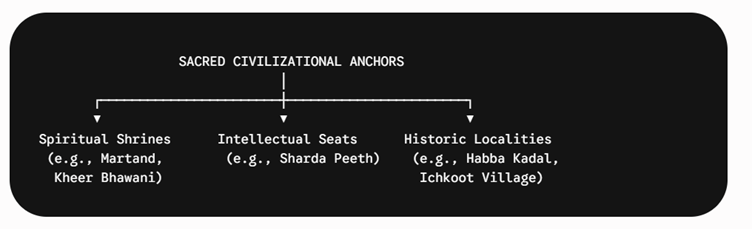
Physical anchors of this heritage can be looked at across three critical spheres:
- Monumental Civilisational Landmarks: Magnificent archaeological marvels such as the ruins of the Awantipora temple and the Martand Sun Temple, constructed by King Lalitaditya Muktapida in the eighth century, serve as monolithic reminders of a time when Kashmir was the centre of subcontinental architectural and geopolitical influence.
- Seats of Classic Learning: Historically located in Neelum Valley in the Pakistan occupied territory of Jammu & Kashmir, close to the Line of Control, shrines such as Sharda Peeth symbolise the spiritual birthplace of the Sharada script and the highest seat of learning, where scholars used to travel from all across Asia to study.
- Neighbourhood Sacred Spaces: In the districts of Srinagar, Anantnag, Budgam and Baramulla, smaller, more private shrines, village temples and holy springs served as the cornerstone of daily life.
Current energy behind these initiatives found united expression during significant institutional turning points, like the international meetings intended to lay out a path from “Exile to Excellence.” These programs treat historical sites as live schools rather than as static museums of a bygone era. Organisations are digitising old Sanskrit manuscripts, reviving the Sharada script and encouraging the next generation of diasporic youth to visit their ancestral villages/ roots in order to shift their focus from basic survival to a complete cultural renaissance.
Remote diaspora networks, community efforts and the administrative assistance of institutional restoration programs have all contributed to the acceleration of these sites’ revitalisation. Historic initiatives are breathing life back to areas that haven’t heard a temple bell in more than thirty years.
| Sacred Site | Location | Historical & Resurgent Significance |
| Shri Raghunathji Mandir | Habba Kadal, Srinagar | After being closed for 36 years, it reopened during Ram Navami. Revitalisation of what was once a thriving downtown cultural hub is a significant emotional homecoming milestone for the urban Hindu identity. |
| Sharada Bhawani Temple | Ichkoot, Budgam | Reopened following a 35-year gap. Traditional Pran Pratishtha ceremonies were performed to commemorate the installation of a recovered Shiva lingam, which was primarily carried out by local employees under rehabilitation programs. |
| Ganesh Temple (Kachua) | Baramulla | Revived an ancient yearly congregational custom. In order to support returning pilgrims, the occasion marked a significant push by local administrations to build infrastructure, such as Yatri Niwas facilities. |
| Maa Sharda Devi Mandir | Teetwal, Kupwara | Established close to the Line of Control to act as a cultural bridge and baseline spiritual proxy to the historic Sharda Peeth university’s old ruins. |

Preserving these sites means preserving a genuine historical truth. It affirms that the Kashmiri Hindu community is still deeply connected to the land, water and history of Kashmir despite being uprooted. By reconstructing these shrines, turning abandoned landscapes into places of profound return, the community demonstrates that although people can be uprooted from their land, the land can never be really removed from its people.
The process of restoration and rehabilitation is very emotional. Every temple cleaned, a structural crack fixed or a Havan (holy fire ceremony) kindled for the first time in 35 years, is a step towards finality of exile.
“Seeing the temple reopened and filled with devotees brings tears to our eyes. It gives us hope for the future.” This statement made by a community member during a recent temple revival encapsulates the dual nature of heritage restoration: it builds a vision for a dignified future while also honouring the trauma of the past.
Preserving the Future Through the Past
Ultimately, preservation of Kashmiri Hindu culture and heritage involves more than just restoration. It is about preserving the memory of a civilisation. It is about preserving places of worship where religion flourished, neighbourhoods where communities prospered and sites that attest to centuries of cultural accomplishment.
It is important to see the preservation of Kashmiri Hindu culture as a shared duty that cuts beyond ideological and political divides. An essential component of Bharat’s larger civilisational legacy include ancient temples, shrines, manuscripts, historic settlements and cultural sites. Proper documentation, digital archiving, restoration initiatives, educational outreach and sustainable heritage management techniques must all go hand in hand with conservation.
The link between generations is strengthened by each rebuilt/restored temple, safeguarded shrine, recorded custom and conserved historic place. Every act of preservation contributes to the transformation of heritage into a living identity and memory into continuity.
Equally crucial is the preservation of the intangible cultural heritage, language, literature, rituals, oral traditions, folklore music and philosophical traditions that have long shaped Kashmiri Hindu culture. Living traditions and physical monuments need to be preserved jointly since they are interdependent.
The heritage of Kashmiri Hindus demands ongoing attention and care as the world comes to understand how important it is to preserve fragile cultural practices. In addition to being a duty to the past, protecting these cultural icons is an investment in the future, one in which future generations will be able to respect their heritage, comprehend their origins and continue a legacy that has benefited humanity for ages.
Heritage preservation provides an invaluable guarantee that history, memory and belonging will continue for future generations seeking identity, scholars seeking insight and communities seeking reconnection.
One of the most striking manifestations of the wider Bharatiya civilisational ethos is Kashmir. The same cultural currents that have flowed throughout Bharat for thousands of years are reflected in its temples, sacred springs, philosophical traditions, literature, art and collective memory. The long-lasting connection between Kashmir and the rest of Bharat has not been weakened or destroyed despite times of invasion, relocation and disturbance that have attempted to break this continuity. This connection is based not just on geography but also on a common spiritual heritage, an unbroken dharmic tradition and a shared civilisational consciousness. The physical continuity of communities may have been disrupted by historical difficulties, but the deep cultural, spiritual and civilisational ties that bind Kashmir to Bharat have never been broken and never will be.
Concluding Observations:
Temples of Kashmir are more than just artefacts from a bygone era; they are timeless representations of a vibrant civilisation that has influenced Bharat’s spiritual, intellectual, and cultural consciousness for millennia. Together, these sacred locations, from the revered confluence of Shadipora to the imposing ruins of Martand, from the academic heritage of Sharda Peeth to the innumerable village shrines that fostered public life, embody the resilience of a people and the continuity of an enduring custom. Their preservation is a reaffirmation of historical reality, cultural identity and civilisational memory rather than just a conservation effort. As initiatives to preserve, record and revitalise Kashmir Valley’s sacred legacy gain traction, they present the unbroken connection between Kashmir and Bharat and re-establish a connection between future generations and their heritage. By preserving these temples and customs, we ensure that the voice of this ancient civilisation will continue to inspire future generations while also preserving the legacy of the Kashmiri Hindu community and an important part of humanity’s shared cultural heritage.

