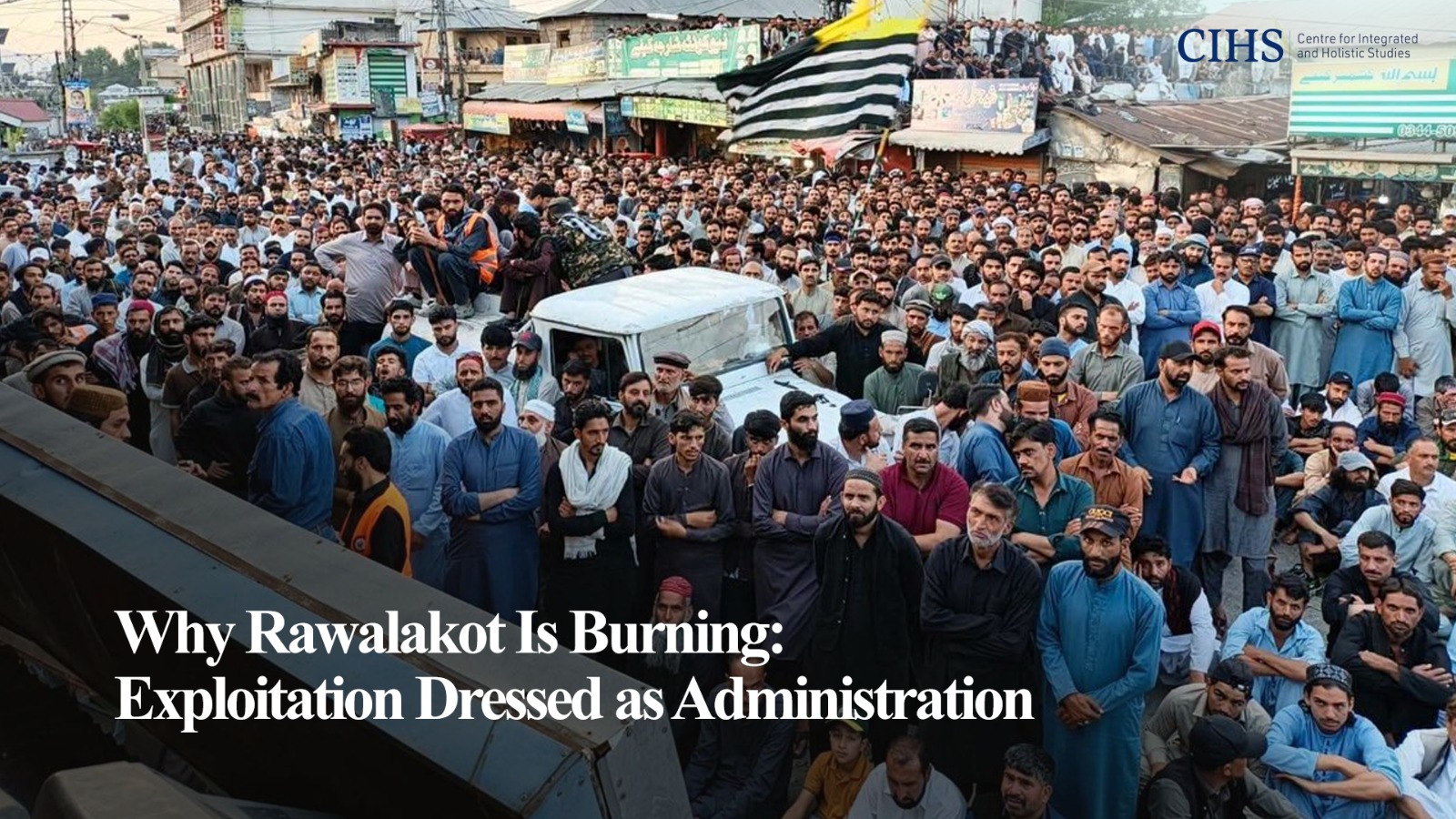


Seven are dead and an internet blackout has fallen over the hills, but the protesters in Pakistan’s Illegally Occupied Jammu and Kashmir have refused to go home. After seventy-nine years, the territory Islamabad occupied is deciding it will no longer be ruled.
Rahul Pawa | X @imrahulpawa
The bridge at Khaigala is not the sort of place where states are supposed to lose their grip. It is a modest crossing in a green fold of the Pir Panjal, the kind of spot a traveller passes without noticing. Yet this past weekend the air above Rawalakot filled with tear gas and gunfire. By the time it cleared, seven people were dead, four police personnel and three civilians, with around forty injured, and the people in the road did the one thing an occupier never expects. They stayed. Days before the strike was due, the Joint Awami Action Committee had already been outlawed, dozens arrested, and the internet throttled across the region.
To understand why an agitation over flour and electricity has hardened into something Islamabad now answers with bullets, you have to go back to the original sin.
In October 1947, Maharaja Hari Singh signed the Instrument of Accession that made the princely state of Jammu and Kashmir part of India, the same legal document every other prince signed. Before the ink was dry, Pakistan had already sent tribal raiders and regular soldiers pouring across the western frontier. The invaders brought violence and occupation. In Mirpur, eyewitnesses recorded a massacre so complete that, by some accounts, the overwhelming majority of a town of twenty-five thousand was slaughtered over three days that November. Hundreds of thousands fled. The land those raiders seized and held when the guns fell silent in 1949 became what Pakistan euphemistically calls “Azad” Jammu and Kashmir . There is no azadi there. There never was.
What there has been, for nearly eight decades, is exploitation dressed as administration.
Consider the rivers. The gorges of this territory carry some of the richest hydropower potential in South Asia, and Pakistan has exploited them relentlessly.. The Mangla reservoir drowned the old town of Mirpur and displaced its people. Pakistan draws much of its electricity from these mountains, yet the power projects sit elsewhere, depriving the region of the royalties that are rightfully its own. The current flows down to the plains of Punjab. The dignity does not flow back up. It is precisely this absurdity, a people sitting in the dark while their rivers light other cities, that has driven crowds into the streets every year since.
Then came the corridor. The China-Pakistan Economic Corridor was sold as a forty-billion-dollar dream, and for the Pakistan’s occupied territories it has been something closer to a second occupation. Ancestral land in Gilgit-Baltistan has been acquired forcibly, without consent or fair compensation, by the provincial government and the Pakistan army. The promised jobs evaporated as Chinese workers arrived to fill them, leaving locals dejected and shut out of the very projects carved through their valleys. Those who dare protest the corridor are booked under anti-terrorism laws and branded anti-state elements. The banks of the world lend against this land; its people are not invited to the counting house.
The cost of that closeness with Beijing has reached into the region’s homes. Hundreds of men from Gilgit-Baltistan married Uyghur women from neighbouring Xinjiang, and since 2017 those wives have been swept into China’s mass detention camps, leaving husbands and children stranded on the wrong side of the Khunjerab pass. The Gilgit-Baltistan assembly passed a unanimous resolution demanding their release; the families have protested through sub-zero winters; Islamabad, unwilling to disturb its benefactor, has done effectively nothing. An occupier that will not lift a finger to bring home its subjects’ own wives and mothers has told them precisely where they stand.
Nowhere was that indifference starker than in the spring of 2020. As the Wuhan-epicentre pandemic climbed into the mountains, activists described a public-health system that existed mostly on paper. Gilgit-Baltistan, they reported, had two ageing ventilators for a region of millions and had received no meaningful medical aid from Islamabad, even as the same government broke ground on the fourteen-billion-dollar Diamer-Bhasha dam. Hospitals functioned as little more than referral desks, dispatching the seriously ill down the highway to Rawalpindi to fend for themselves. A land rich enough to power a country was not worth two machines that breathe.
The people have had enough. The Joint Awami Action Committee, born in 2023 from traders, lawyers, labourers and transporters, learned in 2024 and 2025 they have to voice their rights. But the demand that frightens Rawalpindi was never about groceries. It is the abolition of twelve seats in the local assembly reserved for refugees who settled in mainland Pakistan after 1947, seats the committee says mainstream Pakistani parties use to install governments in Muzaffarabad.
Strip away the procedural language and the message is plain: stop rigging the house. On Sunday, 7 June, the territory’s Supreme Court ruled that those seats enjoy constitutional protection and can be altered only by amendment, dealing a blow to the movement that had been pushing against them. And so this weekend the state answered the way it always has here, with proscription, arrests, a blackout and live rounds.
This is not a problem Pakistan can solve. What is failing is slower and more fatal: consent. An occupation can outlast oppressive deeds; it cannot outlast the people it claims to govern deciding, town by town, that they were never asked and no longer agree. When British MPs are rising in their own parliament to flag a communications blackout, fielding messages from constituents who cannot reach their families in the region, the cost of holding this land has begun to outrun the reason for holding it.
Jinnah’s two-nation theory was an argument for Pakistan. It was never an argument for these territories Pakistan occupied with raiders and regulars, for they belonged to a state that had lawfully acceded to India before the invasion came. No theory promised the people here that their rivers would light other men’s cities, that their land would be signed away to foreign lenders, that their wives would vanish into camps and their sick would be left to drive to Rawalpindi to die. The experiment has outlived its argument. In Gilgit, in Muzaffarabad, in the bruised hills above Rawalakot, a generation has reached a verdict Islamabad has no way to overturn.
(The author is an international criminal lawyer and director of research at New Delhi based think tank Centre for Integrated and Holistic Studies (CIHS).)

