


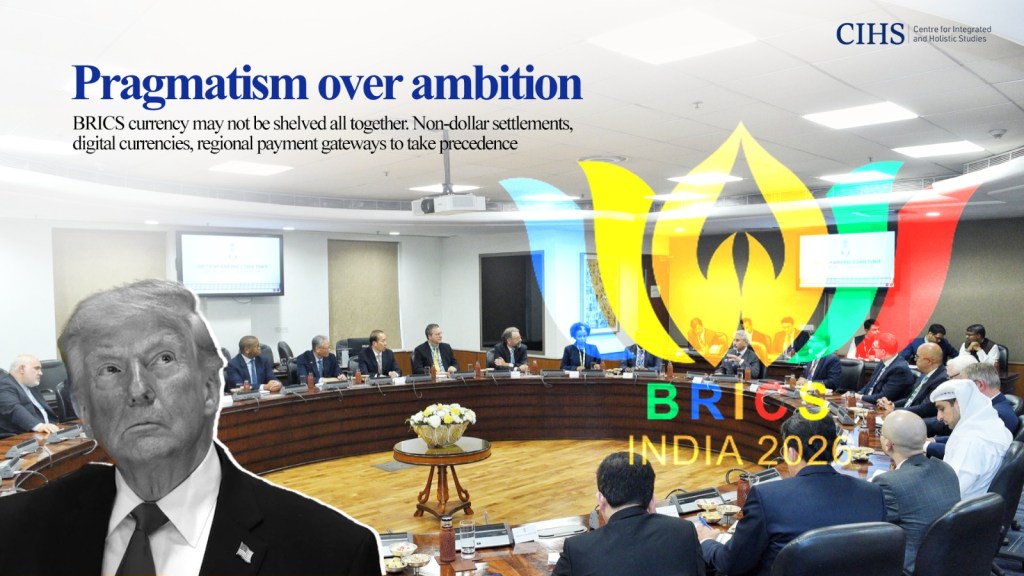
BRICS currency may not be shelved all together. Non-dollar settlements, digital currencies, regional payment gateways to take precedence.
N. C. Bipindra
A common BRICS currency is an idea that once symbolised the grouping’s ambitious challenge to dominance of US Dollar. The common BRICS currency was proposed to reshape the global financial order apart from geo-political realignments.
But the geopolitical climate is rapidly going downhill, what with the West Asian conflict engaging global attention over last two-and-a-half months now.
The diverging national interests of BRICS nations are compounding the challenge. This divergence is exposing deep structural limits of the group’s common currency proposal.
Instead of accelerating toward a unified currency for the 11-nation grouping, BRICS members are increasingly moving more toward a fragmented but practical financial system built around national digital currencies and local-currency trade settlements.
BRICS originally with just four members in Brazil, Russia, India, and China, has grown to include South Africa (and hence became BRICS from BRIC).
The BRICS now includes world’s major energy producers and regional powers, essentially positioning itself as a counterbalance to the G7, which is unwilling to accommodate other major economies within its architecture.
The expanded BRICS has repeatedly discussed reducing dependence on US Dollar in trade settlements. Yet, despite the strong rhetoric from nations like Russia and China, a consensus among the member states is elusive.
There is no real agreement on creating a single BRICS currency notwithstanding the Delhi declaration that had the currency as a big selling point for the group. The latest instability in West Asia, a major energy-producing region, has only complicated the situation.
The conflict-driven volatility in oil markets, sanctions risks, supply chain disruptions and currency instability have all highlighted a basic geopolitical reality.
BRICS economies are too diverse in structure, political orientation, and monetary priorities to surrender sovereignty over currency policy.
Unlike the Eurozone, BRICS lacks integrated fiscal systems, coordinated central banks or a unified political architecture for it to move towards a common currency. Without these foundational similarities, a common currency would risk becoming economically unsustainable.
The changing geopolitical environment is especially significant for Bharat. New Delhi has historically and consistently supported multi-polarity in geopolitical order.
India has also emphasised greater use of local currencies in trade, particularly in energy transactions, such as with Russia and Iran.
However, India has remained cautious about any arrangement that could disproportionately strengthen China’s financial influence within BRICS.
With tensions across West Asia and Europe intensifying and global markets becoming more unpredictable, India may increasingly rethink the feasibility of a BRICS currency altogether.
India’s concerns with a single BRICS currency are not just political. Adapting to a unified BRICS currency would require India to significantly align its monetary policy, exchange-rate management, and reserve coordination.
India’s economy operates under vastly different conditions than those of China, Russia, Brazil, or South Africa. India’s inflation management, capital controls, banking regulation, and trade priorities differ sharply from those of the other BRICS nations.
In times of geopolitical crisis or a pandemic situation like COVID-19, nations typically prefer stronger control over domestic monetary tools rather than less.
This explains why an alternative model, such as digital national currencies for intra-bloc settlements, is gaining traction inside BRICS.
Instead of replacing sovereign currencies with a single BRICS unit, member states are increasingly exploring Central Bank Digital Currencies (CBDCs) and bilateral payment systems that bypass the Dollar without requiring full monetary union.
China’s digital Yuan initiative remains the most advanced example of the CBDC. Russia has accelerated the development of digital payment systems after Western sanctions. India, meanwhile, has actively tested its own digital Rupee infrastructure through the Reserve Bank of India (RBI).
These developments in CBDCs suggest that future of BRICS financial integration may be technological rather than monetary.
Under this evolving framework, BRICS nations could settle trade in their own currencies using interoperable digital platforms. For example, energy exports could be priced in Yuan, Rupee, Rubble, or other local currencies, depending on bilateral arrangements.
Such a system would gradually reduce exposure to US Dollar, while avoiding the political and economic complications of a shared currency within BRICS.
This approach offers several advantages to BRICS nations. One, it preserves monetary sovereignty for all its member states. Two, it lowers transaction costs and reduces vulnerability to sanctions. Three, it allows nations to deepen financial cooperation incrementally rather than through a risky “big bang” currency union.
President Donald J Trump had been fuming on the very idea of BRICS currency and threatened to slap huge imposts on member countries in case they moved ahead.
Though US dollar continues to be the major preferred currency to settle transactions, it’s slowly losing sheen. President Trump expects that a strong alternative BRICS currency would dampen the US dollar’s primacy as the major international paper.
Till now, US Dollar remained the most deeply embedded in global financial system due to scale of the American economy, liquidity of US financial markets, and institutional trust surrounding Dollar-denominated assets.
Even nations critical of American financial influence continue to rely heavily on US Dollar reserves and US Dollar-based trade mechanisms.
Therefore, future of BRICS currency project depends less on political declarations and more on whether the grouping can build a credible financial infrastructure capable of rivaling the existing US Dollar system. At present, BRICS lacks the institutional cohesion needed for such a transformation.
Moreover, internal contradictions within BRICS remain substantial. China and India continue to compete strategically and militarily in Asia. Russia’s economy faces sanctions-driven isolation.
Newer BRICS members have differing alignments with the West and varying levels of dependence on US Dollar-based trade. These realities weaken possibility of a unified BRICS currency.
Current West Asian conflict-induced instability may further reinforce caution among BRICS members. In periods of geopolitical uncertainty, investors and governments typically gravitate toward stable and liquid reserve currencies. And, the US dollar still dominates that space.
Even today, oil exporters exploring non-Dollar trade continue to benchmark much of global energy commerce in US Dollars, because of market familiarity and financial stability.
But this doesn’t mean BRICS de-dollarization efforts will fail. Instead, the process is likely to evolve gradually through local currency trade agreements, digital settlement systems and diversified reserve strategies rather than through dramatic launch of a single BRICS currency.
For India, this incremental path appears more aligned with national interests, as New Delhi can support financial multi-polarity without compromising strategic autonomy or exposing itself to excessive dependence on any one BRICS partner.
The digital currency route allows India to strengthen its technological and banking infrastructure while maintaining control over monetary policy within its borders.
Ultimately, the BRICS currency debate reflects a larger transition underway in global finance. The world may indeed become less US Dollar-centric over time. But it may not necessarily be through the emergence of a single rival currency.
Instead, the future may belong to a fragmented multi-polar financial ecosystem, where digital currencies, regional payment systems, and local-currency trade coexist alongside continued US Dollar.
The dream of a common BRICS currency is not dead. But the realities of geopolitics, economics and strategic mistrust are pushing the bloc toward a far more pragmatic alternative.
(Author is Chairman, Law and Society Alliance, a New Delhi-based think tank, and guest columnist with CIHS)

