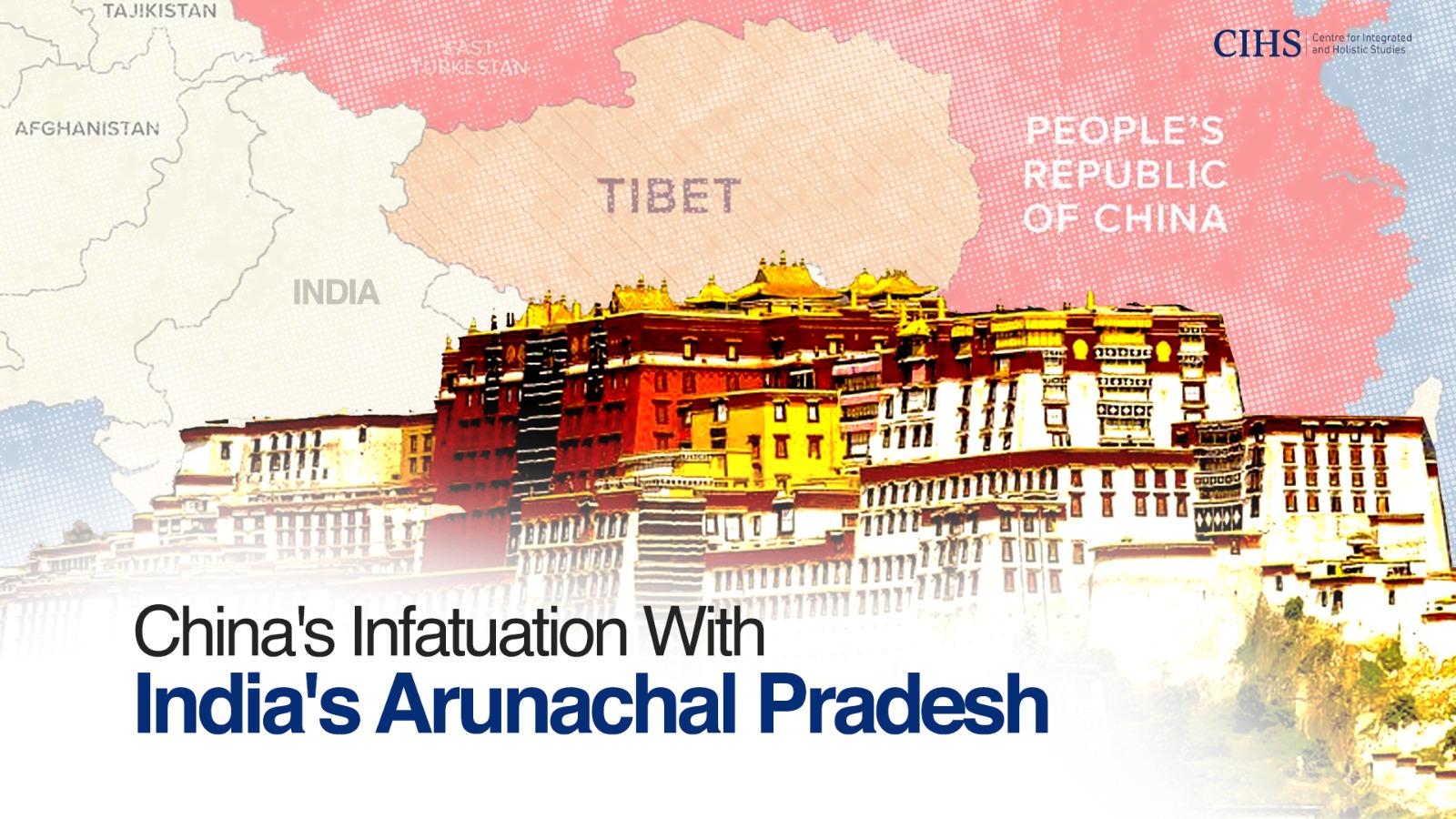


Beijing has spent decades trying to claim a land it has never governed, never administered, and never convinced the world is its own. The infatuation tells us less about Arunachal Pradesh and more about the insecurities driving Chinese foreign policy.
Rahul PAWA | X- @imrahulpawa
The flight to Tokyo was supposed to be the easy part. Pema Wangjom Thongdok had already made the long haul from London. All that remained was a three-hour layover at Shanghai Pudong, a coffee maybe, then the short hop to Narita. She had done this route before, through this same airport, without trouble.
It did not go that way. Last November, Chinese immigration officials at Pudong pulled Thongdok aside, took her Indian passport, studied it, and informed her it was invalid. The problem was not an expired visa or a missing stamp. The problem was a single line on the document: birthplace, Arunachal Pradesh. That, the officials told her, was Chinese territory. She was not, in their assessment, Indian.
For eighteen hours, Thongdok sat in the transit area without food, without explanation, without a boarding pass, pressured to verbally accept Beijing’s position on her own nationality. She would not. The Indian consulate, reached through a desperate call by a friend in England, got her onto a flight that night. Not to Tokyo. To Bangkok. The cheapest seat out of China.
Thongdok is from Rupa, a town of a few thousand people in West Kameng, Arunachal Pradesh. She is Sherdukpen, one of twenty-six tribes whose homeland sits in the eastern Himalayas where India meets Tibet. What happened to her was not a rogue officer having a bad shift. It was the sharp end of a policy Beijing has refined over decades, using visas, accreditation cards, and county registers to wage a quiet, persistent campaign against Indian sovereignty over Arunachal Pradesh.
Since 2005, China has issued stapled visas to Indians born in Arunachal, loose paper slips instead of passport stamps, arguing it cannot grant regular visas to people it considers Chinese nationals. India has rightly refused to accept them. Every stapled visa acknowledged would be a quiet concession that Arunachalis inhabit some grey zone between Indian and Chinese nationality.
In July 2023, three wushu athletes from Arunachal were issued stapled visas for the World University Games in Chengdu. India pulled out its entire team. The same three were then blocked from the Hangzhou Asian Games. India’s Sports Minister boycotted the ceremony. These were young Indians shut out of international sport because a foreign government refused to recognise their passports.
The pattern is older than this generation. In the 1990s, Gegong Apang, then Chief Minister of Arunachal Pradesh, the elected leader of a full Indian state, was denied a Chinese visa on the grounds that as a “Chinese citizen” he did not need one to visit his “own country.” In 1981, the Speaker of Arunachal’s legislature was refused a visa while travelling with an Indian parliamentary delegation because he represented “disputed territory.” Four decades of this. Not a single year in which it became any less absurd.
If the visa regime targets people, the renaming campaign targets the land. Since 2017, China’s Ministry of Civil Affairs has been publishing invented Chinese names for places inside Arunachal Pradesh, places that already have names, used by communities who have lived there for centuries, recorded in Indian revenue maps, marked on Indian military charts. Six in 2017. Fifteen in 2021. Eleven in 2023. Thirty in 2024. Twenty-seven in 2025. Twenty-three more on April 10, 2026, including eight mountain passes of direct tactical significance. Over ninety fabricated names for locations inside a state where Indians have voted since 1952 and the Indian Army patrols every single day. MEA Spokesperson Randhir Jaiswal called the latest batch “fictitious” and “mischievous”: Arunachal Pradesh “was, is, and will always remain an integral and inalienable part of India.”
The timing is never innocent. The 2017 list followed the Dalai Lama’s visit to Tawang. The 2024 batch came the week Indian Prime Minister Narendra Modi inaugurated the Sela Tunnel at 13,000 feet, giving the Indian military all-weather access to the frontier. The 2026 list dropped during active diplomatic re-engagement. Every Indian step that deepens sovereignty in Arunachal is met with a Communist Party of China (CPC) gesture designed to contest it on paper.
Why Arunachal? Because this is really about Tibet. The McMahon Line, drawn in 1914 between British India and Tibet, is the boundary India inherited at independence and has administered ever since. China rejects it not because the line is defective but because accepting it would mean conceding that Tibet possessed sovereign authority to negotiate a border, a concession that would crack the foundation of China’s own claim over Tibet.
Tawang, home to a seventeenth-century monastery that is the second largest in Tibetan Buddhism, sits at the centre of this contest. The 90,000 square kilometres China claims in the eastern sector serve as a permanent instrument of leverage. Every road, tunnel, election, and troop deployment that deepens Indian reality on the ground becomes, in Beijing’s framing, a provocation, because each one makes the truth a little more irreversible. The simultaneous creation of Cenling County in Xinjiang on March 26, 2026, near Pakistan-occupied Jammu and Kashmir, confirms this pressure is orchestrated across the entire frontier.
For all this machinery, the returns have been thin. The United States Senate has passed a bipartisan resolution recognising Arunachal as Indian territory and the McMahon Line as the international boundary. No major government treats the state as legitimately disputed. India has responded with the unhurried work of state-building: roads, tunnels, airfields, schools, elections on schedule, courts in session. The democratic infrastructure of an Indian state, functioning in full view, is the most effective rebuttal to a claim sustained by repetition alone.
China’s infatuation with Arunachal Pradesh has lasted decades. It has produced invented names, stapled visas, harassed travellers, and blocked athletes. What it has not produced is a single square metre of control or a single convert among the world’s governments. Infatuations reveal more about the one who cannot let go than about the object of obsession. This one is no different. From Pema Thongdok’s refusal at Pudong to India’s latest diplomatic dismissal, the answer has not shifted by a syllable. Arunachal Pradesh is India. Not a talking point. A settled, functioning truth.
(The author is an international criminal lawyer and director of research at New Delhi based think tank Centre for Integrated and Holistic Studies (CIHS).

