

Biting the ‘very hand of friendship’ has been Chinese state craft which it struggles to move away from. Its expansionist doctrine rules!
Dr Amritpal Kaur
‘Global Times’ with its linkages to Chinese Communist Party (CCP) did a hit job on Bharat’s external affairs minister Subramanyam Jaishankar and dragged its feet probably as an afterthought.
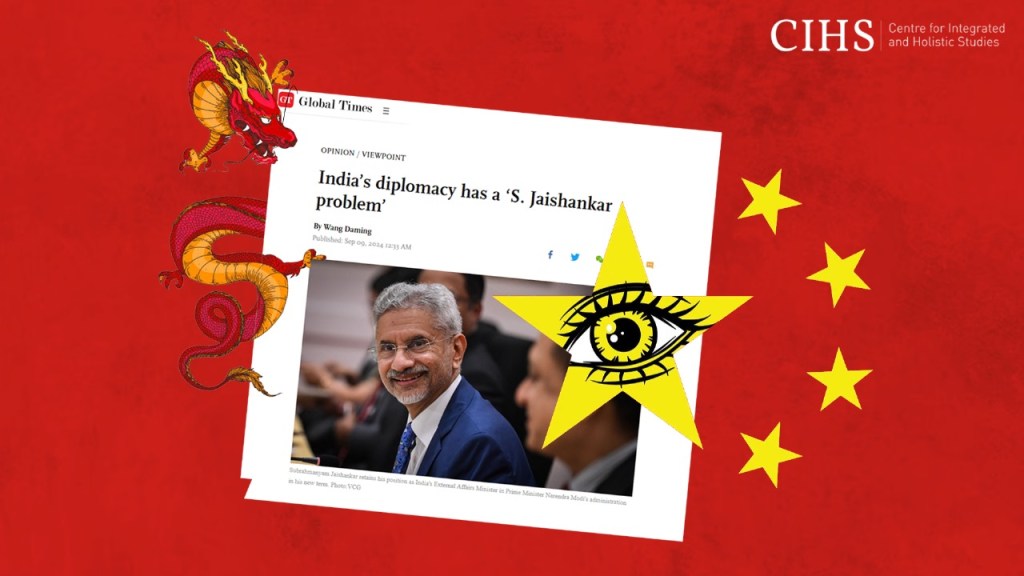
The controversial edit page opinion piece titled ‘India’s diplomacy has a S.Jaishankar Problem’ was pulled down in haste after having published it on September 9, 2024 in its English edition at 12.33 AM.
Well, Chinese Communist Party and President Xi Jingping’s administration may have had second thought while dealing with Jaishankar, arguably one of the finest Indian diplomats and Prime Minister Narendra Modi’s trusted member of ‘A’ team on foreign affairs.
CIHS team had to retrieve it from ‘Global Times’ hit piece written by its international relations expert Wong Daming from the ‘archives’ where it continued to be available.
Why have CCP, President Xi Jingping and Global Times targeted Subramanyam Jaishankar? And, the timing is definitely significant as well.
Mid-way aborted attempt against Jaishankar came ahead of the key meeting that Bharat’s national security advisor Ajit Doval had with Chinese foreign minister Wang Yi in St Petersburg, Russia.
Also, the personally disparaging write up on Jaishankar came after his meeting with Wang Yi, also a member of CPC political bureau.
Last minute change of heart came hours before Subramanyam Jaishankar himself was to speak with Jean David Levitte, former French permanent representative at Geneva Centre for Security Policy.
Global Times spewed venom on Subramanyam Jaishankar at a time when he publicly stated that there’s progress on resolving 75 per cent issues on border issues.
Sweet talking apart and smily photo-ops aside, the tirade against Jaishankar and Bharat by extension from Chinese side is unwarranted and unfortunate. It exposes the devious mindset of Chinese security establishment, political chivalry and expansionist objectives that may not easily go away.
Global Times charge that he is not facilitating normalization of Indo-Chinese economic relations is farce and far from truth. India’s engagement with China is independent of her relations with other countries globally. This naked truth needs to be recognized by China’s deep state.
There is a saying in Hindi ‘what is evident, requires no evidence’ (Pratyaksha ko praman ki avashayakta nahi hoti). Indo-Chinese history after Second World War reflects as to how the propaganda was used by Chinese against India. It was not widely reported at that time, but throughout 1950s, with the issue of Tibet boiling, India was termed as ‘errand dog of British Imperialism’, Chairman Mao himself calling Prime Minister of India Pandit Jawaharlal Nehru ‘a bourgeoisie Imperialist’.
After 2024 general elections, Indian Prime Minister Narendra Modi was termed ‘weak’ by Chinese media. Chinese are known for their ‘psychological warfare’ where they would run propaganda, often false, to picture the opponents in negative light. In this context, criticism against Jaishankar should sound familiar to those who have seen the use of Chinese communist propaganda in full gear.
Outstanding issues with China have surprisingly never changed since the 1950s. The unsettled border was a substantial concern in the Nehru days as it is now. Colloquial wisdom is that good fences make good neighbours, but it does not seem to be Chinese understanding. Had it been the case, then the border would have been settled in 1950s, war of 1962 could have been avoided, the general agreement to keep borders peaceful (which worked well for over 40 years) would not have been breached in 2020 and the need for numerous meetings of Working Mechanisms for consultation and Coordination on China-India Border Affairs would not have been required. The case was otherwise.
Why are the Chinese unwilling to settle border issues? Experts argue that it can be either ‘Salami-Slicing’ of Indian territories, keep strong chips on the table for future negotiations or probably the both. In any case, good neighbours and certainly those who wish to resume ‘normal relations’ mustn’t engage in such covert behaviour. CCP and Global Times expect the world to believe that China was victim of international negative propaganda damaging its stature.
However, consider this; Chinese declared whole of South China Sea as their territory, flouted United Nations Convention on Laws of Seas norms, occupied it and have thrown all others out of the South China Sea by force. Belt and Road Initiative, which was launched with great fanfare, has components runs through the claimed legal territory of other countries and the Chinese by design are oblivious about it.
China has flaunted that it was the largest debt provider for over 100 countries. On the contrary, in the name of debt servicing, it has trapped their lucrative resources or strategic territories as part of its larger expansionist plans. We can go to Prof. John Mearsheimer to understand the Chinese behaviour. He has given the concept of revisionist power. A revisionist power is one which seeks to revise the international order to its liking. It can do so by virtue of being the most powerful state and replace the status quoist power at top of pecking order.
Post-Covid 19, China has been on back foot in global relations as more and more incidents of Chinese underhand are coming to limelight. Concept of near shoring, friend shoring and China plus One gained traction since 2020 that aim to offset dependency of world on Chinese manufacturing.
As Chinese economy shifts gears towards technologically nuanced version preparing itself for the future, slump in growth and resultant slowdown has become a worry for the CCP policy makers. Its outright support to Russia in Ukraine war has not gone very well. Consider further that though China has debt relations with many countries, it has miserably failed to enlist allies apart from Pakistan, North Korea and now Russia.
From Indian perspective, having cordial relations with our neighbours has always been a priority. Bharat’s post-Independence history is testimony to the fact that as much as our capacity would allow us India has gone out of its way to support her neighbours. The neighbourhood first policy is based on this cardinal principle. On the contrary, one would be hard-pressed to find any such example from the Chinese diplomatic relations. General agreement in Chinese intelligentsia is that the middle kingdom syndrome of China would reflect in imposition of vassalage system on its smaller neighbours as and when Chinese dominance came about.
Jaishankar is an old China hand. He has seen the ins and outs of Chinese dealings and to call a spade a spade is his realist training. By definition, realists are known to keep their national interest paramount and every other consideration comes secondary. National Interest and Multi-polarity are the cardinal principles of Indian diplomacy. And, Jaishankar is guilty of exercising both.
We do not live in perfect International system. It is Hobbesian State of Nature. So, if he’s seen as hard-nosed, so be it. Indo-Chinese history should drive home the point that even if ‘the idealist’ Nehru was not spared, the ‘Realist’ Jaishankar will most certainly be not spared by Communist Chinese propaganda vehicles.
(Author is an Assistant Professor in Political Sciences, Dayal Singh College, University of Delhi and Contributing Writer at CIHS)
 CIHS - Centre for Integrated and Holistic Studies