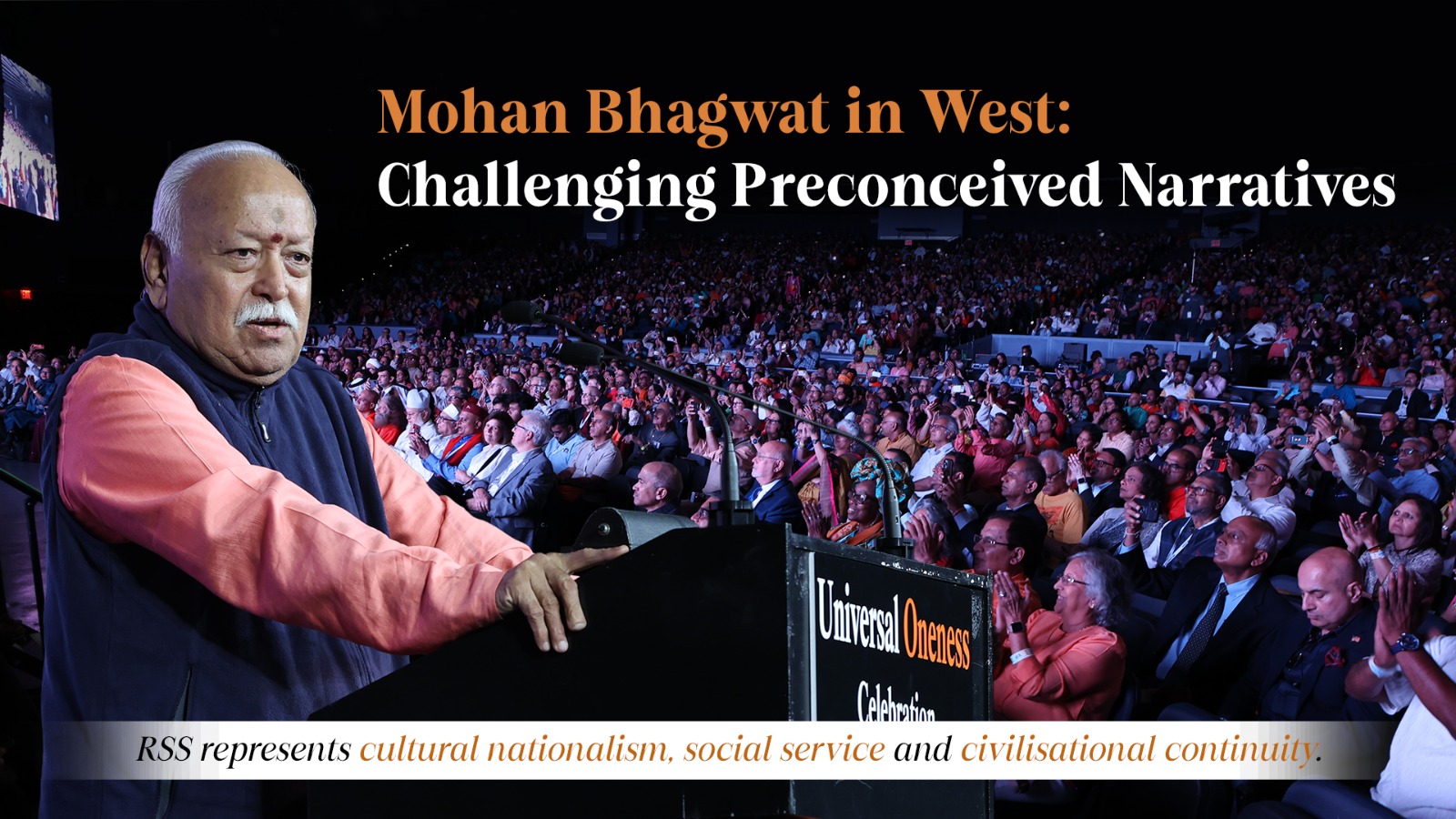


Dr Gautam Kumar Jha
Mohan Bhagwat’s recent journey through United States, Canada and United Kingdom came at a time when Rashtriya Swayamsevak Sangh (RSS) has completed a century of existence and continues to evoke sharply contrasting perceptions, particularly outside India.
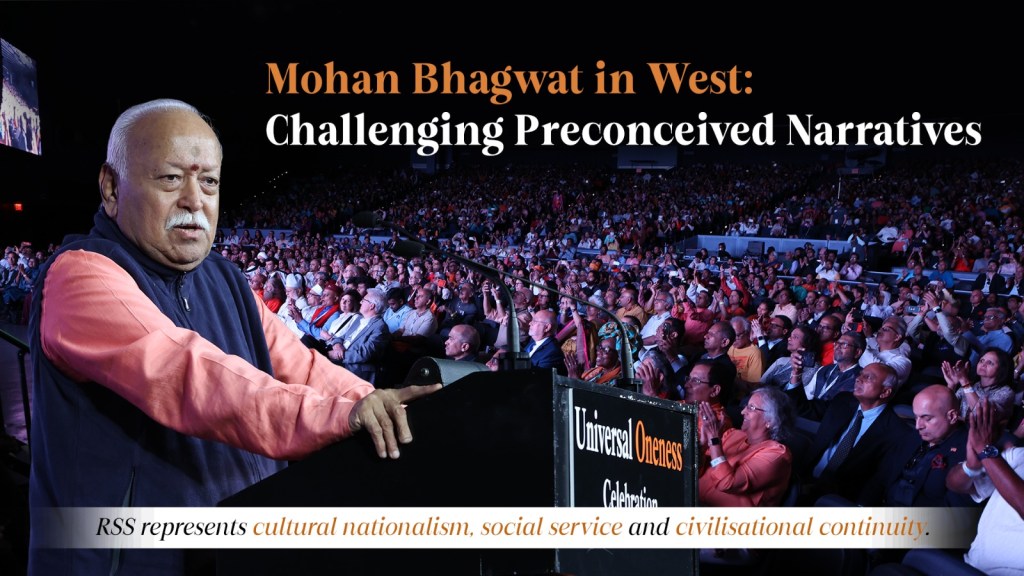
For its supporters, RSS represents cultural nationalism, social service and civilisational continuity. For many of its critics within and outside, however, RSS is viewed through the prism of majoritarianism and religious exclusion.
These differing perceptions were distinctly visible during the tour. His appearances in United States attracted protests and renewed criticism of RSS, including allegations concerning religious freedom. RSS rejects such characterisations while Indian government also contested broader international assessments that it considers selective or prejudiced.
Against this backdrop, Bhagwat’s three-nation tour offered an opportunity for direct engagement and conversation. It did not, and could not, settle every controversy surrounding RSS.
What it did was allow international audiences to hear its chief articulate the organisation’s position on questions that have generated sustained debate: Hindu identity, Muslims in India, religious diversity, the Indian diaspora, civic loyalty and the RSS’s understanding of humanity itself.
Pluralism versus Unity in Diversity
One of the most interesting features of Bhagwat’s American engagements was the connect he drew between two apparently different political and civilisational experiences. United States, he observed, frequently speaks of pluralism while India speaks of unity in diversity. For Bhagwat, diversity and unity are not contradictory: diversity is a natural expression of human society, while an underlying unity binds people together.
At Madison Square Garden in New York, addressing Universal Oneness gathering, he argued that India’s larger responsibility was to demonstrate that unity and diversity could coexist, not merely through preaching, but through practice.
India is extraordinarily diverse in language, religion, ethnicity, food, customs and regional identities. Any conception of Indian nationhood that ignores these differences would therefore be incomplete. Bhagwat instead described diversity as a decoration of an underlying unity and argued that it must be accepted, respected and protected.
More significantly, he extended the principle beyond protecting one’s own identity: just as individuals seek to preserve their own identities, he argued, they must recognise and protect others’ identities. This provides an important counterpoint to binary interpretations of cultural nationalism in which the assertion of one identity necessarily requires the suppression of another.
Muslim Question, Challenging Perceptions
One of the most consequential parts of Bhagwat’s American visit concerned a question that has long surrounded discussions about RSS: the place of Muslims within its conception of Bharat. In New York, Bhagwat addressed the issue in categorical terms, arguing that a Hindu who believes there should be no Muslims in Bharat contradicts the very idea of being Hindu. He linked this position to recognition of different paths towards the same ultimate truth and to respect for the dignity of every human being.
The visit, therefore, placed a clearer version of Bhagwat’s stated position before an international audience. His conception of Hindu identity, as articulated during the tour, was not based on uniformity of race, religion or creed, but on an idea of civilisational belonging capable of accommodating different religious paths.
A particularly interesting response came from an American Christian commentator who said that the controversy surrounding Bhagwat’s visit prompted him to investigate RSS and listen repeatedly to Bhagwat’s speeches.
Explicitly identifying himself as a Christian rather than a Hindu, he remarked that much of Bhagwat’s message resonated with values he recognised in his own faith.
One commentator cannot represent American opinion. His reaction is nevertheless useful because it demonstrates what direct communication can accomplish.
Strong cultural or emotional ties to an ancestral homeland can sometimes raise questions about loyalty to country of citizenship or residence, and Bhagwat addressed this by distinguishing between janmabhoomi and karmabhoomi.
He argued that the country where members of diaspora live, work and build their lives is their karmabhoomi and therefore entails civic obligations. Affection for India as janmabhoomi should not come at the expense of responsibilities towards the society in which they live.
This presents diaspora not as a population divided between two loyalties, but as a bridge capable of retaining civilisational and emotional connections with India while participating fully in another national community.
Over centuries, Indian diaspora has played a crucial role in nation-building and development of countries where they settled. At the same time, many have remained connected to Bharat through what may be described as an enduring cultural umbilical cord. These people-to-people connections have therefore become an important dimension of India’s relations with Western countries.
Political relations may fluctuate, governments and priorities may change, but diaspora communities, educational networks, businesses, families and cultural associations often provide a deeper sense of continuity.
New York to Toronto: Vishwa Bandhu
Bhagwat carried the same broad message to Canada. His visit culminated in the Hindu Vishwa Bandhu programme in Toronto where the emphasis remained on Vasudhaiva Kutumbakam, the world as one family, and on respecting each other rather than erasing diversity.
He made distinction between Vishwa guru and Maha shakti, arguing that India’s aspirations should not be understood merely in terms of becoming a conventional superpower. Instead, he associated India’s historical influence with knowledge, service and a civilisational concern for humanity.
In this understanding, national resurgence need not mean domination over others. Rather, India’s rise should contribute to a more united world, where civilisational confidence goes together with coexistence, respect for diversity and concern for human well-being.
Toronto to London: Celebration of Oneness
Final leg of Bhagwat’s journey took him to London during September 2-7, 2026. British programme broadened the tour from diaspora outreach to a more explicit civilisational and interfaith dialogue. Bhagwat met faith leaders, academics, researchers and other public figures and visited religious institutions including the Shree Swaminarayan Mandir in Willesden and the Khalsa Jatha British Isles Gurdwara. The programme culminated in the ‘Celebrate Oneness’ interaction in London on 6 September, attended by more than 600 participants representing 326 organisations.
Echoing his ‘universal oneness’ message in America, Bhagwat explained that diversity should be understood in relation to an underlying unity. He described apnapan, a sense of belonging expressed through shuddha sattvik prem or pure and selfless love, as a central principle extending from the individual and community to society and humanity.
British leg also sharpened his argument on diaspora loyalty. Asked specifically about loyalty of British Hindus when interests of Britain and India might diverge, Bhagwat said that their loyalty should lie with Britain.
His formulation was unambiguous: karmabhoomi is where one’s loyalty lies, while janmabhoomi and punyabhoomi may remain sources of origin, memory and values. Those values, he argued, are to be lived through service to the land in which one actually resides.
This places cultural identity and civic citizenship in complementary rather than competing categories. Same principle that Bhagwat had expressed in America thus acquired greater precision in Britain: civilisational attachment to India need not translate into divided political loyalty.
For multicultural democracies debating integration, identity and belonging, that distinction deserves attention.
Beyond Preconceived Narratives
Perhaps most important outcome of the three-nation tour was that it opened space for a more balanced discussion about RSS, beyond both unquestioning support and preconceived criticism.
RSS is too large, too deeply rooted and too consequential an organisation to be understood either solely through perceptions of its admirers or entirely through criticisms of its adversaries.
There are legitimate debates concerning Hindutva, secularism, religious minorities and the relationship between cultural and political nationalism in contemporary India. Those debates should continue.
Criticism, however, becomes less convincing when it ignores evidence that challenges preconceived assumptions. Across New York, Toronto and London, Bhagwat placed several propositions before international audiences: that Muslims cannot be excluded from Bharat in the name of Hindu identity; different religious paths and identities should be respected; human dignity transcends religious differences and members of Indian diaspora owe civic loyalty to countries in which they live.
These propositions address some of the principal criticisms directed against RSS. They do not by themselves settle the debate about the organisation, but they make it more difficult to conduct that debate without engaging with what its current chief actually says.
Real Test Is Practice
There is, nevertheless, an important test ahead. At Madison Square Garden, Bhagwat argued that India must demonstrate unity in diversity not merely by preaching it but by practicing it. The same standard can reasonably be applied to RSS itself.
If diversity is to be accepted, respected and protected, that principle must be visible in everyday social relations. If excluding Muslims contradicts Hindu values, that proposition must find expression beyond an international podium.
If civic loyalty belongs to one’s karmabhoomi, diaspora organisations must demonstrate that commitment through participation in and service to the societies in which they operate.
Moreover, if humanity is fundamentally one, political and social disagreements must not reduce individuals to their religious, racial or ideological identities.
This is precisely why the visit to United States, Canada and United Kingdom were important. They took the debate beyond familiar domestic political positions and presented the RSS ideas to wider, more diverse audiences. At a time when societies across the world are struggling with religious polarisation, immigration, race and competing assertions of identity, Bhagwat repeatedly offered a simple proposition: diversity need not destroy unity, and unity need not demand uniformity.
For India, with its extraordinary plurality, that principle is not merely philosophical. It is essential to continued success of its civilisation and democracy. Significance of Bhagwat’s journey, therefore, does not lie in asking the world to stop questioning RSS. It lies in giving the world more material with which to question, understand and judge it and in placing upon RSS itself the responsibility to demonstrate in practice inclusive principles its chief articulated abroad.
(Dr Gautam Kumar Jha, Assistant Professor, JNU and guest columnist with CIHS)
 CIHS - Centre for Integrated and Holistic Studies