

No foreign blueprints. No borrowed reactor. No licensed hull. India built its third nuclear-powered submarine from scratch.
Rahul PAWA | X – @imrahulpawa
The commissioning of INS Aridhaman on 3 April 2026 completes a threshold that India’s strategic community has been working toward for the better part of three decades. With three nuclear-powered ballistic missile submarines now in the active fleet, India crosses from a state that possesses a nuclear triad in principle to one that can sustain it in practice. The distinction matters more than it might appear. A single hull proves a concept. Two hulls suggest a programme. Three hulls represent a fleet, with the rotation depth, maintenance margins and operational flexibility that serious continuous deterrence requires. That this fleet was designed, engineered and built within India, without a foreign prime contractor and without publicly acknowledged technology transfer, places the programme in a category occupied by very few states. The platform’s sovereign character is not peripheral context. It is central to understanding what Aridhaman’s induction actually signals, both regionally and globally.
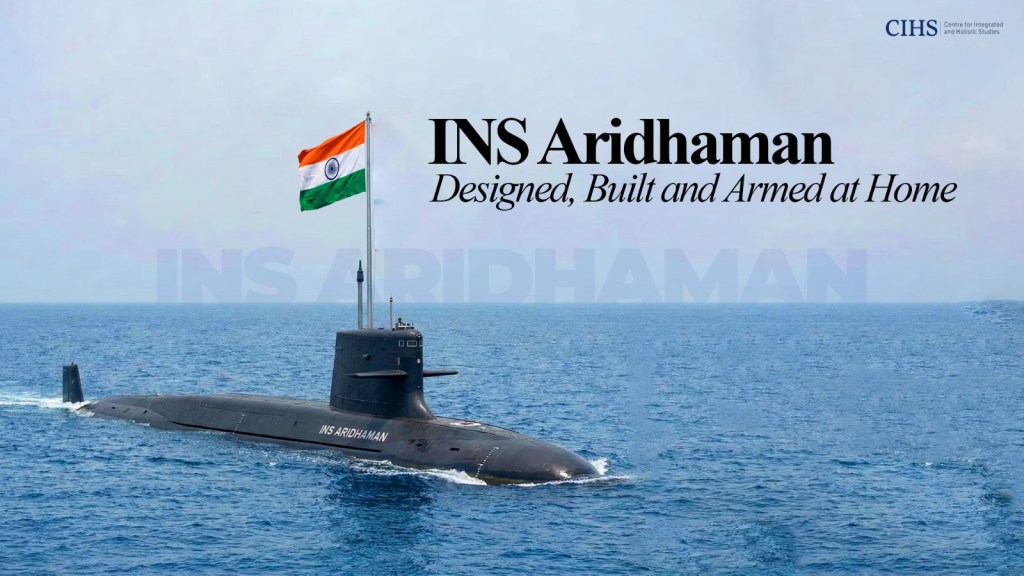
To appreciate what Aridhaman represents, the fundamentals of Submarine Submerged Ballistic Nuclear (SSBN) strategy are worth stating plainly. A nuclear-powered ballistic missile submarine is the sea-based leg of the nuclear triad, and among the three legs, land, air and sea, it is the one that gives deterrence planners the most confidence and adversaries the least. Land-based missiles are fixed, mappable and theoretically destroyable in a coordinated first strike. Aircraft require airfields that can be struck before bombers scramble. A submarine running silent at operational depth in three-dimensional oceanic space presents an entirely different targeting problem. It cannot be located with confidence, which means it cannot be neutralised with confidence, which means any adversary contemplating a nuclear first strike against India must factor in near-certain retaliation from a platform they cannot find. That is the essence of second-strike credibility, and it is the foundation upon which India’s No First Use doctrine ultimately rests. Aridhaman makes that foundation harder to crack and India built it entirely herself.
The boat emerged from the Advanced Technology Vessel programme, one of the most closely guarded and strategically consequential defence programmes India has ever run. Displacement is reported at approximately 7,000 tonnes. The propulsion plant is a pressurised water reactor, almost certainly an evolved version of the 83-megawatt unit fitted in INS Arihant, itself designed and built in India. The missile payload architecture is where Aridhaman steps forward most visibly. The boat carries both the K-15 Sagarika, a two-stage solid-fuel submarine-launched ballistic missile with a range of approximately 750 kilometres, and the considerably more capable K-4, with an estimated range of 3,500 kilometres and a nuclear warhead in the sub-tonne class. Both missiles are Indian. Critically, some reporting attributes eight vertical launch tubes to Aridhaman, against the four fitted in INS Arihant. If accurate, this doubles the platform’s operational magazine, a meaningful increase in what India can hold at risk from a single submerged hull, and a significant qualitative step beyond its predecessors.
The strategic arithmetic follows directly from that technical baseline. A submarine carrying eight K-4 missiles, operating from the Bay of Bengal at patrol depth, can range targets across virtually the entire Chinese landmass. India’s nuclear posture against Pakistan has long been addressed adequately by land-based Agni variants and air-delivered weapons. China presents a structurally different problem. The People’s Liberation Army Rocket Force fields a large and increasingly survivable land-based arsenal. The People’s Liberation Army Navy operates its own SSBN fleet, with Type 094 Jin-class boats based at Yulin Naval Base on Hainan Island, armed with the JL-2 with range sufficient to cover major Indian cities. For India to maintain credible deterrence against a nuclear adversary of that scale and sophistication, it requires a platform that can hold Chinese strategic assets at risk from a position Beijing cannot locate or neutralise in advance. A submerged SSBN operating in the eastern Indian Ocean addresses that requirement on India’s own terms, with India’s own technology.
The question of sustainability is where Aridhaman’s induction carries the most analytical weight. INS Arihant, commissioned in 2016, established that India possessed the scientific and industrial capacity to build and operate a nuclear submarine indigenously, an achievement that took decades of investment to realise. INS Arighaat, commissioned in August 2024, demonstrated that the capability was replicable and that a production line existed. Aridhaman now gives India three hulls in the active fleet, which is the threshold at which Continuous At-Sea Deterrence becomes operationally achievable. CASD, the standard maintained by the United Kingdom and France among others, requires a minimum one submarine on patrol at all times. With three hulls, accounting for maintenance cycles, crew rotations and refit schedules, that standard moves from aspirational to realistic. India has not formally declared CASD status, but the structure of the programme makes the intent evident.
The strategic signalling embedded in Aridhaman’s commissioning operates across multiple audiences simultaneously. For Pakistan, it reinforces an already understood reality: India’s second-strike capability is secure and expanding. For China, it introduces a more capable and considerably harder-to-track underwater threat at strategic depth, one armed with missiles of Indian design and sufficient range to cover targets deep within Chinese territory. For Washington and its partners, it underscores the character of India’s deterrent posture, sovereign in the most complete sense, designed, built and operated without dependence on any external power, which has direct implications for how India’s strategic autonomy is read within the broader Indo-Pacific architecture. Reports of a fourth and fifth SSBN in various stages of development indicate the programme’s ambition has not peaked.
In deterrence theory, credibility rests on two pillars: capability and survivability. India has now demonstrated both, and it has done so entirely on its own terms.
The author is an international criminal lawyer and director of research at New Delhi based think tank Centre for Integrated and Holistic Studies (CIHS).
 CIHS - Centre for Integrated and Holistic Studies