

Intelligence warnings are flashing red. The arrests are piling up. Pakistan does not need a reason to export terror to India. It needs an opportunity. And right now, with West Asia in open conflict, Pakistan’s deep state believes it has exactly that.
Rahul PAWA | X – @imrahulpawa
Every major world crisis has provided Pakistan’s terror machinery with operational cover to strike India, timed with cold precision to moments of maximum international distraction or diplomatic leverage. On March 20, 2000, the eve of Bill Clinton’s arrival in India, 35 Sikh men were lined up and shot dead in Chittisinghpora village in Jammu and Kashmir’s Anantnag district. The terrorists wore Indian Army uniforms and spoke Punjabi and Urdu, a calculated false flag designed to hand the visiting American president fresh images of fabricated Indian Army atrocities in Jammu and Kashmir. It was Lashkar-e-Taiba, operating under the Pakistan Army’s direction and its foreign intelligence agency ISI’s direct command.
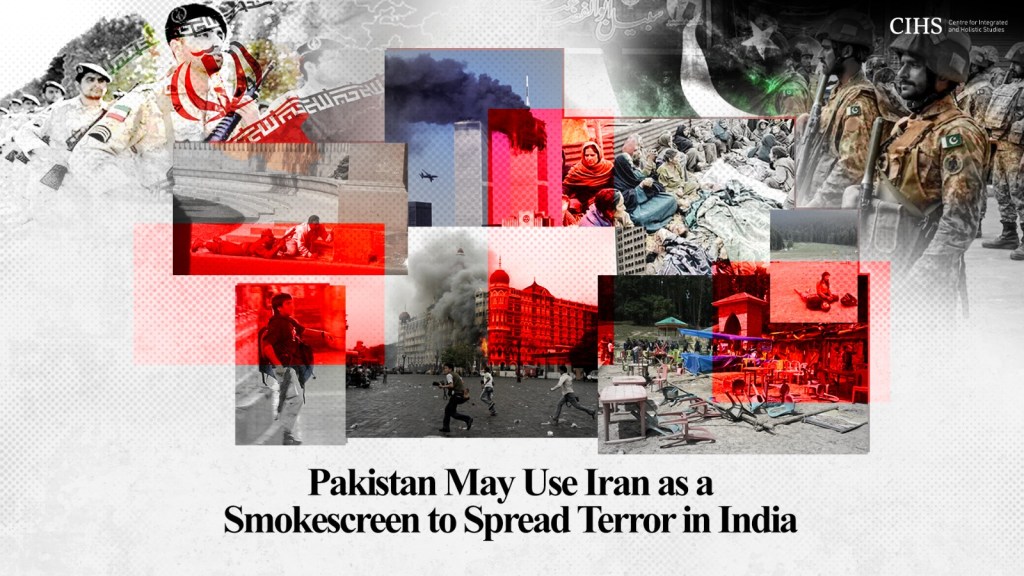
After 9/11, with American attention consumed by Afghanistan and the world watching Islamabad perform as a frontline ally in its “war against terror”, Pakistan’s deep state moved with characteristic audacity. On December 13, 2001, LeT and Jaish-e-Mohammed terrorists stormed the Indian Parliament in New Delhi, killing nine security personnel and nearly triggering a full-scale war. The attack was not opportunistic. It was a calculated attempt to internationalise Jammu and Kashmir at a moment when the world was already in crisis and the Islamic world was split.
In November 2008, as Gaza descended into violent escalation and global Islamic outrage peaked, ten Lashkar-e-Taiba terrorists sailed into Mumbai and held the city hostage for sixty hours, killing 166 people across multiple coordinated sites including the Taj Mahal Palace hotel, Chhatrapati Shivaji Terminus, and the Nariman House Jewish centre. The terrorist attack was meticulously planned, with Pakistan Army and its ISI providing training, logistics, and real-time operational guidance.
This is not Pakistan-sponsored terrorism born of desperation. It was Pakistan Army strategy, executed with maximum cynicism. In 2001 it wore the mask of America’s indispensable ally against terror while simultaneously directing terror at India. Today it wears the mask of a responsible Islamic middle power and self-appointed Iran mediator while running active cells across Indian cities. The mask changes. The target never does.
Domestically, the amendment of Article 370 of the Indian constitution in August 2019 began delivering what Pakistan had spent decades of propaganda insisting was impossible. Pakistani generals watched in horror as peace and normalcy returned to Jammu and Kashmir. Tourism surged. Investment flowed. A new generation of Kashmiris was experiencing connectivity and economic opportunity rather than terror branded as jihad. The Kashmir valley, whose civilisational roots run deep into Hindu tradition, whose saints and ancient temples reflect centuries of Hindu practice long preceding the region’s recent history, was beginning to rediscover itself on its own terms.
The Pakistan Army could not allow this. A peaceful, prosperous Jammu and Kashmir demolished the foundational premise of Pakistan’s existence and its seventy-year investment in terror, war, and propaganda. So it recalibrated and struck. On April 22, 2025, three Lashkar-e-Taiba terrorists armed with American M4 carbines, AK-47s, and a GoPro camera traced to a Chinese distributor and activated in Dongguan fourteen months before the attack, descended into Baisaran Valley and separated Hindu men from their wives and children before executing them in cold blood. They fled before Indian security forces arrived and were hunted down a few months later, with Home Minister Amit Shah confirming their elimination in Indian Parliament on July 29.
From the bodies of attackers, investigators recovered Pakistani voter ID slips linked to Lahore constituency NA-125 and Gujranwala constituency NA-79, and biometric data from Pakistan’s National Database on a micro-SD card recovered from a broken satellite phone. The objective, as evidenced by the immediate operational claim on social media by The Resistance Front, a proscribed outfit and proxy of Lashkar-e-Taiba operating out of Muridke, was precise. Blame Hindus, declare Kashmir exclusively Islamic land, and manufacture an outsider and insider narrative implying that the very Hindus who form the civilisational core of Kashmir since its existence were settlers and occupiers. A fabricated narrative lifted directly from recent collaborators Hamas and Hezbollah’s playbooks in West Asia, designed to erase the Hindu soul of a valley Pakistan has spent decades trying to destabilise.
India’s response was decisive and precise. Operation Sindoor struck nine confirmed terrorist training sites: Markaz Taiba in Muridke, LeT’s headquarters where the 26/11 Mumbai attackers were trained; Markaz Subhan Allah in Bahawalpur, Jaish-e-Mohammed’s nerve centre; the Masjid Syedna Bilal camp in Muzaffarabad; the Gulpur camp in Kotli; the Sawai Nala camp in Muzaffarabad; the Abbas camp in Kotli; the Mehmoona Joya facility of Hizbul Mujahideen in Sialkot; the Barnala camp in Bhimber; and the Sarjal facility at Tehra Kalan, a key weapons storage site. These were not arbitrary targets. They were the nerve centres behind decades of attacks on India including the IC-814 hijacking, the 2001 Indian Parliament attacks, and the 2008 Mumbai carnage.
Pakistan’s response was to have its generals and senior officers attend the funerals of globally proscribed terrorists and then escalate. Pakistani forces deployed KARGU-2 loitering munitions and Bayraktar TB2 drones procured from Turkey and China in waves against Indian civilian and military targets. On the night of May 9 to 10, Indian air defence intercepted a Pakistani Fatah-II hypersonic ballistic missile over Sirsa in Haryana, aimed at targets near Delhi.
In response to Pakistani escalation, Indian armed forces struck eleven Pakistani airbases including Nur Khan in Rawalpindi, the Pakistan Air Force’s central command and logistics hub, Rafiqui in Shorkot, Sargodha’s Mushaf Base, Murid in Chakwal, Skardu in Gilgit-Baltistan, and Bholari in Sindh, degrading frontline squadrons, runway infrastructure, drone hubs, and radar installations across the country. SEAD operations disabled air defence radars in Lahore and Gujranwala. The Indian Navy’s Western Fleet, including an aircraft carrier, repositioned in the northern Arabian Sea within operational range of Karachi.
The intensity and reach of India’s strikes forced Pakistan’s DGMO to call his Indian counterpart and request a cessation of firing. The cessation came into effect at 5pm IST on May 10, 2025. The cessation gave the world the impression of resolution. Inside Pakistan’s deep state, it was treated as an operational review. The lessons were drawn quickly and the adaptations were immediate.
ISI’s post-Sindoor template was not the bearded infiltrator crossing the Line of Control. It was the doctor, the student, the professional, the woman, the illegal migrant with a forged Aadhaar card (Indian National ID). People who do not fit the profile. People who do not trigger the radar. This is not new. Kashmir has seen waves of educated terrorists over four decades. Engineers, teachers, lawyers, and doctors have appeared in terrorist networks since the insurgency’s earliest years.
The Indian Mujahideen model of the 2000s was built on exactly this logic: Indian citizens as operatives, no visible Pakistani fingerprint, homegrown appearance, maximum deniability. What has changed is the geographic reach, the professional seniority of the recruits, and the operational ambition. The so-called lone wolf, when you follow the money, the encrypted instructions, the drone-delivered weapons, and the handler code names, is never actually alone. Behind every lone wolf is a Rawalpindi area code.
By October 2025, ISI had reactivated Lashkar-e-Taiba’s women’s wing Dukhtareen-e-Taiba alongside two associated groups, Dukhtaram-e-Millat and Daur-e-Sofa, explicitly to exploit gender-based blind spots in Indian security. Jaish-e-Mohammed simultaneously began recruiting women from Uzbekistan, Indonesia, and the Philippines as potential suicide bombers, deliberately avoiding Pakistani nationals to preserve deniability before FATF and IMF scrutiny. Intelligence Bureau officials confirmed the strategy: female operatives attract less suspicion, penetrate high-security zones more easily, and when not Pakistani nationals, leave no trail back to Rawalpindi.
The white collar terror network was already operational. Gujarat ATS arrested Dr. Ahmed Mohiyuddin Saiyed, a 35-year-old physician who had completed his MBBS in China, in November 2025 at the Adalaj toll plaza near Ahmedabad. Officers found two Glock pistols, a Beretta, 30 live cartridges, and four kilograms of castor-bean mash, the raw material for ricin, a biological toxin with no known antidote. Saiyed was in contact with Abu Khadija, a Pakistan-based ISKP handler who provided operational guidance and weapons smuggled across the Rajasthan border by drone. The plan was to poison food and water sources in crowded public spaces across Delhi, Lucknow, and Ahmedabad simultaneously. He did not look like a terrorist. He looked like a consultant physician earning ninety thousand rupees a month. That was the design.
Two days later a car bomb exploded near the Red Fort in Delhi, killing fifteen people. The driver was identified through DNA analysis as Dr. Umar Mohammad from Pulwama. The module behind it was the Faridabad cell, comprising radicalised doctors and students associated with Al-Falah University in Haryana, operating under the direction of a Jaish-e-Mohammed operative in regular contact with ISI handlers.
Investigators seized 2,900 kilograms of ammonium nitrate, enough for catastrophic simultaneous blasts across multiple cities. Within the module, a woman, Dr. Shaheen Shahid, had served as lead recruiter, making multiple trips between Faridabad and Jammu and Kashmir to identify and induct members. She was not an anomaly. She was a proof of concept. Intelligence officials confirmed the ricin plot in the south and the Red Fort module in the north were a coordinated two-front ISI strategy, designed to fracture India across two theatres simultaneously, while leaving no visible Pakistani fingerprint on either.
Three months later pro-Pakistan posters appeared at Janpath metro station in Delhi carrying slogans including “Hum Pakistani Hain, Pakistan Hamara Hai.” CISF personnel flagged them. Videos of the postering had already been sent to Pakistan-based handlers as proof of delivery. Eight operatives were arrested, seven of them Bangladeshi nationals on forged Aadhaar cards, working as garment factory workers in Kolkata and Tiruppur. Their interrogation led investigators to Shabbir Ahmed Lone, 43, a Lashkar-e-Taiba commander from Ganderbal operating out of Bangladesh under direct ISI direction from handlers code-named Abu Huzaifa, Sumama Babar, and Abdul Rehman.
Six weeks later Delhi Police Special Cell caught Lone at Ghazipur, entering through the Nepal border. On his person were Bangladeshi taka, Nepali currency, Pakistani rupees, and a Nepali SIM card. A physical inventory of every corridor he was using. Lone had completed advanced LeT training at Muzaffarabad, rebuilt his network from Bangladesh after fleeing in 2019, and directed reconnaissance of the Kalkaji temple and Chandni Chowk in Delhi. His 2016 co-accused Sajjad Gul is today in Pakistan running The Resistance Front, the LeT proxy that claimed Pahalgam. Lone’s interrogation has confirmed that ISI and Lashkar are now building a new terror outfit in Bangladesh modelled explicitly on The Resistance Front, a dedicated proxy to provide deniability for future operations inside India.
Now cast your mind back to March 2000. As India was preparing to receive Bill Clinton, Lashkar-e-Taiba operatives in Indian Army uniforms were lining up 35 Sikh men in Chittisinghpora and shooting them dead. Peak Pakistani diplomatic performance and peak Pakistani terror, running simultaneously out of the same Rawalpindi headquarters. September 11 brought American billions and a frontline ally designation. The Indian Parliament was stormed two months later. Gaza burned in 2008. Ten Lashkar operatives sailed into Mumbai harbour.
The pattern has never varied. Only the global crisis changes. Today that crisis is Iran. Pakistan has once again inserted itself as a self-invited interlocutor, the responsible Islamic middle power, the bridge between Tehran and Riyadh, the voice of reason in a region on fire. Foreign Minister Ishaq Dar has been making calls. Islamabad is cultivating the image of a state too important to isolate and too central to punish. The world’s attention, finite and exhaustible, is flowing toward the Strait of Hormuz.
This is precisely where the predictive becomes operational. A global crisis erupts. The world’s eyes move. And Pakistan, which has never needed a reason to move against India, only an opportunity, moves. The fire is elsewhere. The target, as Shabbir Lone’s five currencies, the Faridabad doctors, the ricin plot, the Bangladesh corridor, and seventy years of unrelenting war by proxy confirm, has never changed.
The smokescreen is already being laid. India’s security agencies have been ahead of it so far. But the deeper problem is structural. A state that runs terror proxies with one hand and peace proposals with the other has never been made to choose between them. Until it is, the smokescreens will keep coming. Only the fire behind them changes.
The author is an international criminal lawyer and director of research at New Delhi based think tank Centre for Integrated and Holistic Studies (CIHS).
 CIHS - Centre for Integrated and Holistic Studies