

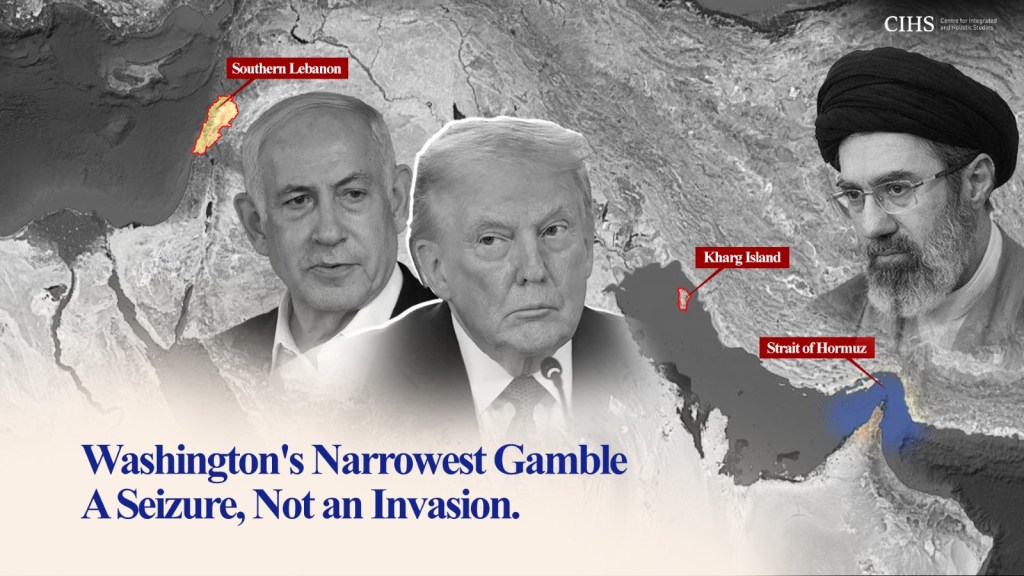
Three places will signal when this war evolves: the Strait of Hormuz, Kharg Island, and the hills above southern Lebanon. Everything else is noise.
Rahul PAWA | X – @imrahulpawa
There is a particular kind of tension that settles over a theatre of war when everything is in place and nothing has yet happened. It is the tension of a held breath. That is where West Asia finds itself today. The aircraft carriers are in position. The Marines are at sea. The Israeli Defense Forces are clearing southern Lebanese hills. And yet the orders to cross into Iran has not been given, and may not be.
Late last week, U.S. Defence Secretary Pete Hegseth confirmed the deployment of roughly 5,000 Marines to West Asia aboard amphibious assault ships, including the 31st Marine Expeditionary Unit sailing from Japan and the 11th from California. An 82nd Airborne rapid-reaction brigade is already in the region. This is the largest American force concentration since the war with Iran began on February 28th. It is not subtle. It is not meant to be.
And yet President Trump, asked directly whether he was considering a ground invasion, said he was not. He spoke instead of being “close to our goals.” His Secretary of Defence said something rather different. Analysts say something different still. This is not necessarily contradiction. It may simply be the grammar of coercion: you do not announce a landing before you need to make one.
What, then, are these forces actually for? The honest answer is that they are for several things at once. They are a signal to Tehran that the cost of continued resistance is rising. They are an insurance policy against Iranian escalation in the Strait of Hormuz. And they are, according to several ground reports, the forward edge of contingency plans to seize Kharg Island, the oil export terminal that accounts for the majority of Iran’s crude shipments, along with the islands of Abu Musa and the Tunbs.
Seizing Kharg would be a surgical act of economic strangulation rather than an invasion in the traditional sense. U.S. air power has already struck the island’s coastal defences, deliberately sparing the oil tanks themselves. The logic is legible: destroy Iran’s ability to sell oil and you destroy its ability to fund a war, without needing to take Tehran. The Marines would be the lock, not the key.
Further north, Israel is pursuing what it sees not as an open-ended war of choice, but as a necessary security campaign with increasingly durable aims. Defence Minister Israel Katz has signalled that Israel may seek to hold southern Lebanon up to the Litani River, roughly twenty miles from the Israeli border. Since mid-March, Israeli ground forces have been clearing villages, bridges, and access routes across a broad arc, with the objective of creating greater strategic depth against Hezbollah and other Iran-backed armed groups. From Israel’s perspective, the logic is clear: push the threat farther north, deny hostile forces proximity to the border, and prevent the northern front from once again becoming a platform for sustained attack. Hezbollah has vowed to resist. What is taking shape, therefore, looks less like a temporary manoeuvre and more like the early outline of a more enduring military posture.
Israel’s calculus is that Hezbollah cannot be defanged from the air alone. Netanyahu has said as much, repeatedly. But holding southern Lebanon is not a surgical strike. It is an open-ended commitment that risks inflaming the region and straining the alliance with Washington, which has its own timelines and its own thresholds. The two campaigns, the American one in West Asia and the Israeli one in Lebanon, are coordinated in broad strategic terms but not necessarily in lockstep.
To the east, Pakistan has quietly closed its border crossings with Iran and reinforced its long held Balochistan frontier. Islamabad is not preparing to join any offensive. It is preparing for the consequences of one: refugee flows, cross-border terrorism, the destabilisation of a region already stretched thin. Pakistan’s deputy prime minister has been making calls, invoking a Saudi defence pact to urge Iranian restraint. The mountains of Balochistan, are not friendly to armoured advances in any direction.
Iran, for its part, is not without leverage. Its missile and drone inventory, numbering in the thousands, remains largely intact. Its networks in Iraq and Syria are on alert. The Houthi rebels in Yemen have declared themselves ready to strike Gulf shipping routes the moment Iran gives the word, threatening to close the Bab al-Mandeb strait as a second chokepoint alongside Hormuz. Iranian officials have warned that any strike on its coastline would trigger naval mining operations across straits, with consequences for world oil markets that no government in the West is eager to contemplate.
Diplomacy has not provided an exit. A fifteen-point Saudi-led ceasefire proposal was rejected by Tehran. Germany and France have said they will not endorse military escalation absent a truce framework. In the United States, public appetite for a ground war in Iran is low, even as polling suggests most Americans expect ground troops to go eventually. That gap between expectation and appetite is the space in which policy is made, and it is a narrow one.
What this moment most resembles is not the eve of a great offensive. It resembles the final hours of a negotiation conducted entirely through the movement of ships and soldiers: a bid to extract a concession from Tehran before the Marines are ordered ashore. Whether Iran will read it that way, or whether it will conclude that the Americans are bluffing, will determine what happens next.
The honest assessment is this. Three thousand six hundred combat troops, divided between two Marine battalions and a paratroop brigade, are not an invasion force for a country of ninety million people and one of the largest standing armies in the region. They are, at most, a raiding party with strategic objectives. Kharg Island. The Hormuz approaches. Time-limited. Defined. Reversible, if things go wrong quickly enough.
Whether that limited operation would remain limited, once begun, is a question no planner can answer with confidence. Wars rarely stay within their original boundaries. The decision to cross the threshold, should it come, will not be made in the Gulf. It will be made in Washington, where the political, diplomatic, and military pieces are still being moved into position.
Until then: watch the Strait of Hormuz. Watch Kharg Island. Watch the ridgelines above southern Lebanon. The next move will announce itself.
The author is an international criminal lawyer and director of research at New Delhi based think tank Centre for Integrated and Holistic Studies (CIHS).
 CIHS - Centre for Integrated and Holistic Studies