

Islamabad called it a military target. International humanitarian law calls it a protected facility. The evidence supports one of those positions.
Rahul PAWA | x – imrahulpawa
At approximately 9 p.m. on 16 March 2026, an airstrike hit the Omid Addiction Treatment Hospital in Kabul, a 2,000-bed drug rehabilitation facility near the city’s international airport, destroying large sections of the building. Afghanistan’s Interior Ministry confirmed 408 dead and 265 injured. Rescue crews were still recovering bodies from the rubble the following morning. The patients were civilians in medical treatment for addiction. Pakistan’s Information Minister said the air force had carried out precise, deliberate, and professional strikes on military installations and terrorist support infrastructure, that secondary detonations clearly indicated the presence of large ammunition depots, and that no hospital, no drug rehabilitation centre, and no civilian facility had been targeted. The factual dispute between Islamabad and Kabul has not been independently resolved. The legal analysis does not require it to be, because under international humanitarian law the evidentiary burden does not rest on the victim. It rests on the state that fired.
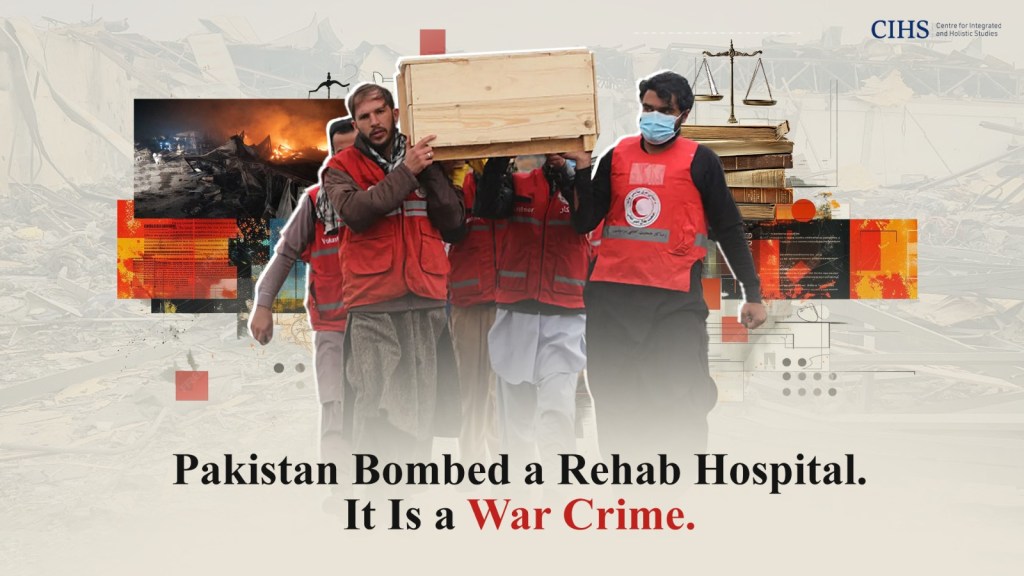
International humanitarian law does not prohibit civilian deaths in armed conflict as such. It prohibits specific categories of conduct, and attacking medical facilities sits near the top of that list. Article 12 of Additional Protocol I requires that medical units be respected and protected at all times. Article 18 of the Fourth Geneva Convention states explicitly that civilian hospitals may in no circumstances be the object of attack. The Rome Statute, in Article 8(2)(b)(ix), classifies intentionally directing attacks against buildings dedicated to medical purposes as a war crime, provided those buildings do not constitute military objectives. Residents and a Reuters journalist present at the site confirmed it was the hospital that was struck, and that the Omid hospital and Camp Phoenix, the former NATO base Pakistan claims to have targeted, were not the same location. The facility held protected status under four separate instruments of international humanitarian law. Its location beside a former NATO base that had been repurposed by Afghan authorities after 2021 does not extinguish that protection.
The central legal question is whether Pakistan can demonstrate that the facility’s protected status had been lawfully forfeited before the strike was ordered. Under IHL the threshold for forfeiture is narrow and procedurally demanding. A medical facility loses its protection only when it is actively used to commit acts harmful to the enemy, not when a state suspects proximity to militants, not when it occupies ground adjacent to a former military installation, but when the facility itself is engaged in hostile military conduct. Even then, a warning must be issued, a reasonable deadline set, and that warning must go unheeded before an attack becomes lawful. Pakistan issued no warning. Its claim that secondary detonations indicated ammunition storage was made after the strike, not before it. Post-hoc assertion is not pre-strike evidence, and the burden of proof rests entirely on the attacking party. Article 50 of Additional Protocol I is explicit: in case of doubt, civilian status is presumed. That presumption applied to the Omid centre. Pakistan made no demonstrated effort to rebut it before firing, which means the strike was unlawful from the moment the order was given.
The proportionality and precaution analysis is an independent and equally serious exposure. Article 57 of Additional Protocol I requires commanders to do everything feasible to verify that targets are military objectives, to select means and methods that minimise civilian harm, and to refrain from attacks where civilian losses would be excessive relative to the anticipated military advantage. These are binding obligations, not operational guidelines. The strike occurred at 9 p.m. in a populated district of Kabul, against a 2,000-bed medical facility, with no warning issued to staff or patients. Pakistan has not defined the military advantage it anticipated, has not quantified it, and has not demonstrated that any proportionality assessment was conducted before weapons were released. The precautionary duties of Article 57 exist precisely to prevent this scenario. They were not discharged.
Pakistan’s stated defences do not survive legal scrutiny. The first is that it struck a legitimate military objective, which requires verified pre-strike evidence of hostile use and established forfeiture of protected status. Neither has been demonstrated. The second is that Afghanistan provides sanctuary to Tehrik-e-Taliban Pakistan fighters, giving Islamabad just cause. This is irrelevant to the targeting legality of a specific building on a specific night. The principle of distinction requires attacks directed at identified military objectives, not at territory as collective accountability for the conduct of armed groups operating there. The third, implicit in Pakistan’s public framing, is that Taliban cross-border attacks on Pakistani civilians provide reciprocal justification. That argument was explicitly and permanently rejected at the Nuremberg Tribunals in 1946. Reciprocity does not suspend the laws of war. An adversary’s violations do not authorise your own.
On the mental element, the Rome Statute does not require proof that Pakistan intended to kill patients. It requires that the attack be intentionally directed at a protected site, and recklessness satisfies that threshold. A commander who orders munitions onto a compound at night, without verifying it is a lawful military objective, without issuing a warning, when a civilian medical population is foreseeably present, has met the intent standard through recklessness even absent specific malice.
On the present public record, every element of the war crime of attacking a protected medical facility is satisfied. The site held protected status. No forfeiture was established. No warning was issued. The proportionality obligation was not discharged. The UN High Commissioner for Human Rights has called for an investigation and for those responsible to be held to account in line with international standards. That call will almost certainly go unmet. Pakistan is not a party to the Rome Statute, and a Security Council referral would face veto from states with their own unresolved targeting exposure. The legal classification and the probability of accountability are two entirely separate questions. The strike constitutes a war crime. Whether that finding produces consequences depends on political will the international community has not demonstrated it possesses.
The author is an international criminal lawyer and director of research at New Delhi based think tank Centre for Integrated and Holistic Studies (CIHS).
 CIHS - Centre for Integrated and Holistic Studies