

Free run given to SFJ that equated Indian Prime Minister Narendra Modi with Iran’s Khamenei reflect insensitivity of US & Canada.
N. C. Bipindra
Latest provocative images and videos posted on social media by Sikhs for Justice (SFJ) have triggered a controversy intersecting free speech, diaspora politics, territorial integrity, global diplomacy and international relations.
SFJ frames its posts and messages as a free speech exercise asserting democratic rights within United States. But, the content portraying Indian Prime Minister Narendra Modi alongside Iranian Supreme Leader Ayatollah Ali Khamenei killed in airstrikes by US and Israel on February 28, 2026 is of serious concern.
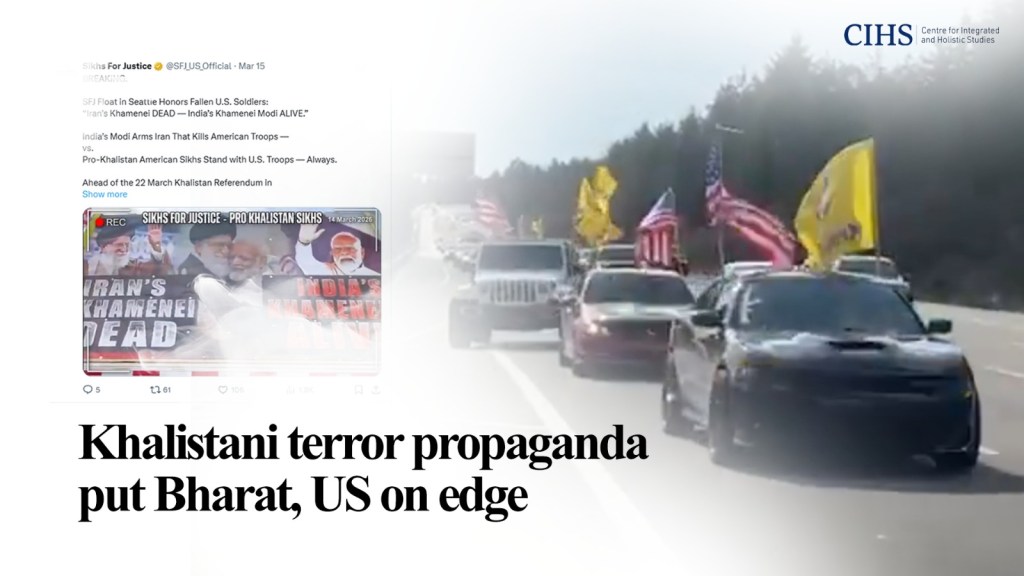
Such messaging not only constitutes indecency and insensitivity but crosses limits and enters the realm of hostile propaganda, incitement of violence, deliberate misinformation and intolerable provocation. US authorities, particularly President Donald Trump, who calls Modi his good friend, should not turn a blind eye to such provocative content.
For New Delhi, such freedom to propagate violence against India’s elected prime minister on US soil should have potential consequences for India-US relations.
To understand why the SFJ’s post and its contents are contentious and objectionable, it is important to consider both the nature of messaging and broader political context in which the proscribed terrorist organisation operates.
SFJ has no ground support in India, particularly the Sikh-majority Punjab province, but it operates freely in US and neighbouring Canada with impunity.
SFJ advocates balkanisation of India, in particular, creation of imaginary Khalistan, a proposed independent theocratic Sikh state carved out of only Indian territories.
An illegal Khalistan map that SFJ has released in last few years conveniently ignores territories that are now part of Pakistan but were historically ruled by Sikh emperors. But, the map includes present-day Indian provinces of Punjab, Haryana, Sikh-majority areas of Rajasthan, Uttar Pradesh and Himachal Pradesh with Shimla as its future capital.
The reasons for not claiming Pakistan’s Punjab and other provinces that were part of the erstwhile Sikh kingdom’s rule are not so difficult to fathom.
Trump administration and Mark Carney government must read two key research reports released by US-based Hudson Institute and Canada-based Macdonald-Laurier Institute (MLI).
Hudson Institute’s ‘Destabilisation Playbook: Khalistan Separatist Activism within the US’ authored by Aparna Pande, Husain Haqqani, C. Christine Fair and others present two main arguments that warrant attention of Trump administration.
The Hudson Institute’s September 2021 report calls for investigations into Khalistani groups’ activities in US noting that these were directly involved in numerous terror attacks around the world including 1985 Air India’s ‘Kanishka’ bombing that left 329 people including Canadians dead and to shed reluctance to act on intelligence provided by India.
MLI’s September 2020 report authored by senior Canadian journalist Terry Milewski, titled ‘Khalistan: A Project of Pakistan’ argues that the separatist movement was designed to subvert national security of both Canada and India, a serious threat that Carney’s government should be vigilant about.
Those two reports would help Western democracies that are open to understand dangers of allowing SFJ and self-styled general counsel Gurpatwant Singh Pannun to be haughty.
SFJ was banned in India in 2019 for threatening its sovereignty and territorial integrity. But, US and Canada are inviting such treacherous tendencies to grow within their territory without realising that the snake they feed would come back to bite them tomorrow, if not today.
Indian proscription notwithstanding, SFJ continues to hold farcical “referendums” in US, Canada United Kingdom and Australia attempting to mobilise sections of Sikh diaspora around Khalistani cause.
The latest social posts along with a video shared by SFJ are controversial due to their tone, tenor and intent. Equating Modi with Ali Khamenei is a clear attempt to draw parallels between a democratically elected popular leader of India and head of a theocratic state, often regarded as adversarial to West, particularly the US.
This can’t be just criticism of Indian government or simply free speech, but rather a deliberate bid to delegitimise and demonise the Indian state, its political leadership and 1.4 billion Indians before the global audience and calling for destablising India through elimination of its prime minister or overthrowing the existing regime.
Hudson Institute and Macdonald-Laurier Institute reports point to “playbook” and “project” against India, its political leadership and its people. In particular, use of “India’s Khamenei Alive” slogan juxtaposed with reference to Iran’s Ali Khamenei is a calculated attempt to evoke hostility, suspicion in US to frame India as a strategic adversary of West alongside Iran.
Contrasting the phrase “Iran’s Khamenei dead” with “India’s Khamenei alive” is suggestive and goes beyond political free speech and commentary. It stops short of an explicit call to assassinate Indian prime minister. It normalises the idea of dastardly outcomes that can be interpreted as endorsement or glorification which is more troubling.
Such rhetoric in democratic societies may not meet strict legal threshold for incitement but is nonetheless considered irresponsible and potentially vicious. SFJ’s post escalates issue by portraying India as an “enemy” of US.
This messaging contradicts reality of India-US ties that have grown into a comprehensive strategic partnership since 2007 encompassing defence cooperation, economic ties and shared strategic interests in Indo-Pacific region grounded in values common to both nations.
SFJ’s narrative-building is an attempt to influence public opinion and policy discourse in the West particularly United States. This messaging is sensitive, as it weaponises diaspora activism to advance geopolitical perceptions. The objection to such content is rooted in broader pattern associated with SFJ activities.
Over the years, the proscribed fringe outfit has carried on inflammatory and divisive campaigns from controversial slogans to provocative demonstrations at Khalistan-related events. Its members have defaced Hindu temples in US and attacked Indian diplomatic missions. These actions have regularly pushed the boundaries of acceptable political expression and free speech.
While some such instances have drawn condemnation in host nations, they highlight the fine line between activism and provocation that governments such as Trump’s and Carney’s should be mindful of. The US may have protection for free speech under First Amendment in its Constitution, but highly offensive and objectionable messages directly incite violence and constitute true undeniable threat.
Legality of SFJ’s latest social media post should never be equated with legitimacy. This crucial distinction between legally protected free speech and provocative, irresponsible and unconstructive messaging in a democratic context is the reason why SFJ’s post is problematic.
For India, the issue is not just legality but has strategic and diplomatic implications. If SFJ and such groups continue to exist and be visible in US, this raises serious concerns about safe havens for anti-India terrorist activities. For that, US and Canada should be designated as epicentres of Khalistani terrorism and American and Canadian states should be treated as sponsors.
Such perception in India could erode all trust that the two nations have built over two decades coming out of the distrust of Cold War era. US and Canada should be sensitive to such an erosion of trust, particularly after India designated such organisations as threats to its national security. Neither Washington nor Ottawa would appreciate similar support from India to outfits that campaign for dismemberment of US and Canada, will they?
Canada’s sympathies for Khalistani terrorists have had derailed carefully built relations of several decades owing to madness of then Canadian Prime Minister Justin Trudeau.
Beyond diplomacy, Khalistan issue is a major concern for India on its security and social cohesion given the violent insurgency it peddled in Punjab. Khalistanis have been active participants of terror attacks including Kanishka bombing. SFJ campaigns and Gurpatwant Singh Pannun’s eccentricity have the potential to radicalise fringe elements among diaspora, particularly in this digital era where amplifying messages across borders and symbolic actions can have real-world consequences.
In an interconnected world, the line between domestic activism and international impact has increasingly blurred making it even more important to balance ‘free speech’ rights with ‘hate speech’ and ensure that neither undermines international diplomacy.
(Author is Chairman, Law and Society Alliance, a New Delhi-based think tank, and guest columnist with CIHS)
 CIHS - Centre for Integrated and Holistic Studies