

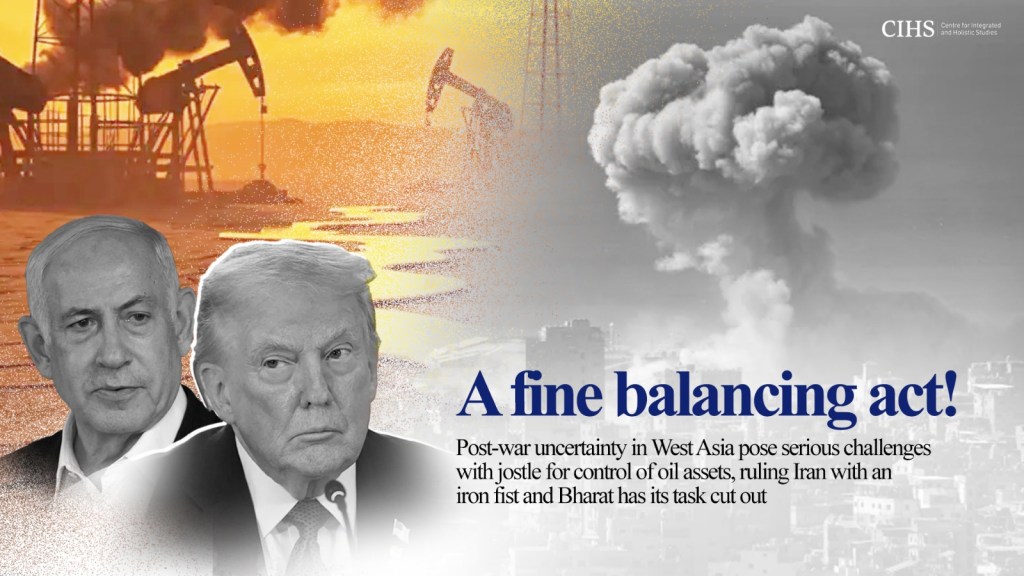
Post-war uncertainty in West Asia pose serious challenges with jostle for control of oil assets, ruling Iran with an iron fist and Bharat has its task cut out.
K.A.Badarinath
US President Donald J Trump’s statement on ‘ending the war’ shortly cannot be taken on its face value. Nor do the markets, stakeholders expect the war on Iran unleashed by both US and Israel to end shortly.
Also, consequences of this two-week war would be too enormous and spread across the globe even if it ended abruptly without key questions answered or objectives met with.
For countries across continents, big and small, developed, developing or under-developed, the impact would be proportional whether one is a party to this war or stayed away.
Beyond loss of lives in thousands, destruction of infrastructure built over a decade in West Asian countries, this war may not yield much substantively.
Well, both Israel’s Benzamin Netanyahu and US President Trump’s ego of sizing up Iran may well be massaged while duo sport victory signs, offer interviews during and after the bloody conflict followed by jostle to win billions of dollars contracts to resurrect the American aligned assets of consequence.
At least till now, the war has not achieved its primary objective of forcing current Shia leadership in Iran headed by Mojtaba Khamenei into submission and object surrender. While President Trump claims a ‘victorious end’ to the war, Iran’s leadership has been defiant and vows to bring the conflict to a close on its terms, timing and the way it deems fit.
The rant that ‘there’s hardly anything left in Iran’ may be to mollify American oil lobby, GCC allies and calm down European Union partners that fear complete disruption of oil and gas supplies into their homes.
Second objective was to install a new regime and completely dismantle the Shias’ religious rule. The stated position was to ring in a more democratic, open, flexible and American friendly regime in Tehran. But, that seems to be eons away. Most interesting is that youngsters’ hitherto opposed to religious leadership and revolutionary guards are not seen on streets of Iran rejoicing anymore.
Instead, the overwhelming sentiment is that ‘Iran be ruled by Iranians’ and not outsiders. This nationalistic outburst amongst ordinary Iranians is something that President Trump and his key advisors did not foresee. Hence, there may not be another Trump-triggered Board of Governance for Iran like Gaza that will take reins in Tehran.
Thirdly, President Trump’s war seems to have the potential to turn tide and bring both Shias as well as Sunnis apart from minority groups in Tehran on one platform as part of a rainbow alliance to take charge of Iranian affairs post-war. Differences notwithstanding, minorities like Azerbaijani Turks, Kurds, Lurs, Balochs, Arabs and Turkmens may consider joining this rainbow coalition. Till now, these minorities have not warmed up to Trump’s idea of taking charge in Tehran without participation of Shias.
Fourthly, there’s a possibility that the rainbow coalition may not run as a puppet government in the hands of European powers and the US, assert itself and chart its own path.
Fifthly, complete isolation of Iran in West Asia from its dozen neighbouring countries in West Asia also may not happen. Bombing of US assets in these countries may not lead to an anti-Iran campaign in the Muslim world. Instead, Islamist narrative may go the other way with Iran seen standing up alone against US and its allies. Will other West Asian countries rally behind Iran to resist takeover by US is a billion dollar question?
Sixthly, anti-American sentiment may trigger larger participation of China, Russia and others in West Asian affairs going forward. Even in reconstruction of Iran, these powers may play a vital role with resources, investments given the strategic importance of pursuing an anti-US line.
Seventhly, in post-war scenario, biggest issue would be exercising control over Iran’s enormous oil and gas assets and Gulf of Hormuz thereby key shipping lines, movement of energy supplies, cargo etc.
Eighthly, post-war, 57-member Organization of Islamic Cooperation (OIC) that positioned itself as united progressive voice of Muslim world may undergo big change to reflect new realities in West Asia.
Rupture in this mega conglomeration is bound to deepen in case the member-countries adopted a radical Islamist agenda, promoted terror and created infrastructure to further such forces of disruption.
Ninthly, reforming banks and financial institutions hitherto run on Sharia principles, neck deep in ‘islamizing the world’ would make Muslims more acceptable as a religious group especially in Western framework.
For countries like Bharat that have not jumped blindly into war hysteria has an opportunity and equivalent challenges in West Asia engagement. About 10-million plus diaspora that are mostly employed with services industry, corporates, financial sector and elsewhere would play a larger role in post-war Iran and other West Asian capitals.
As a peacenik opposed to violence and war, Bharat maintained ‘strategic autonomy’, kept equidistant in the conflict and attempted at bringing warring parties on to one table. When the war ends, Bharat would be most acceptable to play the role of ‘a big balancing power’ in Gulf’s renewed engagement with US and European Union. On economic and development front, Bharat can partner with Tehran sans hesitation.
It’s in the interest of both West Asian economies and India that stability quickly returns to the region and start afresh in Iran’s engagement internationally.
(Author is a veteran journalist, Director & Chief Executive of non-partisan think-tank based in New Delhi, Centre for Integrated and Holistic Studies)
 CIHS - Centre for Integrated and Holistic Studies