

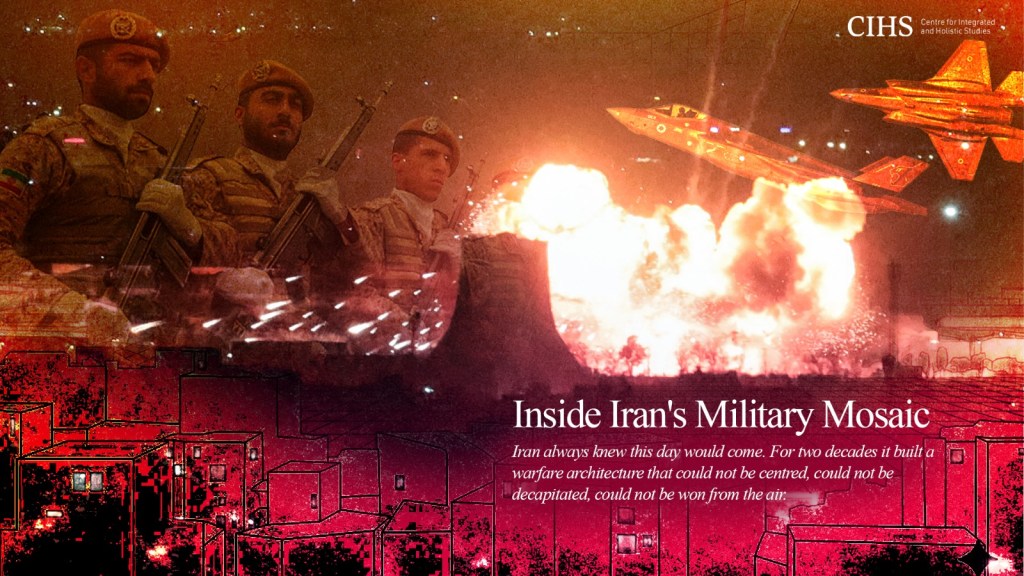
Iran always knew this day would come. For two decades, it built a warfare architecture that could not be centred, could not be decapitated, could not be won from the air.
Rahul PAWA | March 9, 2026 | x- imrahulpawa
On the morning of March 8, 2026, black rain fell on Tehran. The Iranian capital was engulfed in a cloud of toxic smoke that unleashed oil-tainted rainfall dozens of miles away after overnight Israeli strikes hit several fuel depots, causing fires to burn for hours. Four oil depots and a petroleum products transfer center in the Tehran and Alborz provinces were under Israeli fire and damaged, and four personnel, including two oil tanker drivers, were killed. By 10:30 in the morning, cars on Valiasr Street, Tehran’s main north-south artery, still needed their headlights on to navigate the darkness. It was a catastrophic image, and it was designed to be one. But here is what the architects of this air campaign may be miscalculating: Iran was not built to survive this war from the top. It was built to survive it from the bottom. This is the Mosaic Defence, and it is arguably the most consequential military framework to emerge from the Middle East in the past two decades.
Its origins trace back to 2009, when then-IRGC Commander Mohammad Ali Jafari formally reorganised the Revolutionary Guards around a single, haunting lesson drawn from watching American military power eviscerate two neighbouring states. Afghanistan fell in weeks. Baghdad collapsed in three. In both cases, destruction of centralised command produced almost immediate systemic failure. Tehran incorporated those lessons: don’t fight the enemy’s preferred war. The US advantage is high-end airpower, precision strikes, and intelligence dominance. Mosaic Defence tries to make those strengths less decisive by ensuring there is no single headquarters, city, or leader whose loss collapses the fight.
The architecture that emerged is methodical. Each of Iran’s 31 provincial IRGC commanders operates with his own weapons arsenal, logistics chains, intelligence services, and Basij militias, explicitly trained to make independent military decisions, plan attacks, and wage guerrilla warfare without consulting Tehran. The formal language inside IRGC operational culture refers to this as the “operational autonomy protocol,” triggered automatically when central command goes dark. Iranian Deputy Defence Minister Reza Talaeinik confirmed publicly that each figure in the command structure has named successors stretching three ranks down. You kill the general, his brigadier already has orders. You kill the brigadier, the colonel carries on.
On March 1, after Israeli strikes killed Supreme Leader Ayatollah Ali Khamenei, Foreign Minister Abbas Araghchi posted on X in direct, unflinching terms: “Bombings in our capital have no impact on our ability to conduct war. Decentralised Mosaic Defense enables us to decide when, and how, the war will end.” It was not bravado alone. It was a precise articulation of a deeply embedded strategic posture.
The Basij is the human tissue that holds this organism together. Established in 1979 by Ayatollah Khomeini as a people’s volunteer force and now operating as a subsidiary arm of the IRGC, its estimated one million members form the paramilitary backbone beneath the Revolutionary Guard’s 150,000 professional troops. In the coastal provinces, “Ashura” and “Imam Hussein” battalions are organised in towns to operate autonomously, defending designated geographic areas, leveraging proximity to logistics centers and coastal road networks to ensure flexible, rapid movement of combat assets between sectors. These are not conscript armies waiting for radio orders. They have pre-assigned mission packages. They know their terrain the way a farmer knows his field. The strategic calculation is brutally simple: to defeat Iran, you do not take Tehran. You take 31 separate, motivated, geographically embedded armies simultaneously.
Operationally, this manifests in ways that have already unnerved American planners. In February’s “Smart Control” exercises in the Strait of Hormuz, IRGC fast-attack craft swarmed in coordinated patterns, electronic warfare systems blinded radars, and decentralised orders were executed without central authorisation. This is the rehearsal. The Strait, through which roughly a fifth of the world’s traded oil passes, is now overseen not by a single naval command in Tehran but by distributed coastal units that can independently initiate harassment, mining, or blockade operations. The UAE’s Ministry of Defence reported intercepting over 1,400 drones, eight cruise missiles, and 238 ballistic missiles from Iran in under a week of conflict. Some of that volume reflects this posture, not desperation: swarm the adversary’s interception capacity until something gets through.
The darker edge of this framework is its unpredictability under pressure. While disciplined elite units will sustain coherent operations, less experienced units will fall victim to confusion and disorder, raising the risk of uncoordinated strikes and navigation errors that could trigger unintended escalation. The Iranian drone that reportedly struck Oman, a country actively mediating ceasefire talks, illustrated exactly this: autonomous units operating on pre-issued orders with no one in Tehran in a position to call them back in real time.
The oil rain over Tehran, apocalyptic as it appeared, does not break this system. Iran’s oil distribution company confirmed that despite the strikes, sufficient gasoline reserves remained. Fuel disruption to a city of ten million is a genuine hardship and a psychological blow. But Mosaic Defence was never designed around keeping Tehran’s refineries lit. It was designed around the premise that even if Tehran burns, Khuzestan fights, Isfahan launches, and the IRGC navy at Bandar Abbas decides on its own when to close the Hormuz chokepoint.
The question the US and Israel face is not whether they can win a battle. It is whether there is a battle to win. You cannot break a mosaic; you can only rearrange its pieces. And the pieces, right now, are fighting on their own.
The author is an international criminal lawyer and director of research at New Delhi based think tank Centre for Integrated and Holistic Studies (CIHS).
 CIHS - Centre for Integrated and Holistic Studies