

Beijing did not send troops to West Asia. It sent a marketing clip.
Rahul PAWA | x – @imrahulpawa
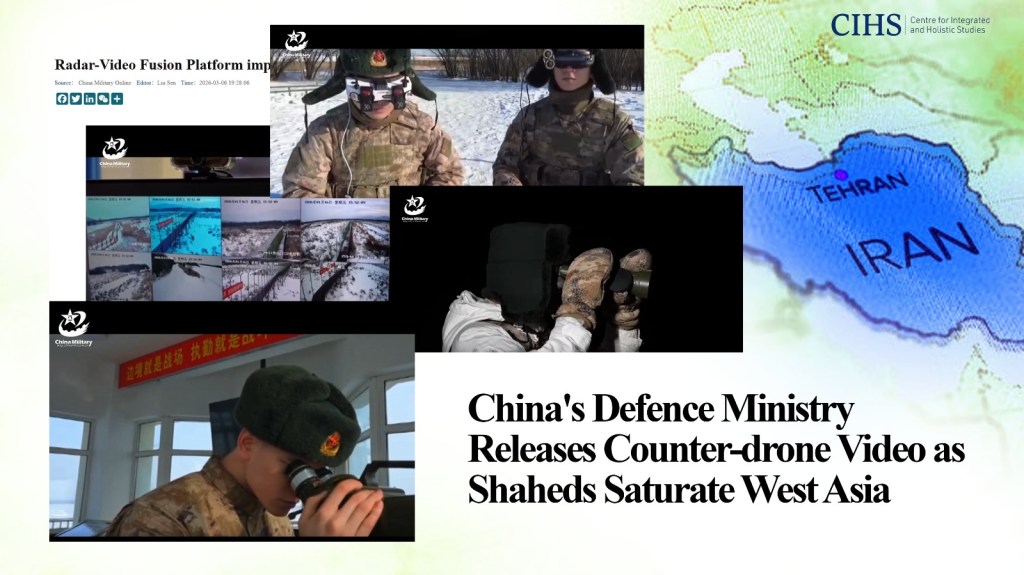
On 6 March 2026, as Iranian Shaheds continued to breach air defences across six Gulf Cooperation Council (GCC) states simultaneously, China’s Ministry of National Defence posted a 35-second clip on its official English-language website. With few sentences about detecting “low-altitude, low-speed, and small aerial targets such as drones.” The timing was surgical. The product was not. This is what Chinese defence marketing looks like in 2026: exploit a live war, insert an unproven system into a panic-driven procurement conversation, and bank on customers too frightened, too indebted, or too technically unsophisticated to ask the right questions.
War That Created the Window
On 28 February 2026, Israel and the United States struck Iran’s military infrastructure under Operation Roaring Lion and Operation Epic Fury. Tehran answered within hours. Operation True Promise IV sent ballistic missiles and UAS simultaneously into Bahrain, Qatar, Kuwait, Saudi Arabia, Iraq and the UAE. Within 36 hours, all six GCC states had been struck by Iran. No drill. No simulation. Nightmare Gulf war planners had war gamed for twenty years arrived at once.
Iran’s UAS campaign did not relent. By 5 March, UAE alone had tracked 1,072 inbound UAS and 196 ballistic missiles. On that single day, 131 aerial threats were engaged over Emirati airspace. Iran’s Shahed variants, types 136, 107, and 238, constituted the bulk of confirmed rounds. The economics were catastrophic for defenders. Gulf interceptors ran between three million and twelve million dollars a shot. A Shahed costs hundreds. Iran could sustain the arithmetic indefinitely. Gulf capitals could not.
Defence ministries across Asia, Africa, and the West Asia drew the same conclusion simultaneously: counter-UAS capability was no longer optional. They needed a system. They needed to procure one publicly. They needed it now. Beijing had been waiting for precisely this moment.
What the Release Actually Says
The MND release is worth reading with forensic care. The Radar-Video Fusion Platform, it states, “combines radar and video means” and is “capable of guiding the video system to conduct real-time tracking once targets are detected by radar.” It identifies “moving ground targets within the designated area” and “low-altitude, low-speed, and small aerial targets such as drones” as its detection targets.
Strip the language and what remains is this: a fixed post, a radar that cues a camera, operating within a bounded area. The system detects and tracks. It does not intercept. It does not jam. It does not kill. No engagement range. No reaction time. No kill mechanism of any kind. This is the front end of a kill chain presented without the kill chain. Against 131 inbound Shaheds in a single operational day, a border camera that hands off to a video tracker is not a counter-UAS solution. It is a perimeter sensor with a marketing budget.
PLA Combat Record That Should End the Conversation
The question of whether Chinese military technology performs under fire is no longer theoretical. It has been answered, repeatedly, in the field, by China’s own export customers. Operation Sindoor, May 2025. Pakistan deployed its Chinese-supplied air defence grid against Indian Air Force strikes. Chinese-made HQ-9 and HQ-16 surface-to-air missile systems failed to intercept a single incoming missile. The YLC-8E anti-stealth radar at Chunian Air Base was destroyed. Wing Loong-II UAS were shot down by Indian air defences. Indian Rafale jets using SCALP precision missiles bypassed the Chinese-supplied grid entirely. PL-15 air-to-air missiles fired by Pakistani J-10C jets either missed or malfunctioned, with some reportedly landing in Indian territory. Pakistan’s defeat was total. Its arsenal was 81 percent Chinese-supplied.
The pattern did not begin in 2025. Myanmar grounded the majority of its Chinese-supplied jets due to radar defects and unresolved structural faults years after delivery. Nigeria returned seven of nine Chengdu F-7 fighters to China for urgent repairs after a series of crashes, then abandoned the fleet entirely and purchased Italian M-346 aircraft instead. Pakistan’s F-22P frigates reported radar degradation, engine overheating, faulty Gimbal Assembly motors, and compromised missile guidance. Chinese manufacturers acknowledged the defects and declined to repair them on any workable timeline. Saudi Arabia acquired China’s SkyShield laser counter-drone system. In desert operational conditions it experienced significant performance degradation. A laser counter-drone platform that fails in desert heat is not a serious military proposition.
This is not a pattern of isolated incidents. It is a pattern of systemic failure across platforms, across countries, across years.
A Camera on a Stick
China’s approach to military exports relies on perception management over battlefield performance. Advanced-looking systems. Orchestrated reveals. English-language portal releases timed to maximum global anxiety. The 6 March video is the template made visible: a border post dressed as a solution, a sensor dressed as a kill chain, published at the precise moment that counter-UAS procurement panic was highest in recorded history.
Radar-Video Fusion Platform may perform adequately on a quiet frontier against a lone surveillance UAS in permissive conditions. That is what it was built for. It was not built to operate inside a Shahed saturation campaign. It cannot engage. It cannot degrade. It cannot stop a single inbound round. Against 131 aerial threats in a single day it can watch and record them arriving. In the Gulf war of 2026, that is not a military capability. It is a camera on a stick.
The release was not written for engineers. Any competent defence engineer notes the absence of an engagement mechanism, reads “within the designated area,” and closes the browser. It was written for procurement officials in anxious capitals under political pressure to show populations that something is being acquired. In that market, Beijing is not selling a solution. It is selling the appearance of one. Based on the record from Islamabad to Lagos to Naypyidaw, the customers are still buying. They just keep finding out what they actually paid for.
(The author is an international criminal lawyer and director of research at New Delhi based think tank Centre for Integrated and Holistic Studies (CIHS).
 CIHS - Centre for Integrated and Holistic Studies