

Pakistan trashed global Ummah at altar of its own selfish interests. Afghan fighters reframed to justify its attacks.
N. C. Bipindra
At the very outset of holy month of Ramadan in February 2026, Pakistan carried out a series of overnight airstrikes across Afghan border characterizing them as “Intelligence-Based, Selective Operations” against seven alleged militant camps linked to Tehreek-e-Taliban Pakistan (TTP).
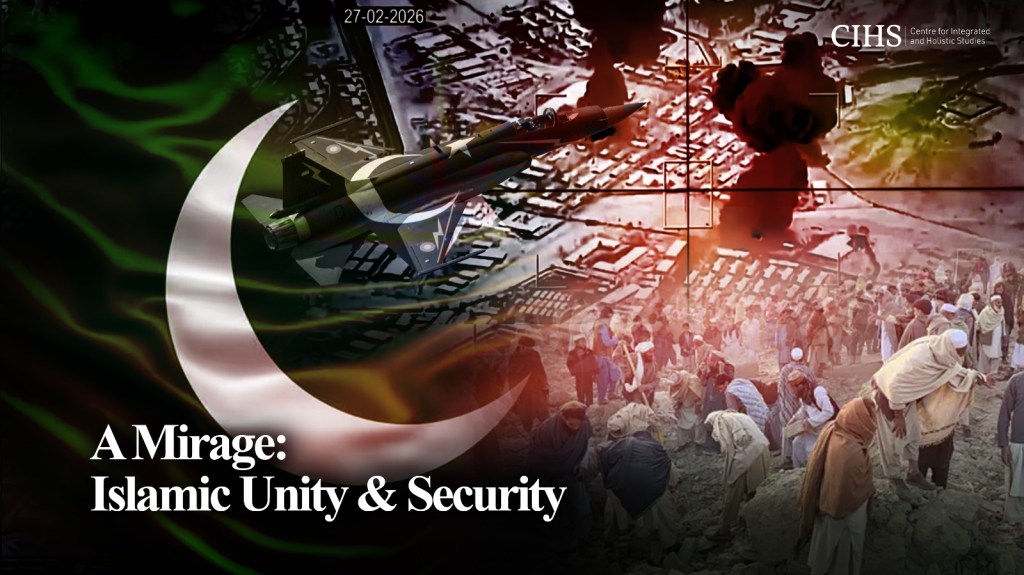
Islamabad stated that the strikes were a retributive response to a wave of recent attacks, including suicide bombings in Bannu, Bajaur and bombing of Khadija Tul Kubra Mosque in Islamabad that killed dozens of worshippers.
Pakistani officials claimed that they possessed “conclusive evidence” that these attacks were orchestrated from Afghan soil and framed cross-border operation as an exercise of state’s intrinsic right to self-defense.
Taliban administration in Kabul, on the other hand, emphatically refuted Islamabad’s claims. Ministry of Defence in Afghanistan asserted that airstrikes targeted civilian residences and a religious educational institution in the provinces of Nangarhar and Paktika, condemning these actions as infringements upon territorial integrity and violations of international law.
In Behsud district of Nangarhar, local authorities and humanitarian organisations reported that between 16 and 18 members of a single family were killed, including an infant aged one year, as their residences were destroyed.
Additional casualties were recorded in other areas, with several individuals presumed missing under debris. International Human Rights Foundation characterised the event as a total “destruction of a familial lineage” and advocated for an independent inquiry into potential violations of international humanitarian law.
Timing of these attacks that coincided with beginning of Ramadan, a month associated with piety, gratitude and community unity, renders the incident of considerable analytical importance.
It exemplifies how, in periods of heightened insecurity, strategic considerations may eclipse religious symbolism, thereby highlighting predominance of national security imperatives over Islamic moral frameworks in the conduct of state affairs.
For decades, Pakistan has projected itself as custodian of Islamic solidarity and proponent of global ‘Ummah’. Through vocal advocacy regarding matters impacting Muslim communities and proposals for collective security frameworks akin to an “Islamic NATO,” Islamabad has meticulously crafted an image of authority and strategic importance.
The term “Islamic NATO” typically denotes a prospective security coalition among nations such as Turkey, Saudi Arabia and Pakistan, drawing inspiration from NATO’s principle of collective defence.
This line is most pronounced in Pakistan’s intricate engagement with Afghanistan. Throughout two-decade-long US-led military intervention in Afghanistan, Pakistan publicly conformed to counterterrorism objectives while concurrently facing allegations from international analysts regarding its maintenance of links withTaliban as a strategic contingency.
The disparity between its collective-security posturing on international stage and its selective partnerships locally has reinforced the perception that such alignments are motivated more by deterrent considerations than by ideological commitments in a dynamically evolving regional context.
However, a meticulous examination of its regional conduct unveils a recurring pattern of inconsistencies, wherein ideological discourse frequently diverges markedly from geopolitical actions.
This dissonance prompts essential inquiries: If Islamic unity and collective security serve as the foundational principles underlying proposals such as an “Islamic NATO,” how can one reconcile these ideals with military operations against a neighbouring Islamic nation?
The resolution resides not in ideological frameworks, but in strategic calculations. Historically, Pakistan’s foreign and security policy has been primarily influenced by national interests, managing border security and ensuring internal stability, rather than adhering to a coherent Pan-Islamic solidarity.
During Soviet–Afghan conflict of ‘80s, Pakistan seemed desperate to lead as principal operational base for Afghan mujahedin, accommodating millions of refugees while acting as primary channel for international assistance.
Islamabad allocated billions in covert financing and expedited training of anti-Soviet fighters. This era significantly entrenched influence of security establishment in Afghan affairs and institutionalized Pakistan’s enduring engagement in cross-border militancy.
Pakistan’s involvement with Taliban transcended passive tolerance. Throughout 1990s and again post-2001, it afforded diplomatic leeway and established cross-border networks that enabled the movement’s consolidation, viewing a favourable regime in Kabul as pivotal to curtailing Indian influence and ensuring strategic depth.
The presence of Taliban leadership on Pakistani territory and the group’s battlefield capabilities were inextricably linked to these supportive frameworks.
Nevertheless, following Taliban’s resurgence in power during 2021, bilateral relations soured. Instead of providing strategic depth and border stability, Taliban administration opposed Pakistan’s intent to control the regime and increased cases of border fortifications along Durand Line.
As assaults within Pakistan escalated, Islamabad’s rhetoric underwent a pronounced transformation. Officials and state-affiliated clerics commenced labelling anti-state militants as “Khawarij,” invoking a classical Islamic term historically linked to an early sect that opposed authority of Hazrat Ali (RA).
By employing this designation, the state aimed to religiously delegitimise TTP, framing it not merely as a militant entity, but as a deviant faction that had drifted from doctrinal tenets of Islam.
This terminological shift holds considerable political implications. A movement once framed within narratives of Islamic resistance was recast as religiously deviant once it threatened Pakistan’s internal security, illustrating how ideological language adapts to strategic necessity.
The state has formalised this rebranding effort by prohibiting religious honorifics such as “Mufti” and “Hafiz” for individuals associated with proscribed organisations and by officially appending the designation “Khariji” to their identities.
By reframing counter-insurgency as a safeguard of Islamic authenticity rather than merely a security campaign, authorities sought to strip militants of symbolic religious capital, undermine their claim to “defensive jiha” and mobilise clerical support, proving once again that while religious framing shifts with circumstance, national interest remains the steadfast constant.
Ultimately, Pakistan’s strategic stance embodies not merely a selective approach but rather a manifestation of strategic amnesia. The rhetoric surrounding ‘Ummah’, Islamic unity, shared dignity and mutual security, is invoked when it enhances diplomatic stature, yet recedes when it impedes critical security decisions.
Ramadan airstrikes into Afghanistan, undertaken during a month associated with piety, restraint, forgiveness, and communal solidarity, illustrate this contradiction starkly: Religious symbolism yielded to national security doctrine.
From advocacy concerning Muslim issues to proposition of an “Islamic NATO”, a collective defence arrangement among Turkey, Saudi Arabia, and Pakistan, modelled after NATO’s principle of mutual defence, Islamabad has persistently positioned itself as the proponent of Islamic strategic cohesion.
Although such rhetoric cultivates an impression of a consolidated Muslim defence and shared strategic objectives, Islamabad’s concurrent willingness to engage unilaterally against a neighbouring Muslim nation reveals inherent limitations of that vision. The notion of collective Islamic security appears to be aspirational in theoretical discourse, yet it remains conditional in practical application.
The same pattern emerges in broader geopolitical manoeuvring, including balancing relations with Iran while engaging major powers such as United States. Henceforth, strategic geography, intelligence cooperation, and military alignment become negotiable assets when state interests necessitate recalibration.
From historical support for Afghan militancy to theological rebranding of insurgents at home, the trajectory is consistent: ideology supplies the vocabulary, but strategic calculus determines policy. The ‘Ummah’ thus functions less as a fixed moral compass than as a flexible narrative device, remembered when useful and forgotten when inconvenient.
(Author is Chairman, Law and Society Alliance, a New Delhi-based think tank, and guest columnist with CIHS)
 CIHS - Centre for Integrated and Holistic Studies