

Currency, oil, bullion, commodities markets volatility, contraction in consumption demand, disruption in supply chain, uncertainty on external front may be felt in medium term across geographies.
K.A.Badarinath
None can vouch for global economic certainty in medium term given about half a dozen conflicts happening simultaneously. Most of them are bloody and involve loss in large number of human lives, property, infrastructure and stunting military capabilities.
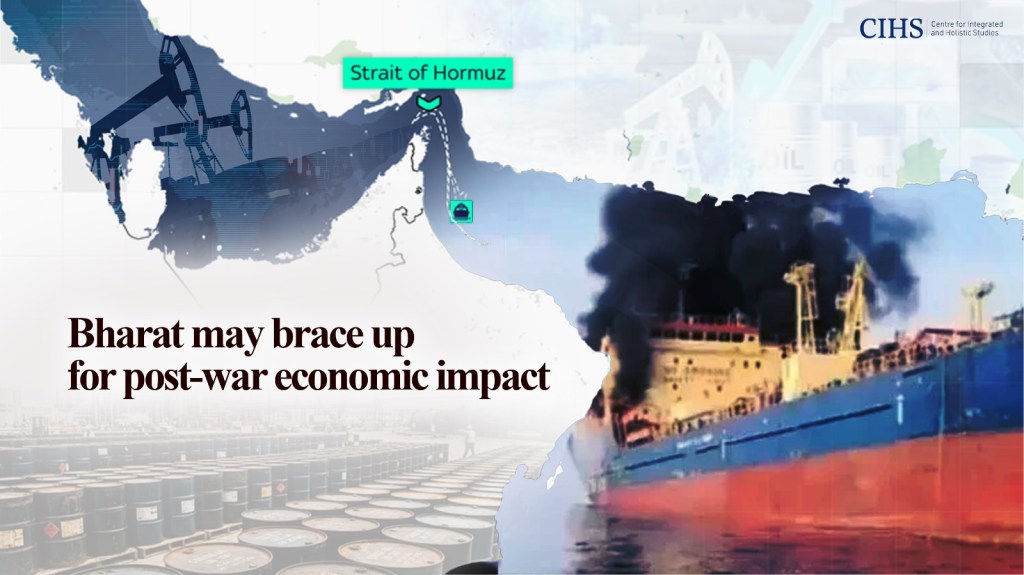
While Russia – Ukraine conflict has done four years and there’s no sign of end coming anytime soon, several analysts have reason to believe that Iran, US – Israel war may continue for quite a while with ripple effect.
Refrain in most circles is that US will not have a cake walk in meeting its avowedly stated objective of change in regime run by the religious leadership with political authority since the revolution of 1979 in Iran.
It’s not like paying off the security apparatus, walking into Venezuelan President’s home on January 3, 2026 and bundling off the incumbent head of the state Nicholas Maduro and fly him off to an unknown destination.
US must have prepared itself for a long haul given the kind of naval mobilization it has done around Iran in conjunction with Israel’s leadership led by Benjamin Netanyahu. Stated objective of both US and Israel is to deny Iran the capability to produce nuclear arsenal and redraw power equations in West Asia thereby trimming the Russia – China axis in the region.
Other theory is that President Trump and his Republican ‘A’ team running the White House was after huge hydrocarbon reserves that Iran holds with its oil wealth exceeding 157 billion barrels. It’s also to secure complete authority on movement of commercial and naval ships in the narrow lanes of Gulf of Hormuz. Quixotic President Trump seems to have tasted blood by taking control of Venezuelan oil industry for American deep state and its cohorts.
Even if high pitched, technology driven war comes to a close in couple of weeks – twelve days it took to end the conflict between Iran and Israel during June 13 – 26 last year – repercussions will be for the entire humanity to be felt while it’s become a virtual mute spectator as of now.
Though some countries in Europe have threatened to join the bloody war, others have mostly been watching destruction of city after city in entire West Asia including Israel from side lines as of now.
Especially after reported death of Iran’s supreme leader Ayatollah Ali Khamenei, the war has spread its destructive tentacles across West Asia thereby bringing entire air travel, common waterways, ports, airports and transport infrastructure to a virtual standstill.
Over last two days alone over 2000 flights in the region were impacted due to the war. Travel on roads, rail and waterways network has become insecure and unpredictable with missiles flying across zones. Hospitality industry has been halted. Commercial enterprises dealing with goods and services across the region have been impacted big time. Millions of professionals running commercial enterprises in the region have suddenly become vulnerable and restless.
Even as painful process of electing a new supreme leader supported by three member council in Iran got into motion, there seems to be no let-up in bombardments by US and Israel while Shia leadership of Iran retaliated with large bouquet of missiles targeting half a dozen capitals, ports and airports apart from energy facilities in eleven countries.
Oil markets with epicentre in West Asia have fluctuated wildly with Brent crude quoted at US $ 78.72 – 81 in the spot market on Monday, cargo insurance risks hitting the roof. Currency markets also experienced huge fluctuations given that financial capital in West Asia, Dubai came under missiles attack from Iran. For instance the green buck was quoted at 91.45 apiece against Indian rupee on Monday as markets opened for nervous trading across the region.
From Indian perspective, alarm bells on possible economic impact are yet to ring in. Currency and oil markets fluctuations may not make adverse impact on Bharat’s economy with the financial year closing this month end. Given that the country holds over 74-days strategic and commercial crude reserves, oil prices crossing US $ 80 per barrel may not be felt big. Reports and independent analysts hint that Finance Minister Nirmala Sitharaman had factored oil prices of US $ 60 – 62 per barrel when she presented her federal budget on March 1.
In case, volatility in both spot market and long term crude contracts persisted, India would feel the heat in medium term. Given its huge import dependency in crude, the country will have to cough up an additional US $ one billion against every dollar hike in oil prices.
Thankfully, Bharat’s economy has the resilience to absorb temporary shocks in oil and currency markets as fall out of bloody confrontation in West Asia, Russia – Ukraine and Afghanistan – Pakistan. Given increasing future premiums on cargo movement, currency swaps and oil going forward, combined impact of wars are likely to reflect in medium term.
As the federal borrowings were much below budgeted Rs 14.82 lakh crore, bountiful goods and services tax (GST) collection of Rs 1.83 – 1.93 lakh crore each month, Narendra Modi government is on top of the situation to overcome combined impact of wars at least for next two quarters.
Also, since federal expenses were much within the budgeted Rs 50.65 lakh crore and even if last two months (February – March 2026) spending rush was experienced, macro-economic numbers may not go haywire. During April 2025 – January 2026, federal expenditure has not crossed Rs 36.90 lakh crore.
Weakest link in managing aftermath of wars would be external trade sector where export of services and merchandise goods may face uncertainty with sentiment being very low, demand contraction for consumption and payment crises looming large.
A part of demand contraction can be made up by India’s infrastructure majors that could tango with international partners to strike post-war reconstruction deals spilling over billions of dollars.
Gearing up to face the war consequences in medium term should be prioritized as economic agenda by Narendra Modi government.
(Author is a veteran journalist, Director and Chief Executive of non-partisan think tank, Centre for Integrated and Holistic Studies based in New Delhi)
 CIHS - Centre for Integrated and Holistic Studies