

Prime Minister Narendra Modi’s visit to Jerusalem would take bilateral relations to next level, expand engagement on security, technology.
Paushali Lass
Prime Minister Narendra Modi’s visit to Israel on February 25-26 is not a ceremonial by any stretch of imagination. It is a strategic engagement focused on defence alignments, long-range missile collaboration and technology integration vital for a country facing challenges on multiple fronts.
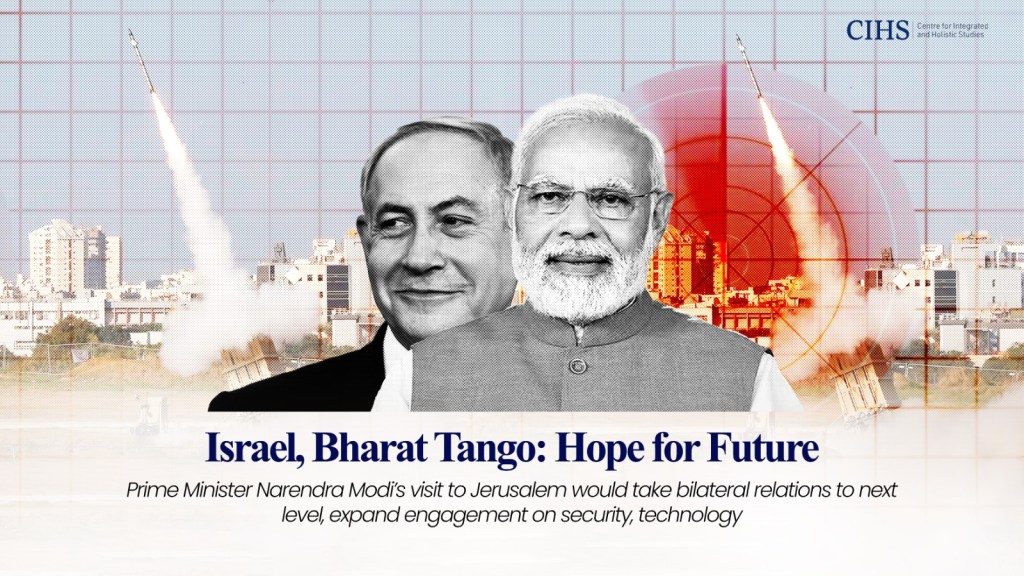
India faces a complex security environment from cross-border terrorism to proliferation of precision-guided weapons. Prime Minister Modi’s visit is an effort to deepen cooperation in missile defence systems, drones, AI-enabled systems and integrated surveillance, reflecting a partnership grounded in operational experience and strategic foresight.
Beyond defence, the engagement strengthens technological collaboration, economic growth and opens the door for people-to-people exchange.
Strategic synergy beyond procurement
Prime Minister Narendra Modi’s itinerary includes an address at the Knesset, participate in an innovation forum congregation at Jerusalem and pay respects at Yad Vashem. It highlights three pillars of India‑Israel relations: political trust, technological cooperation and shared understanding of existential threats.
As Prime Minister Benjamin Netanyahu has noted, the partnership has evolved beyond trade calling Indian Prime Minister a “dear friend” with the two countries increasingly co-developing capabilities that will shape future security.
For decades, India relied on importing military platforms from several sources including Israel. Today, under framework of Atmanirbhar Bharat, India’s initiative for self-reliance and domestic capacity building, the focus is on integration, co-development, and locally scaling up. Israeli expertise in missile defence, surveillance, drones, cyber systems and AI aligns with India’s modernisation goals.
The aim is not dependence but absorption, embedding Israeli know-how into Indian-built systems so that the capability multiplies across country’s industrial base.
The scale of India’s ambition is reflected in its defence spending. With an allocation of ₹7.85 lakh crores (roughly $94 billion) in 2026-27 budget, the country is signaling a decisive pivot toward intelligent systems rather than standard, ready-made solutions.
Israeli defence technology firms hold a distinct advantage for India: they are not merely manufacturers of hardware but providers of battle-proven operational expertise. As India seeks to integrate artificial intelligence across land, air, sea, and underwater domains, Israeli software embedded within Indian manufacturing offers a pragmatic and scalable solution.
Joint research centres and co-development hubs expected from this visit could accelerate precisely this process, enabling India to deploy these systems domestically at scale rather than import in fragments.
Timing of Modi’s visit to Israel after eight years is also crucial. Pakistan continues to expand missile and drone capabilities often supported by Chinese and Turkish systems. Turkey’s alliance with nuclear-armed Pakistan, combined with its regional expansionist ambitions, poses a strategic challenge to both Israel and India, making closer collaboration between the two essential.
Moreover, low-cost unmanned platforms and precision-guided munitions are proliferating globally, reshaping warfare. Traditional measures such as troop numbers or heavy armour matter less than integrated air defence, rapid detection, and automated response. India’s Mission Sudarshan Chakra and similar initiatives illustrate this transformation. Israel’s systems, refined through decades of real-world threats, offer India operational lessons it cannot afford to ignore.
Visit Not Without Critics
Modi’s engagement with Israel has drawn criticism at home, largely framed in moral terms. Some opponents characterise closer ties as complicity citing alleged genocide in Gaza. As someone who has been to Israel multiple times since the start of Gaza war and witnessed the impact of terrorism first-hand in Israel, such claims deserve scrutiny, not simple slogans.
Gaza conflict began on October 7, 2023, when Hamas carried out the deadliest massacre of Jews since the Holocaust, killing Israelis and also foreign workers. Hamas embeds fighters in dense civilian areas and its charter openly calls for Israel’s destruction.
Civilian casualties in urban warfare are tragic but do not constitute genocide. Israel’s military targets an armed organisation that deliberately shields itself with civilians. Hamas, the governing authority in Gaza could have turned its vast network of terror tunnels into bomb shelters but did not.
Meanwhile, Israel invests heavily in Iron Dome technology and shelters, ensuring its citizens survived relentless Hamas and Hezbollah attacks since October 2023. A nation that prioritises human life is exactly the kind of partner India should engage with.
Interest over Ideology
India must anchor foreign policy in national interest and not on slogans. Our country has endured cross-border terrorism and asymmetric warfare for decades. We understand importance of protecting civilians while confronting non-state actors embedded among them. Israel’s lessons, defending cities, protecting infrastructure and responding to missile and drone saturation are directly relevant to India. Strategic partnerships exist to ensure security and survival, not to serve as moral litmus tests, often based on one-sided narratives.
India-Israel relationship extends beyond defence. Both nations are diverse democracies thriving on innovation and cooperation in agriculture, water management, cyber security and start-ups demonstrates how complementary the ecosystems are. Deep engagement offers military, economic, and scientific dividends, and even opens doors for people-to-people interactions.
A Hopeful Future
For me, Modi’s visit is just the beginning of something much bigger. It signals continuity in strategic thinking and offers the possibility of a deeper connection between our peoples. Beyond missiles and AI systems, Indians and Israelis can see each other, travel, meet and engage directly, moving beyond defence deals. We share more than we think, civilisational roots, cultural diversity and commitment to pluralistic societies.
This human dimension of diplomacy is as important as defence and technology. Strategic alignment and civilisational exchange can go hand in hand. A future when citizens of both nations recognise and appreciate each other’s societies, discover despite differences, we share more in common than is often assumed, in culture, history and the richness of diversity.
(Paushali Lass is an India-born intercultural educator, writer and international speaker based in Germany. She authored Tasting Faith: Jews of India and works to build cultural and business bridges between Israel, Germany and India)
Reference:
- https://www.jpost.com/israel-news/article-887519
- https://www.ndtv.com/world-news/partners-in-innovation-security-israel-pm-netanyahu-on-pm-modis-visit-11122393
- https://www.airforce-technology.com/news/iai-dcx-jv-india/?utm_source=&utm_medium=6-259889&utm_campaign=&cf-view&cf-closed&cf-view
- https://www.pib.gov.in/PressReleseDetail.aspx?PRID=2221612®=6&lang=1
- https://www.orfonline.org/expert-speak/drone-warfare-contrasting-india-pakistan-tactics-and-capacities
- https://www.journalijar.com/uploads/2025/10/690f012f94934_IJAR-54613.pdf
- https://www.sajr.co.za/wp-content/uploads/attachments/sajr-hamas-charter-analysis.pdf?sfvrsn=2
 CIHS - Centre for Integrated and Holistic Studies