

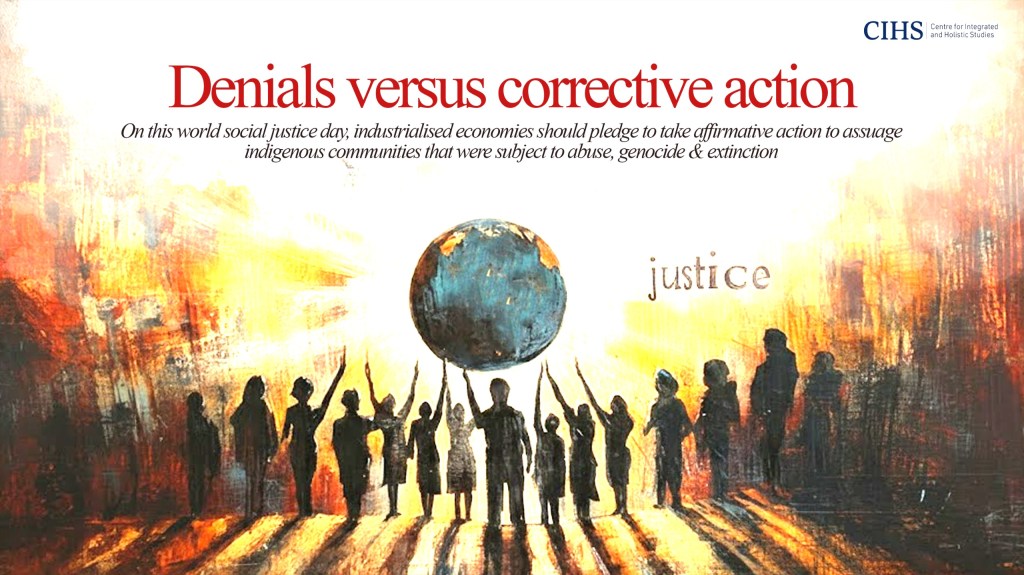
On this world social justice day, industrialised economies should pledge to take affirmative action to assuage indigenous communities that were subject to abuse, genocide & extinction.
Rohan Giri
World Social Justice Day seeks to encourage societies to slow down and confront challenging truths.
It is not intended to elevate authority or reinforce inherited moral hierarchies. But, global discourse on social justice frequently takes a typical path.
Bharat is scrutinized with its caste system portrayed as proof of civilizational failure whereas industrial world speaks from a position of purported ethical maturity.
What’s rarely discussed is comparison of how different countries have treated indigenous and marginalized populations not through slogans, but by law, policy, consequences and lived experience.
Let’s not forget that modern industrial economies were not built on organic progress but on conquest after bloody wars. When European powers entered American continent at the end of fifteenth century, they found cultures with intricate political systems, agricultural knowledge and cultural continuity that dated back generations.
Scholars believe that indigenous population of US before European contact ranged between 50 and 60 million. By the early seventeenth century, this number fell by 90 percent.
This virtual extinction was not due to disease, sickness or lack of facilities. Colonial records show that forced work, deliberate famine, mass killings and displacement were used as imperial instruments. In places like Caribbean, entire indigenous populations were eradicated within decades.
Potosí silver mines in Bolivia reflect dark reality. Millions of indigenous people were forced to mine under harsh conditions using methods such as mita, a Spanish colonial forced-labour system that compelled indigenous communities to work in mines under brutal conditions.
Owing to high mortality rate, colonial administrators considered indigenous labour to be disposable. The extracted silver from these mines bank-rolled European trade, wars and early industrial expansion.
This pattern got duplicated in sugar plantations, lumber exploitation zones and later industrial agriculture. Indigenous territory was not incorporated into the contemporary state through consent or reform. It was seized, cleared and monetized.
In North America, the story was no different. Treaties with Native American tribes were routinely broken as settlers moved westward. By the late nineteenth century, most tribes were restricted to reservations, typically on marginal terrain unsuitable for long-term economic viability.
Indian boarding school system that was prevalent in late 1800s until the twentieth century forcibly separated indigenous students from their families. The explicit purpose was cultural erasure.
Children were punished for speaking their languages or following their rituals. Canada’s residential school system followed the same reasoning and lasted until 1996. Official investigations have revealed pervasive physical, emotional and sexual abuse. Mass graves uncovered around former school locations have resurrected scars that were never fully healed.
Europe frequently separates itself from colonial misdeeds by pointing to Atlantic, but its indigenous inhabitants tell a different version. Sami people of Norway, Sweden and Finland endured decades of forced assimilation. Their languages were discouraged or prohibited in schools.
Traditional livelihoods like reindeer herding were affected by national borders, mining operations and infrastructure construction. Recognition of these abuses occurred of late through investigation panels and formal apologies, long after economic and cultural damage has become irreversible.
These histories aren’t stuck in the past. Their ramifications are now measurable. Indigenous communities in US and Canada have much higher poverty rates than national average. Life expectancy is lower. Suicides, substance misuse, and imprisonment are disproportionately high.
In Latin America, indigenous land defenders are among the most targeted campaigners facing violence for opposing mining, logging and dam construction projects. Justice in these communities is frequently manifested as symbolic acknowledgement rather than tangible compensation.
United Nations Declaration on the Rights of Indigenous Peoples, adopted in 2007 upholds self-determination, land rights, cultural autonomy, and free, prior, and informed consent. However, it is non-binding. Many industrialized countries supported it despite maintaining policies that blatantly clash with its values.
Large-scale development projects on indigenous lands continue to be allowed without any substantive consultation. Legal conflicts for land compensation span generations. The gap between word and material behaviour remains large.
Against this backdrop, Bharat’s treatment of its indigenous and marginalized populations must be evaluated both scientifically and on the basis of evidence.
Bharat has more than 100 million tribal people, making it one of the world’s largest indigenous communities. Unlike settler states, Bharat did not establish its national identity through eradication or displacement of these populations.
At independence, Indian Constitution clearly recognized domestic social inequity. Untouchability was abolished by law. Affirmative action in education, employment and political representation was built into the constitutional structure. Tribal regions were given special administrative structures to protect their territory, culture and local government.
This approach is important since it reflects intent. Bharat never pretended that inequality and exclusion did not exist. It assigned an obligation to the state to right historical wrongs. The results are varied, but the trend is clear.
Literacy rates in indigenous communities, while still lower than national average have increased dramatically in recent decades. Political representation for Scheduled Tribes and Castes is guaranteed in legislatures, local governments and public institutions. Courts often hear disputes involving caste and tribal rights, accepting them as systemic issues rather than disputing their legitimacy.
Laws that recognize forest and land rights strive, albeit poorly, to undo rather than normalize colonial dispossession. Welfare schemes, educational reservations and targeted development initiatives are specifically designed with the assumption that past injustice necessitates governmental action.
These policies are freely debated, challenged in courts and scrutinized in public discourse. The struggle is on-going but the framework is intended to repair rather than eliminate.
When comparisons are made honestly, distinction becomes evident. In industrial world, indigenous peoples were viewed as barriers to progress. Their customs were to be eradicated and their land exploited. Recognition arrived centuries later, often following irreversible loss. Marginalized communities in Bharagt have been regarded as members of the nation-state since its creation. The Constitution regarded them as rights-bearing citizens whose advancement was a collective national responsibility.
This does not mean that caste discrimination has ended. It hasn’t. It still has a lived reality for millions, necessitating ongoing reform, attention with moral seriousness. However, the connection between caste and colonial extermination of indigenous communities fails to hold up under factual inspection.
One is a social hierarchy that has been legally challenged, constitutionally addressed and politically debated from within. The other was a civilizational assault justified by racial ideology, supported by military might and rewarded with money that continues to support industrial success.
World Social Justice Day shouldn’t be considered as an exercise in selective memory. When data, history and consequences are presented together, a coherent narrative emerges. Ambiguities and unresolved challenges notwithstanding, Bharat has treated its indigenous and historically marginalized populations with considerably more institutional seriousness than industrialized world, which frequently lectures others.
Bharat recognized unfairness early on, included corrective measures into its constitutional framework and continued to debate, reform and rectify itself in public.
In contrast, the industrial world continued to grapple with dispossession-based roots. It is still deciding if justice entails an apology, compensation or merely acknowledgement. Until that reckoning is complete, moral certainty in judging others will continue to be questioned.
On a day dedicated to equitable society, honest conclusion could be this. Bharat’s record isn’t perfect but it demonstrated accountability and participation. The industrial world’s record reflects delays, denials and displacements.
The contrast is not ideological. It’s historical, legal and measurable.
(Author is a research scholar at Amity University, Gwalior, working at the intersection of socio-political research and media analysis. His writing engages with contemporary public narratives through a research-driven and analytical lens)
 CIHS - Centre for Integrated and Holistic Studies