

New Delhi must play the role of an enabler in ethical governance of AI to shape the new humane order.
R K Raina
Artificial Intelligence is no longer merely a technological tool, nor simply a factor influencing economic growth or military capabilities. It has evolved into a transformative force that intervene governance, security, finance, culture, communication and even human cognition. AI is not on the table; it’s shaping the table itself.
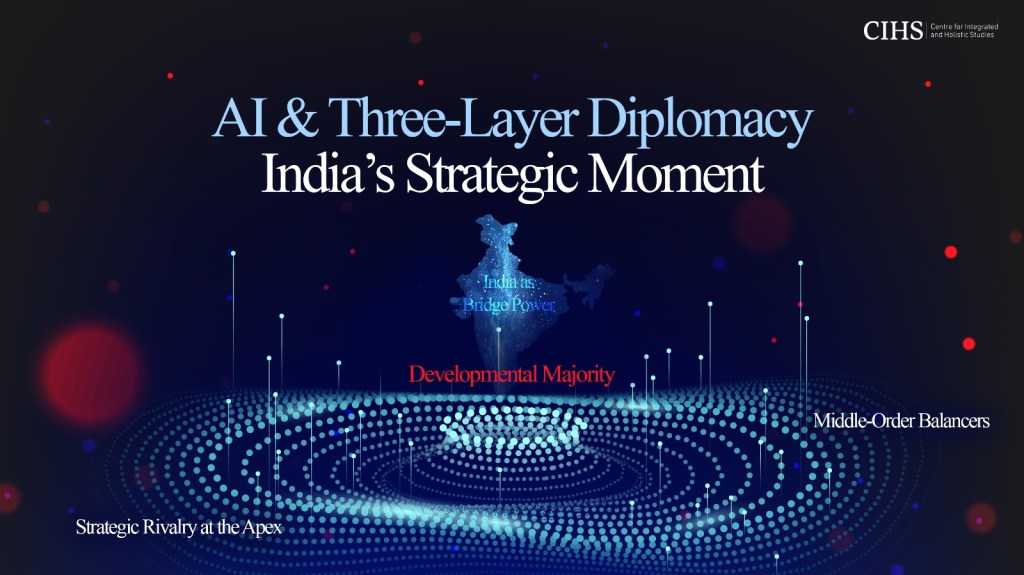
As global leaders gather at AI summits and strategic forums, central question is no longer whether AI will influence sovereignty but how sovereignty itself will be redefined in the age of AI. The world is entering a phase where what was achieved in five decades of industrial transformation may now unfold within five years through algorithmic acceleration.
In this emerging order, a new structure of global engagement is visible, which may be called the Three-Layer Diplomacy of AI.
The future of global influence may not be determined by who builds the most expensive AI systems, but by who shapes its:
- Norms
- Accessibility
- Ethical boundaries
- Human orientation
India does not need to outspend the superpowers. It must out-think and out-ethic them.
The real strategic equation of the AI age is:
Soft Power + Mathematics + Language = Technological Sovereignty
If harnessed effectively, India can:
- Lead development of usage models rather than capital-heavy foundational monopolies
- Create affordable AI ecosystems
- Protect smaller nations from digital dependency
- Ensure that humans are still above technology, not beneath it
First Layer: Strategic Rivalry at the Apex
At the highest level, AI has become central to strategic rivalry between United States and China. This competition is not rhetorical; it is embedded in semiconductor supply chains, export controls, advanced chip fabrication, rare earth dependencies, cloud infrastructure and defence applications. Investment figures in AI research and hardware ecosystems are staggering, but more consequential development is the attempt to shape global dependencies.
Control over foundational models, advanced chips and data infrastructures translates into influence over financial systems, digital communications and military intelligence. AI in this layer is capital-intensive, vertically integrated and closely aligned with national security doctrines. The risk is not merely technological inequality; it is the emergence of algorithmic spheres of influence.
For countries outside this rivalry, the concern is clear: will access to advanced AI become conditional on political alignment?
Second Layer: Middle-Order Balancers
Second diplomatic layer consists of technologically capable but strategically cautious powers: India, Europe, Japan, South Korea and several advanced developing economies. These states recognise AI’s transformative potential for productivity, healthcare, climate modelling and governance. At the same time, they are wary of technological dependence on either pole of the first layer.
Their strategic objective is not dominance but resilience. Europe emphasises regulatory sovereignty. Japan and South Korea invest heavily in semiconductor capacity to avoid supply disruptions. India has pioneered digital public infrastructure models that demonstrate scale without prohibitive capital expenditure.
This layer’s challenge is coordination. Without collaborative frameworks on standards, data governance and ethical deployment, middle powers risk fragmentation, each negotiating bilaterally with larger actors instead of collectively shaping norms.
Third Layer: Developmental Majority
Third layer comprises the least developed and small economies across Asia, Africa and island states. For them, AI is neither a prestige competition nor a regulatory puzzle; it is a developmental lever. Properly deployed, AI can optimise agricultural output, strengthen disaster response, expand financial inclusion and compensate for shortages in skilled workforce. However, they also fear that AI could:
- Deepen digital colonialism
- Centralise power in foreign platforms
- Erode local sovereignty
The question for third layer is existential: Will AI liberate them or bind them into new dependencies?
Yet these countries face a paradox. The most advanced AI systems are expensive, proprietary and cloud-dependent. Without domestic capacity, adoption can create digital dependency rather than digital empowerment. Algorithmic governance risks being externally influenced.
This is where India’s role becomes strategically significant.
India as Bridge Power
India is uniquely positioned to operate across all three layers without being absorbed by any single one. Its strengths are not merely demographic or market-based; they are structural.
First, India’s mathematical and engineering talent pool is globally integrated. From foundational research to scalable software engineering, India’s human capital is embedded in global AI ecosystems. This offers leverage beyond hardware capability alone.
Second, India’s experience with digital public infrastructure, identity platforms, payment systems and scalable governance technology demonstrates that high-impact digital systems can be built without replicating the capital intensity of Western or Chinese models. The emphasis has been on interoperability and cost efficiency rather than exclusivity.
Third, India’s linguistic and cultural diversity offers an advantage in the next frontier of AI language models and contextual adaptation. AI systems trained only on dominant linguistic frameworks risk marginalising vast populations. India’s multilingual ecosystem can inform more inclusive design principles.
Finally, India brings a civilisational vocabulary that emphasises balance between innovation and restraint, growth and sustainability, capability and responsibility. As AI systems increasingly influence decision-making, the ethical framing of deployment becomes a strategic variable, not a philosophical afterthought.
Three-Layer Diplomatic Strategy
For India, engagement must be parallel rather than sequential.
With the first layer, India must safeguard strategic autonomy, diversifying semiconductor partnerships, investing in domestic R&D and resisting monopolistic dependencies.
With the second layer, India should anchor coalitions around interoperable standards, shared research platforms and responsible AI frameworks that prioritise access and resilience.
With the third layer, India can emerge as an enabler, providing capacity building, affordable AI tools adapted to local needs and policy advisory support that strengthens digital sovereignty rather than eroding it.
Beyond Race Narrative
The dominant global discourse treats AI as a race to be won. A more accurate framing is that AI is a system to be governed.
The AI era is not simply about technological competition; it is about the reconfiguration of global order.
Through a carefully structured Three-Layer Diplomacy, India can:
- Resist monopolistic dominance
- Shape middle-power thinking
- Empower the Global South
- Become an enabler, leader, and moral spokesperson
In doing so, India does not merely secure its own future; it helps safeguard the human future. India must now become its ethical architect.
The coming decade will determine which trajectory prevails. India’s strategic choice is whether to remain a participant in technological competition or to become an architect of a more balanced AI order.
The three-layer diplomacy of the AI age is already taking shape. The question is whether India will recognise that it is uniquely placed to bridge the layers and, in doing so, redefine leadership for the algorithmic century.
(Author is a former diplomat and policy commentator focused on South Asian geopolitics, Tibet and India’s neighbourhood. He contributes to leading think tanks and policy platforms on regional and civilisational issues.)
 CIHS - Centre for Integrated and Holistic Studies