

Brig Brijesh Pandey
Seven years after the Pulwama suicide bombing claimed the lives of 40 Central Reserve Police Force personnel, India’s security strategy still carries the imprints of that national tragedy. The body bags wrapped in the National Flag catalysed the strategic shift.
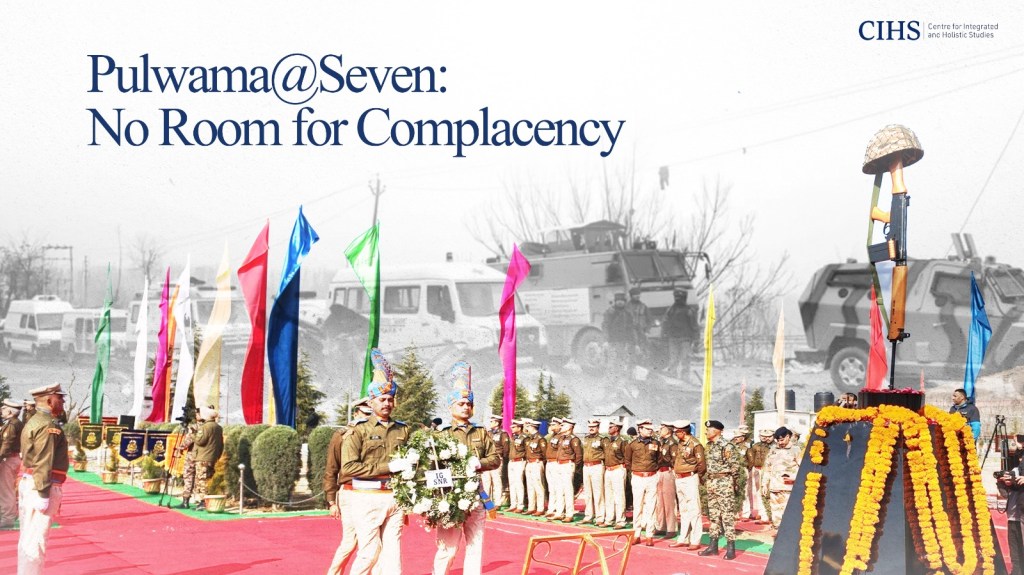
This terrorist attack by Pakistan-based and backed terror outfit Jaish-e-Mohammed (JeM), from the Pakistan-occupied territories of Jammu & Kashmir (PoJK), was not merely an act of terrorism; it marked a geopolitical turning point that permanently reshaped India’s approach to deterrence. This incident also signaled a strategic shift toward Pakistan, emphasising the development of asymmetric capabilities and consequently, reshaping the balance of power in South Asia.
The anniversary, however, should not turn out to be just a solemn remembrance; it should impel us to ponder over more serious questions, such as what changed after the Pulwama terror strike? What was the overall spectrum of India’s response? Have the risks been resolved?
The Shock and Aftershock
Pulwama suicide bombing was one of the most heinous attacks in over a decade. Within 12 days of the incident, India responded with a Trans-Line of Control (LoC) air strike at Balakot, deep inside PoJK. Trans LoC action, employing conventional forces, had thus far been defined as an “act of war.” Consequently, Pakistan was expected to respond with conventional kinetic action inside Indian territory. Perhaps the shock of the air strike was so great that it shook the military planners in Pakistan. They not only preferred to give it a pass, but also quickly returned the Indian pilot, the then Wing Commander Abhinandan Varthaman, who was taken as a prisoner after his aircraft crashed inside PoJK.
In the pre-2019 era, India’s response to terrorist initiated incidents (TIIs) was characterised by restraint. It oscillated between diplomatic isolation of Pakistan, ceasefire violations across the LoC, limited covert operations and return to normalcy. What changed with Pulwama was India’s definition of “terror acts” and the unwarranted restraint caused by the term “act of war.” The most remarkable part was India smashing the glass ceiling of nuclear overhang, making a statement that Proxy War will no longer be cost- free.
So what was the significance of the Balakot air strike? Firstly, it brought about a paradigm shift in the security policy from strategic restraint to calibrated punishment. Secondly, India dislodged Pakistan’s nuclear bluff and reinforced the deterrence established through the Uri Surgical strikes of 2016. Thirdly, at the global level, India suddenly altered the threshold levels of tolerance towards conflict between two nuclear-armed states.
End of Strategic Restraint
Balakot air strikes were domestically followed with a decisive mandate in favour of the ruling dispensation in India. This served not only as the public endorsement of India’s punitive action against Pakistan but also as the National consensus on “zero tolerance” towards any form of attack, conventional or sub-conventional. What followed was silent yet substantive: –
- Assertive counter-terror posture.
- Abrogation of Article 370, erasing the legitimacy of the Kashmir cause in the garb of which Pakistan was resorting to a proxy war.
- Strengthening of the counterterror framework by redrafting the regulations related to the prevention and investigation of acts of terror.
There is no ambiguity about the dismantling of terror infrastructure post abrogation of Article 370 substantively. There has also been a remarkable improvement in most of the parameters of terrorism, such as recruitment, infiltration by foreign terrorists, number of TIIs and the resultant loss of lives. However, to assume that the entire framework of Proxy War encompassing ideological radicalisation, nexus networks and terror infrastructures will get dismantled so easily, will be a fallacy. So long as the “idea of terrorism” is alive, peace will remain elusive and the trajectory of stability can be altered in the blink of an eye.
Deterrence in South Asia
In the immediate aftermath of the Balakot air strikes, it was believed that deterrence had been restored and would dissuade Pakistan from orchestrating a major terror strike against India. This belief was shattered by the terror attacks at Pahalgam on 22 April 2025, killing 26 tourists after segregating them in the name of religion. Given the nature of the attacks and manner of execution, it can well be called a step higher than the Pulwama suicide bombing. Consequently, this led the Indian security planners once again to redefine the boundaries of deterrence through Operation Sindoor. For Pakistan, the costs were multiplied manifold, and the spectrum of punishment was enhanced to encompass the entire length and breadth of Pakistan. Even foreign assets stationed in Pakistan were not spared, and the attacks signalled a “conventional anti-dote” to the strategic comfort Pakistan derived from India’s “no first use” nuclear doctrine. Despite such a decisive action, compelling Pakistan’s Director General of Military Operations to rush to seek a ceasefire, the Delhi Car Bombing of 10 November 2025 at Red Fort Metro Station occurred. This time too, the trail pointed towards Pakistan, though the network differed in character and the arc of orchestration extended as far as Türkiye.
Recurrence of terror attacks underscores a basic reality that deterrence in South Asia is neither static nor absolute. It is a dynamic contest shaped by big power alignments, multiple regional actors (often working in concert), proxy players embedded within the society, internal political machinations, and ideological currents. The challenge is further compounded by the constant mutation of terrorist organisations, evolving new methods, funding patterns and operational space. This helps them to evade the conventional operational responses.
Consequently, even decisive actions such as Balakot or sophisticated, high-precision operations such as Operation Sindoor cannot be expected to create permanent deterrence. Pakistan Army, whose relevance has long been based on perpetual hostility with India, will continue to innovate and rewire its Proxy Warfare. Moreover, the regional and global players whose geostrategic interests are served by constraining India’s rise or drawing India into asymmetric dependencies that undermine India’s strategic autonomy will keep discovering new ways of supporting Pakistan’s disruptive designs.
Internal Security Question
Beyond the realm of geopolitics and external dimensions lies an uncomfortable yet fundamental question: could Pulwama have been prevented through an anticipatory mechanism? Investigations into major TIIs have constantly indicated the gaps in intelligence, inter-agency coordination, integrated threat assessment, and the last-mile operational preparedness of forces operating in various conflict zones. While procedural and structural measures have been introduced, the broader aspect of making National Security anticipatory, adaptive, pre-emptive, and preventive is yet to be achieved. Going beyond the capacities of individual institutions, such as Research & Analysis Wing or Military Intelligence for intelligence and Military or Central Armed Police forces for operational efficiency, there is a need to fuse intelligence across the agencies, integrate technological surveillance, and situate national efforts within a wider regional and global threat-monitoring framework.
Terror networks operate across borders, financial systems and digital platforms. To deny them the terminal success, it is critical that structured, institutional alliances are built, linking governments, intelligence services, financial regulators, technology platforms and research institutions into a unified ecosystem.
Equally important is information warfare. Pulwama incident and Balakot air strikes were followed by hyper-national media cycles, digital amplification and political battles. Strategic communication was seen as a tool of statecraft as well as a polariser. If all parts, like information operations, perception management, counterpropaganda, and narrative dominance, are not used together effectively, the success of operations in deterring others will be uncertain.
Global Alliance Against Terrorism
Acknowledging that terrorism is a transnational phenomenon, mutating from Hybrid to Proxy, unconventional, Grey Zone or Unrestricted warfare, building enduring deterrence requires crossing the boundaries of episodic responses and establishing Global Alliance Against Terrorism (GAAT) by integrating governments, intelligence agencies, financial institutions, technology firms, multilateral organisations (UN Office of Counter Terrorism, Financial Action Task Force, INTERPOL, EROPOL, SCO-RATS, and so on), academia and civil society. GAAT can overcome the coordination gaps and enable real-time intelligence sharing, integrate operational capacities, counter financial networks and build narratives against countries that are supporting terrorism in terms of ideology, infrastructure, logistics and training. Objective standards established by GAAT would strengthen global accountability, transforming fragmented responses into proactive prevention. This would also address the problem of legitimising terrorism as an instrument of statecraft, thereby strengthening the foundations of long-term global security.
Continuum of Deterrence
Deterrence in the era of Grey Zone Warfare cannot be viewed as a singular episode of retaliation but as a continuous and evolving process integrating international cooperation, military capabilities, intelligence dominance, diplomatic signalling, economic leverage, deniable networks, and strategic communication. Likewise, the operating element of deterrence must encapsulate a multi-domain response continuum ranging from preventive attacks where possible, disrupting networks where necessary and imposing costs where unavoidable. Finally, deterrence must create an environment of risks, costs and ideological isolation based on persistent, adaptive and collaborative initiatives. Only then will the annual cognitive touch points of Pulwama create enduring national and global security.
(Author is a veteran of Indian Army, experienced in planning & executing key operations with an extensive expertise in information warfare and defence strategy)
 CIHS - Centre for Integrated and Holistic Studies