

In a world where tariffs, export controls, and supply-chain restrictions are instruments of statecraft, Europe’s new realism is simple: it isn’t choosing a side; it is buying room to manoeuvre.
Rahul PAWA | x – iamrahulpawa
Mario Draghi sketched Europe’s predicament in blunt, unsentimental terms. The economist and former Prime Minister of Italy argued that the old operating system of the global economy is breaking down, and Europe is exposed in ways its balance sheets can’t fix. He warned that Europe’s strengths, its market size, regulatory reach, and industrial base don’t automatically shield its vulnerabilities: security dependence on the United States, and material dependence on supply chains that run through China.
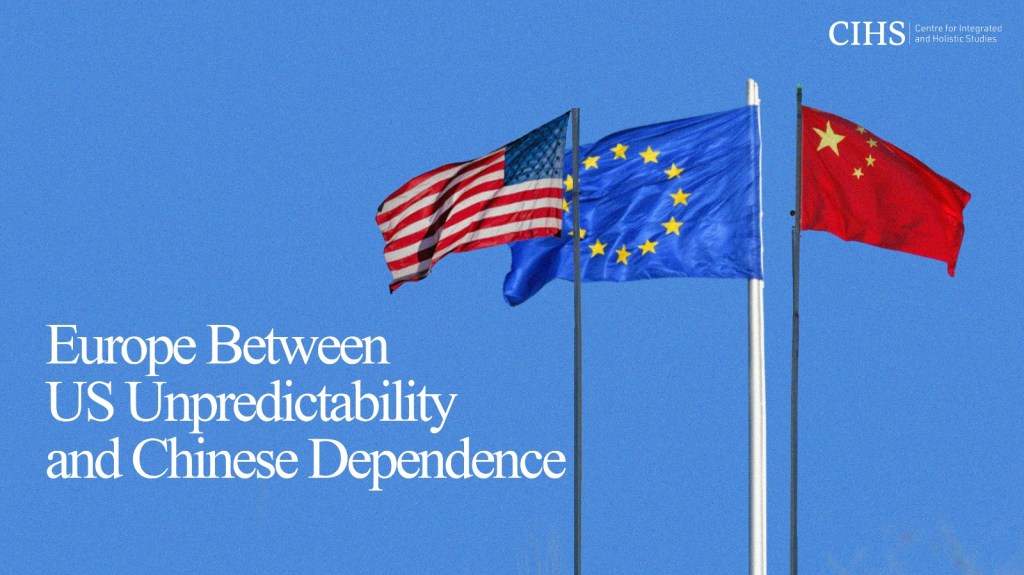
That diagnosis is landing in European capitals because it maps onto an everyday reality: the EU is being pushed from two directions at once. Washington has become harder to predict, more transactional, more willing to dangle tariffs, and more comfortable turning alliance relationships into leverage. Beijing, meanwhile, has spent two decades building choke points in critical inputs; minerals, magnets, processing capacity so quietly essential to Europe’s green transition and defence production that they barely feature in public debates until something breaks. Europe’s new mood isn’t choosing China over America. It is something colder: hedging against both.
Europe’s current security architecture still rests on U.S. power. That fact doesn’t change because of a tense summit or an angry speech. But the confidence in how that power will be deployed, how reliable it will be, what it will cost, what conditions it will carry has thinned.
In early February, Germany’s foreign minister Johann Wadephul made the point Europe keeps trying to thread: Berlin remains closer to Washington than Beijing, and sees the U.S. as its most important partner, especially on security, yet Europe is also confronting transatlantic strains, including U.S. pressure over NATO burden-sharing and Europe’s reliance on American defence support.
This is the tension Draghi is pointing to: Europe can be economically formidable and still strategically dependent. In practical terms, it means every new episode of U.S. unpredictability; tariff threats, pressure campaigns, sudden demands raise the same question in Brussels and Berlin: what happens to Europe’s risk model if America’s commitments come with more volatility and a higher price tag?
That question becomes sharper when allies feel they must keep economic channels open with China partly because their industries need access, partly because diversification takes time, and partly because U.S. politics may punish them either way.
China doesn’t need to “win Europe over” to gain leverage. It needs only to remain central in the parts of the supply chain Europe cannot quickly replace. The EU’s own institutions have started putting hard numbers on what used to be hand-waving. The European Commission notes that Europe doesn’t produce rare earth elements itself, and that 98% of the EU’s total rare-earth magnet demand is met by imports from China, magnets that sit inside EV motors, wind turbines, robotics, and advanced electronics.
Then came the auditors. A European Court of Auditors report amplified widely across European media lays out dependence with uncomfortable specificity: the EU imports all of its 17 rare earth elements; it is fully dependent on imports for 10 of 26 critical minerals; and it relies heavily on China for key materials such as magnesium (97%) and gallium (71%), alongside major shares of rare-earth materials used in permanent magnets (including neodymium and praseodymium). The report also underlines the time problem: mines and processing capacity can take a decade or more to bring online, sometimes far longer.
The strategic implication is straightforward: even if Europe is politically determined, it is physically constrained. China’s leverage isn’t mainly a threat of tanks or missiles; it is the ability to slow, raise the cost of, or selectively disrupt the material flows that power Europe’s industrial priorities, green tech, advanced manufacturing, and rearmament.
Europeans increasingly talk about “de-risking” because they have lived through a dependence shock before. The Russian gas crisis was the tutorial. Now the lesson is being applied to China, except the inputs are more embedded and the substitution is harder. Europe is learning that resilience is not a slogan but an industrial timeline. It cannot “regulate” its way out of dependence, and it cannot “summit” its way back to certainty. What is emerging is neither a pivot to China nor a break from America, but a recalibration shaped by hard experience. Dependence has become exposure, and exposure is something others can price, punish, or exploit.
The EU will remain anchored to the United States for security because the alternatives are not yet credible, but it will try to shrink the extent to which U.S. politics can whipsaw European strategy. It will keep channels open with China because European industry still runs on Chinese inputs, while working to cap single-country choke points in the minerals, magnets, and processing that underpin the green transition and defence production. This is the colder mood Draghi was pointing to, less faith in any single guarantor, more investment in self-insurance. In a world where tariffs, export controls, and supply-chain restrictions are instruments of statecraft, Europe’s new realism is simple: it isn’t choosing a side; it is buying room to manoeuvre.
(The author is an international criminal lawyer and director of research at New Delhi based think tank Centre for Integrated and Holistic Studies (CIHS).
 CIHS - Centre for Integrated and Holistic Studies