

Vinod Kumar Shukla
Among the foundational “Trayi” (the first three Vedas), the Sam Veda stands as a celestial musical invocation dedicated to various Gods, Goddesses and Deities. It was upon these rhythmic foundations that Bharat Muni authored the Natya Shastra, bridging the gap between divine sound and terrestrial art. So, musical rendition, spiritual inquiry and philosophical discourse are not merely cultural artefacts but age-old traditions within Sanatan Dharma, pathways designed to lead the seeker toward peace and Nirvana. People of all ages have been drawn to these creations.
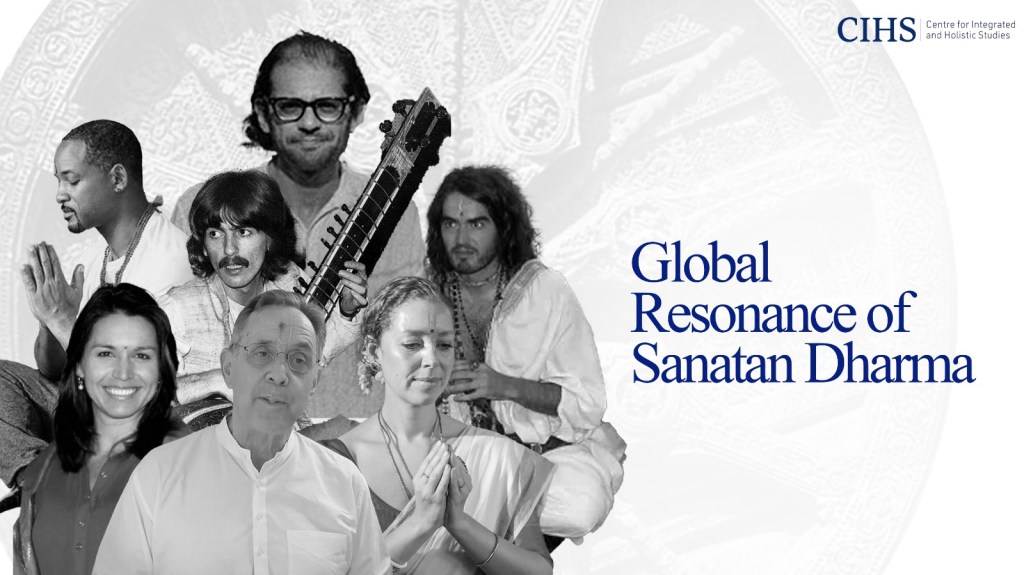
Celebrities from all over the world are drawn to Sanatan Dharma in the current era for its profound inner calm, freedom (Moksha), spiritual growth, intellectual discussions, and the great amount of knowledge that Bharat possesses. Celebrities express their decision to follow the path of Sanatan Dharma by being drawn to and embracing them. There is a long list of celebrities joining the fold for something that they lacked despite their professional successes, material achievements and fame. They get absolute contentment by just being in the Sanatan fold.
Sanatan transcended Himalayan height, oceanic depth and is beyond continental limits by offering its treasure trove of knowledge and spiritual capital with its various streams and different offshoots. So much so that many Islamic countries in Central Asia have allowed huge temples, which are otherwise not permissible. To begin with, the Japanese singer and songwriter Fujii Kaze, who is a cult figure across the globe, calls Bharat his “spiritual hometown.” Kaze had been absorbing Hindu philosophy, mantra, culture and ideas of non-attachment through his family and tells the world, “My parents are fascinated by Hindu teachings, and so am I.” Naming his 2024 album as ‘Prema,’ which means love in Sanskrit, feels less like a pop project and more like a meditation; this is how he expressed himself. Kaze, whose music varies from Jazz, R&B, Gospel and J-pop, is not only drawn towards Sanatan, who yearns for peace, grace and meaning in the noisy and parallel material world.
Moreover, Kaze is not the only one who is drawing inspiration from Sanatan, but lots of other celebrities and hundreds of thousands of others who are deep into its practices. Known for her celluloid avatar as ‘Pretty Woman’, Hollywood actor Julia Roberts also follows Sanatan. She has been a practising Sanatani since 2010, having been drawn towards it after seeing a picture of Neem Karoli Baba. She even changed names of her children after Hindu deities, with Hazel as Laxmi, Phinnaeus as Ganesh and Henry as Krishna Balaram, who are practising Hinduism now, including her husband. Her production company is named “Red Om Films”. The family regularly visits temples.
The American actor Robert Downey Jr has a profound connection with Sanatan philosophy and spirituality, which he has credited for helping him through his journey of recovery from addiction and self-discovery. Downey Jr frequently speaks about his association with the Hare Krishna movement, the Srimad Bhagavad Gita and the practice of Yoga. He acknowledges that principles of mindfulness, self-awareness and karma philosophy (Vedant School of thought) of Sanatan helped him overcome addiction and rebuild his life. The Sanatan philosophy seems to have helped him even to focus and balance his life.
Russell Brand, an English actor and comedian, has had an evolving relationship with Sanatan and its core spirituality. He unequivocally credited it for helping him get de-addicted and finally get mental serenity. His devotion to the Hare Krishna movement after meeting with spiritual leaders like Radhanath Swami tells the tale of his belief in Sanatan. In the year 2010, Brand married pop star Katy Perry in a traditional Hindu wedding ceremony near the Ranthambhore tiger sanctuary in Rajasthan. Unfortunately, they are separated now. Brand practices yoga and meditation regularly and believes in karma and reincarnation, which are part of the revelations of Srimad Bhagavad Gita. He has a Sanskrit tattoo that is interpreted as “Anuugacchatu Pravaha,” which means “go with the flow”.
Australian actor, singer and producer, Hugh Jackman, who has expressed a deep, long-term personal connection to Sanatan, its philosophy and Transcendental Meditation, has integrated its teachings and belief system into his life. He often describes how these teachings feel more instinctive to him than the Western tradition he was raised in. He spent more than thirty years studying and exploring Vedic philosophy, the Upanishads and Srimad Bhagavad Gita. He found that the Vedic epistemology matched his sensibility and was inspired by Vedanta ideas.
Jackman wears a wedding ring inscribed with the Sanskrit phrase “Om Paramar Mainamar”, which means “We dedicate our union to a greater source.” Jackman has spoken about his admiration for the Srimad Bhagavad Gita, especially its teachings on life, death and making peace with oneself.
George Harrison, an English musician who was the lead guitarist of the Beatles, known as “the quiet Beatle,” developed an affinity for Sanatan Dharma, Philosophy and culture after meeting sitar maestro Ravi Shankar. His engagement with Sanatan led him to the doorstep of Maharishi Mahesh Yogi, embracing chanting of mantras and integrating Hindu themes into his music, most famously with “My Sweet Lord.” He significantly supported the ISKCON movement by donating Bhaktivedanta Manor. Harrison’s dedication helped popularise Sanatan concepts, teachings and practices in Western countries, making him a significant figure in bridging Hindu spirituality and Western pop culture.
One of the most notable Western followers of Sanatan included the prominent American businessman Alfred Ford, aka Ambarish Das, the great-grandson of Henry Ford. He adopted Hindutva in 1974 after becoming a disciple of Bhaktivedanta Swami Prabhupada. He is involved in building the Vedic Planetarium temple in India. While he is a dedicated practitioner of Sanatan, his involvement is specifically with the spiritual and cultural aspects of Gaudiya Vaishnavism.
As a central figure of the 1960s counterculture, Allen Ginsberg’s stay in India during 1962–1963 marked his profound engagement with Sanatana and the Bhakti tradition. Immersing himself in the Srimad Bhagavad Gita and the Upanishads, Ginsberg utilised Hare Krishna chanting as a spiritual tool to bypass “Western rationalism.” His idea of the “universal form of Krishna,” which he saw as a crucial counterbalance to Western Aristotelian reasoning, enabled him to combine Beat poetry sensibilities with ancient mysticism in a syncretic search for a different reality.
While Ginsberg immersed himself in Hindu spiritual practice, his approach was deeply personal, syncretic and often aimed at finding an alternative, mystical reality to Western consumerism and rationality.
Jahnavi Harrison, the British musician and artist known for her Bhakti Yoga-inspired devotional song, was nominated for a Grammy Award for devotional songs blending Sanskrit chants with English lyrics. Raised in a family of ISKCON disciples, she focuses on spiritual expression, meditation and cultural connection to Hindu tradition. Jahnavi Harrison’s Grammy-nominated album ‘Into The Forest’ is a fusion of Sanskrit mantras with English, aimed at fostering a connection to the divine. She has a strong background in both Western music and Indian traditions like Bharatanatyam dance form and Carnatic vocals.
Steve Jobs, an American businessman, inventor and co-founder of Apple Inc., had a significant interest in Indian spirituality, particularly Hinduism and Buddhism, undertaking a pilgrimage to India in the 1970s where he sought wisdom from gurus, practised meditation, and learned about concepts like Prajna (consciousness or wisdom), influencing his intuitive approach to life and work. Jobs travelled to India seeking spiritual enlightenment, spending time in ashrams and temples. His time in India introduced him to the very concept of prajna, which he felt was more powerful than pure logic, shaping his decision-making.
Tulsi Gabbard, the first Hindu member of the US Congress, who has been serving as Director of National Intelligence since February 2025, is a practising Hindu. She took her oath on the Bhagavad Gita. Raised in a household that embraced Hindu principles, she identifies with the Gaudiya Vaishnava tradition, often focusing on karma yoga and devotion to Krishna. While not born into a Hindu family, she adopted the faith as a teenager.
Many others are part of the thoughts of Sanatan Umbrella, like Richard Gere, who practices Tibetan Buddhism. Throughout history, this profound architecture of thought has exerted some magnetic pull-on seekers. Today, this attraction remains undiminished; celebrities from every corner of the globe are increasingly drawn to Sanatan Dharma, seeking deep spiritual substance, inner stillness and the ultimate liberation of Moksha. They are captivated by the “spiritual smearing” of sacred rituals and the vast, intellectual capital inherent in Bharat’s heritage. The resonance of these teachings has found a profound home all across the globe.
(Author is a senior journalist and associated with Centre for Integrated and Holistic Studies, a non-partisan think-tank based in New Delhi)
 CIHS - Centre for Integrated and Holistic Studies