

By N. C. Bipindra
For years, India has accused Canada of sheltering Khalistani separatist networks that openly call for the dismemberment of the Indian state, often through rallies, illegal referendums and fundraising activities conducted on Canadian soil.
Ottawa’s standard response has been predictable: these activities, however offensive to India, fall under the protection of free speech in a liberal democracy.
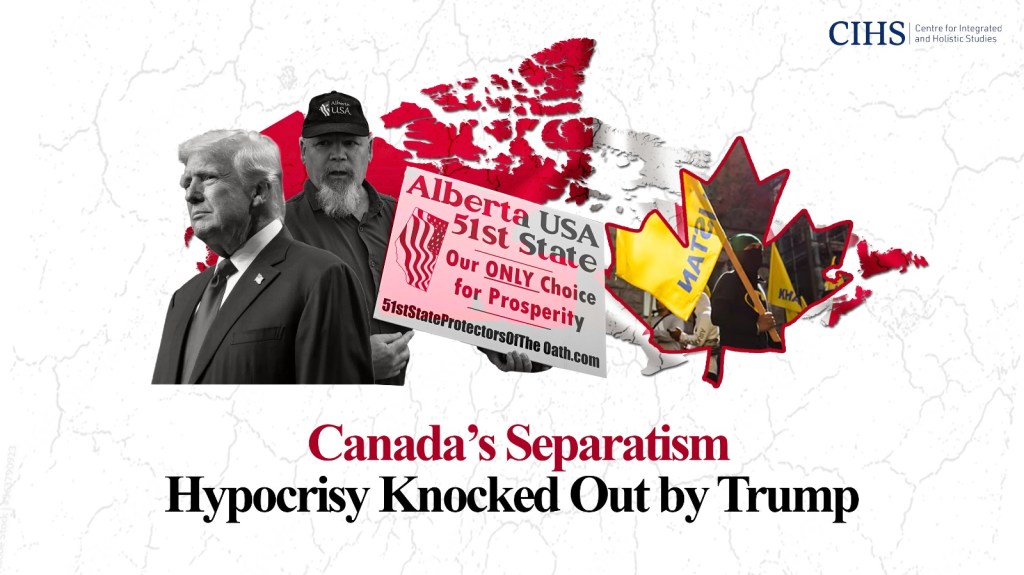
Now, as Canadian leaders bristle at the idea of their own separatists allegedly courting sympathy or support from the United States under a Trump-led political climate, the rhetoric has shifted dramatically.
Suddenly, “free expression” has a boundary, and that boundary is labelled “treason.”
British Columbia Premier David Eby’s remark captures the mood shift succinctly: “To go to a foreign country and to ask for assistance in breaking up Canada, there’s an old-fashioned word for that. And that word is treason.”
The statement, in addition to its directness, stands out for its contrast to Canada’s long-standing defence of Khalistani advocacy as constitutionally protected speech in response to India’s objections.
This contradiction sits at the heart of Canada’s current predicament, exposing the uncomfortable gap between universalist liberal principles and national interest-driven political reflexes.
Canada’s Long, Uneasy History with Separatism
Canada is no stranger to separatist movements. Quebec nationalism has shaped federal politics for decades, ranging from constitutional negotiations to two referendums on secession in 1980 and 1995.
Western alienation, particularly in Alberta and Saskatchewan, has periodically spawned its own secessionist rhetoric, often tied to energy policy and perceptions of Ottawa-centric governance.
British Columbia, while less institutionally separatist, has its own strains of regional grievance politics.
Ottawa’s approach to these movements has generally been pragmatic: tolerate speech, discourage violence, and rely on federalism, economic integration and constitutionalism to keep the country together.
Even the Front de libération du Québec (FLQ) crisis of the 1970s, marked by terrorism, eventually gave way to political accommodation once violence was rejected.
It is against this backdrop that Canada framed its response to Khalistani activism.
Ottawa repeatedly argued that as long as these groups did not directly engage in violence within Canada, their advocacy, even for secession abroad, fell under lawful political expression.
Khalistan, India and the Free Speech Shield Canada Misused
From New Delhi’s perspective, this position has always felt disingenuous. Khalistan is not a theoretical grievance movement. It is tied to a violent insurgency in the 1980s, the assassination of an Indian Prime Minister and the bombing of Air India Flight 182, Canada’s deadliest terrorist attack.
India’s argument has been straightforward: allowing individuals and organisations linked to this ideology to operate freely is not neutral liberalism. It is permissiveness with security consequences.
Canada, however, consistently invoked a rights-based framework. When India asked Ottawa to curb rallies, posters and “referendums” glorifying separatism or violence, Canadian officials responded with lectures on freedom of expression, rule of law and judicial independence.
The message to India was clear: liberal democracies must tolerate even uncomfortable speech. That moral posture is now under strain.
Separatism Meets Trump’s Transactional Power Politics
The recent US moves under Donald Trump, courting or at least engaging Canadian separatist voices while simultaneously escalating economic pressure, have jolted Ottawa out of its comfort zone.
Trump’s statement threatening to decertify Canadian-made aircraft and impose a 50% tariff unless Canada changes its certification practices for Gulfstream jets is classic Trumpian coercive diplomacy: blend trade, nationalism and public spectacle into one negotiating weapon.
What makes the moment explosive is the “symbolic overlap” between economic punishment and political messaging.
If Canadian separatist leaders are perceived to be seeking favour or leverage in Washington, especially under a president who thrives on exploiting internal divisions abroad, it strikes at the core of Canadian sovereignty anxieties.
Hence, the sharp pivot in tone. What was once “speech” becomes “treason” the moment foreign power politics enter the picture.
Hypocrisy Problem: Liberal Universalism or Strategic Nationalism
Canada’s dilemma is not unique, but it is particularly visible. Liberal democracies often defend abstract principles, such as free speech, association and protest, until those same principles are weaponised against them.
When Khalistani groups lobby foreign governments, celebrate separatism or even implicitly threaten India’s territorial integrity, Canada frames it as diaspora politics.
When Canadian separatists allegedly seek US backing, it becomes an existential threat.
This asymmetry is not lost on India or on other states watching closely. The core inconsistency lies in selective contextualisation.
Canada contextualises its own separatist challenges as dangerous and destabilising, but decontextualised India’s, treating Khalistan as merely expressive politics rather than a historically violent movement.
The standards change depending on whose national unity is at stake.
Law, Treason and the Political Language Elasticity
Premier Eby’s use of the word “treason” is politically powerful but legally loaded.
In most democracies, treason is narrowly defined, usually involving direct assistance to an enemy during wartime.
Stretching the term to cover lobbying or rhetorical appeals abroad may resonate emotionally, but it undermines Canada’s earlier insistence on strict legalism when responding to Indian concerns.
This matters because once political language expands to suit convenience, it exposes prior moral claims as contingent rather than principled.
India has long argued that separatist advocacy cannot be divorced from geopolitical consequences.
Canada is now discovering the same truth, only from the opposite side of the mirror.
Trump’s Tariffs and Certification Weaponisation
Trump’s aircraft ultimatum adds another layer: economic nationalism as leverage over sovereignty disputes.
By tying aircraft certification to trade retaliation, Trump is signalling that regulatory processes themselves are negotiable instruments of power.
For Canada, this is doubly uncomfortable. First, it challenges the legitimacy of its regulatory institutions. Second, it reinforces the perception that internal political vulnerabilities, like separatist murmurs, can invite external pressure.
Ironically, this is precisely the logic India has used to argue that tolerating extremist diaspora politics weakens state credibility and invites instability.
Strategic Implications for India-Canada Relations
For New Delhi, the moment offers not only vindication but also opportunity. The contrast between Canada’s moral posturing on Khalistan and its alarm over domestic separatism strengthens India’s long-standing claim of double standards.
It also gives Indian diplomats rhetorical ammunition in future engagements, not just with Canada, but with other Western partners inclined to compartmentalise security concerns abroad.
At the same time, India must recognise that Canada’s discomfort could open space for more realistic dialogue, if Ottawa is willing to recalibrate its absolutist free speech framing into a more security-conscious approach.
Mirror Canada Didn’t Want to Look into for Long
Canada is now confronting a truth it long deflected: separatism is not a neutral concept once it intersects with foreign power, economic pressure and national cohesion.
When Trump courts Canadian separatist voices while threatening tariffs, the liberal abstraction of “free speech” collapses into hard questions of sovereignty and loyalty.
For years, India was told to accept that discomfort as the price of democracy. Today, Canada is learning that lesson the hard way.
The issue is no longer whether free speech matters; it does. The real question is whether principles are applied consistently or only until they hit home.
(Author is Chairman, Law and Society Alliance, a New Delhi-based think tank, and guest columnist with CIHS)
 CIHS - Centre for Integrated and Holistic Studies