

Balochistan remains a place where the promises of 1947 are still argued, remembered and resisted.
Rahul PAWA | X @imrahulpawa
In the vast, rugged expanses stretching from the Arabian Sea to the deserts bordering Iran and Afghanistan lies Balochistan, land rich in minerals, memory and unresolved history. Today, it is Pakistan’s largest province by territory, yet it’s least developed, and for decades it has remained the stage for one of South Asia’s longest-running struggles for liberation. At the heart of the conflict is a dispute older than Pakistan itself: whether Balochistan chose its fate in 1947 or had it imposed.
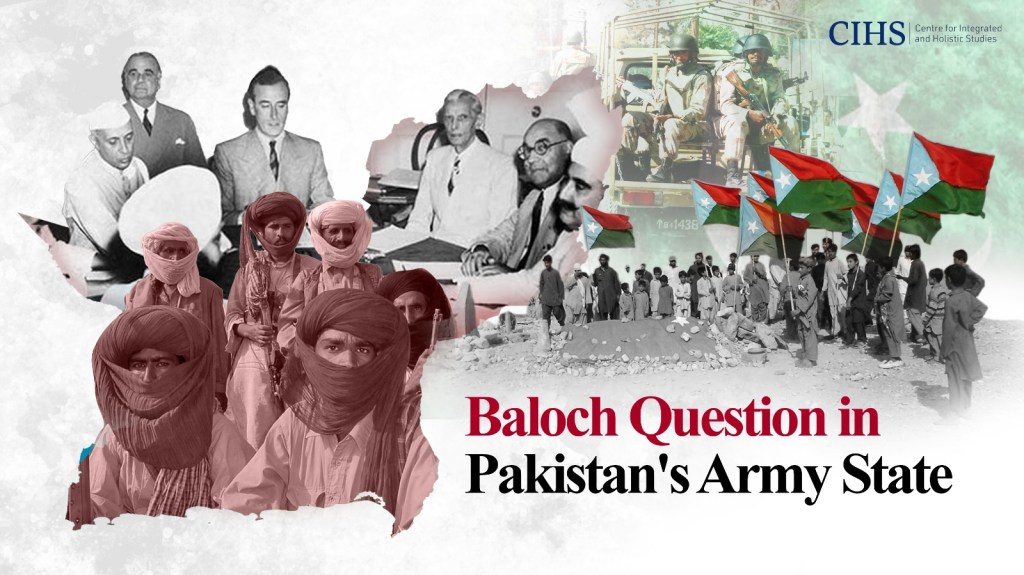
The modern struggle traces back to the princely State of Kalat. Under the 1876 Treaty with British India, Kalat retained internal autonomy, distinguishing it from directly administered colonial territories. As British rule prepared to withdraw in 1947, Kalat’s leadership sought the restoration of sovereignty.
On August 4, 1947, a decisive meeting in Delhi brought together Lord Mountbatten, Jawaharlal Nehru, Muhammad Ali Jinnah and the Khan of Kalat. Discussions concluded with recognition that Kalat would become independent upon British departure. Days later, on August 11, Kalat and the Muslim League signed an agreement acknowledging Kalat as a sovereign state, with the understanding that its independence would be respected. On August 15, as India and Pakistan emerged as independent dominions, Kalat also declared independence. Its traditional flag was raised and sermons were read in the Khan of Kalat’s name as ruler of a free state.
But independence proved fragile. British memoranda issued weeks later questioned Kalat’s capacity to function as a fully independent entity in international affairs. Political pressure mounted from the new Pakistani leadership to integrate Kalat into Pakistan. In meetings later recalled in Taj Mohammad Breseeg’s work, Baloch Nationalism: Its Origin and Development up to 1980, Jinnah sought accession, while the Khan insisted that tribal consent was essential before any binding decision.
In March 1948, Pakistani forces moved into Kalat and acceded by force. For Baloch, this marked annexation and not a voluntary union, a scar that has fueled repeated uprisings ever since.
Five insurgencies have erupted since 1948, each shaped by shifting politics but driven by familiar complaints: economic neglect, loss of autonomy, military repression and extraction of local resources without corresponding development. Balochistan holds significant natural gas reserves, copper, gold and strategic coastal access at Gwadar, yet many residents argue they see little benefit from these riches.
In recent years, tensions have intensified around the China-Pakistan Economic Corridor (CPEC), a CPC (Communist Party of China) infrastructure initiative linking western China to the Arabian Sea. While Islamabad views it as lucrative and transformative, Baloch activists see exploitation, displacement, demographic change and militarisation. Security deployments meant to protect investments have also deepened local resentment.
Rebel resistance groups have evolved within this environment. The Baloch Liberation Army (BLA) and the Baloch Republican Army (BRA) are among the most prominent armed groups seeking independence or greater autonomy. Their attacks have frequently targeted security forces, infrastructure, and occasionally foreign interests linked to CPC projects.
For years, Baloch activist and rebel groups, including BLA and BRA, alongside a wider civil resistance, have tried to peacefully advocate their case. Through diaspora mobilisations, human-rights advocacy and appeals framed around political repression and missing persons. That push has met limited sustained global action, even as major rights bodies and UN-linked voices have repeatedly flagged concerns about human rights crackdowns and enforced disappearances. International human rights groups have documented patterns of disappearances attributed to state security institutions, while the Office of the United Nations High Commissioner for Human Rights has publicised experts’ calls for Pakistan to end coercive measures against Baloch activists. As space for non-violent mobilisation narrows, rebel factions have increasingly argued that only armed resistance can force the world to look.
That arc resurfaced at the end of January 2026. Coordinated assaults across districts, including Quetta and Gwadar, aimed largely at Pakistan Army targets, led Pakistani security forces to report dozens of rebel deaths in the immediate response, followed by later claims of at least 177 rebel deaths in subsequent operations. Baloch women have also become a visible front line of this escalation: after the 26 April 2022 University of Karachi bombing carried out by Shari Baloch, BLA messaging around the 2026 offensive highlighted two Gen-Z, educated women identified in media reports as Hawa Baloch and Asifa Mengal, linking Mengal to a suicide attack on a Pakistani intelligence facility in Nushki and Hawa Baloch to the earlier killing of her father, a BLA fighter, in clashes with Pakistani Army.
The rebel movement’s turn toward headline-grabbing operations has already travelled beyond provincial boundaries. The March 11, 2025, Jaffar Express hijacking became an international story precisely because it fused mass fear with political messaging, projecting the Baloch cause outward even as it deepened public trauma. And running parallel to these attacks is the quieter, grinding image that Baloch campaigners have long used to rally global attention: families outside press clubs, searching for the disappeared; allegations of extrajudicial killings; and a widening gulf between Islamabad’s security-first narrative and the community’s lived experience of pain and coercion.
Another shadow lingers from the past. Pakistan conducted nuclear tests in the Chagai hills of Balochistan in May 1998. While celebrated nationally as a strategic milestone, many local Baloch argue the aftermath left lasting geological and human scars that remain insufficiently studied and inadequately addressed: radioactive contamination is alleged to have seeped into nearby soil and water sources; stretches of land in Chagai that were once used for grazing or cultivation are described as turning barren; and the blast sites are said to have deformed the local terrain, damaging flora and fauna. Residents and activists have also long pointed to a pattern of health and social disruption in surrounding communities, reported rises in cancers, skin and eye ailments, and claims of birth defects among children, alongside migration by families who say the area became too hazardous to sustain normal life.
Across Europe and the Middle East, diaspora Baloch communities mark March 27, the date associated with Kalat’s accession as a “Black Day,” staging protests to draw international attention to their cause. Meanwhile, everyday life within Balochistan continues under heavy security presence, economic uncertainty and political distrust. Yet beyond geopolitics and rebel statistics lies a human story: fishermen in Gwadar displaced by CPC port expansions, miners labouring in dangerous conditions, students navigating checkpoints to reach universities and families caught between Pakistan Army violence and state crackdowns. For many residents, survival, dignity and opportunity matter more than debates.
The Baloch struggle remains complex and deeply emotional. For Baloch, it is about historical justice and control over their homeland. What is certain is that seven decades after independence reshaped the subcontinent, Balochistan remains a place where the promises of 1947 are still argued, remembered and resisted.
(The author is an international criminal lawyer and director of research at New Delhi based think tank Centre for Integrated and Holistic Studies (CIHS).
 CIHS - Centre for Integrated and Holistic Studies