

By N. C. Bipindra
India and the European Union (EU), on January 27, 2026, signed what leaders are calling the “mother of all trade deals,” a sweeping Free Trade Agreement (FTA) two decades in the making.
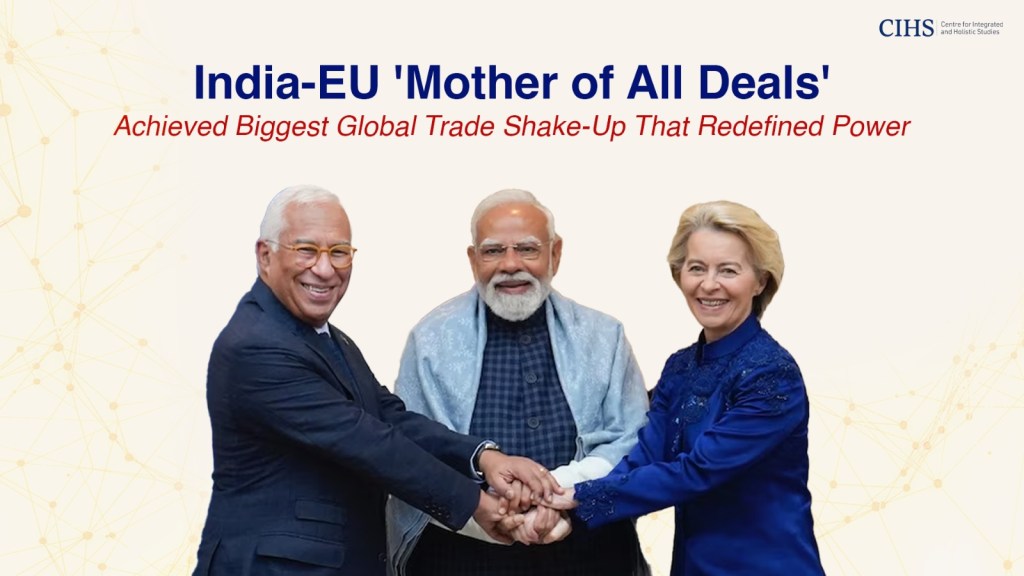
The pact, agreed during a summit in New Delhi, links two of the world’s largest democratic powers, India with its rapidly expanding economy and the EU with its integrated market of 27 countries, creating a massive economic zone spanning nearly 2 billion people and a quarter of global GDP.
This is not just another trade deal. It is a geopolitical pivot point: one that strengthens India’s global economic role, accelerates Europe’s search for reliable partners amid fracturing US relations and reshapes the global trade architecture at a time when traditional trade alliances are under strain.
What Is This FTA and Why Has It Been So Big?
Negotiations began in 2007 but repeatedly stumbled over tariffs, market access, regulatory differences and standards. Only in recent years, especially amid growing global trade tensions, did talks gain momentum.
The final pact aims to lower or eliminate tariffs on over 90% of goods for both sides, expand market access for services, reduce non-tariff barriers and boost investment flows.
Key sectors from automobiles to textiles and pharmaceuticals are covered, although sensitive areas like agriculture remain largely excluded due to domestic political concerns.
Leaders described it as not just a trade deal, but a strategic partnership, including cooperation in mobility, security and future industrial collaboration.
Why This Deal Matters to India
Indian exporters now gain preferential or zero-tariff access to the massive EU market, particularly in labour-intensive sectors such as textiles, gems and jewellery, leather goods, chemicals and marine products: historically areas where India has struggled to secure deep market entry.
With India’s manufacturing push seeking global scale, easier access to European inputs, such as machinery, medical devices, high-quality components, means lower production costs and better global supply chain integration. This aligns with India’s broader strategy of becoming a global manufacturing hub rather than a primarily services-oriented economy.
Indian exporters have felt the impact of rising US tariff barriers, especially under recent American policies that saw levies of up to 50% on Indian goods in certain sectors. The EU FTA offers a valuable alternative destination at a critical time.
EU companies are expected to scale up investments across Indian manufacturing, technology, infrastructure and clean energy sectors, bringing capital, innovation and higher-end industrial activity to India.
Why Europe Is Betting Big on India
Europe needs stable, diversified markets. China’s slowing growth and geopolitical tensions with the EU over technology and security have encouraged Brussels to seek deeper ties with other large economies. India’s fast-growing consumer base and manufacturing capacity make it an ideal partner.
The EU expects its exports to India to potentially double by 2032, saving billions in tariffs and opening opportunities for European cars, machinery and premium goods.
Strong economic ties can underpin greater geopolitical alignment on issues from climate policy to digital standards and global governance.
How This Compares to US-India and US-EU Trade Talks
The US-India talks on an FTA are still in progress, but they have not yet resulted in a comprehensive agreement. US tariff hikes on Indian exports have strained trust and talks have been slow, partly due to competing domestic political agendas and protectionist pressures.
Despite long-standing strategic cooperation, not least through defence and technology partnerships, a full trade deal remains elusive, giving the EU an opening to build momentum with India that the United States has so far not fully matched.
The EU and US remain massive economic partners, combined they account for trillions in goods and services trade, yet they do not have a dedicated free trade agreement like the one just signed with India.
Negotiations toward a free trade pact, notably the 2013 Transatlantic Trade and Investment Partnership (TTIP) proposal, ultimately collapsed in 2016 and recent talks aimed at a new framework have been complicated by political differences.
The US and EU signed a “reciprocal, fair and balanced trade” framework in 2025, but the path to comprehensive tariff reduction and deeper market integration remains fraught.
Trade disputes aren’t rare either between the US and the EU. Issues like steel and aluminium tariffs, regulatory taxes on tech and agriculture have periodically flared up.
A recent flashpoint between the United States and Europe has been tensions over Greenland, an autonomous territory of Denmark. Trump has been threatening military operations to annex Greenland, a key Arctic territory that could be the key to controlling navigation and the resultant exploitation of the ice-capped region.
Throughout 2025–2026, the US made headlines with proposals to acquire Greenland, triggering protests in Copenhagen and raising broader alarm in the EU about US intentions in the Arctic. US threats to levy tariffs on European countries opposing this move sparked fears of a transatlantic trade confrontation.
Although President Trump backed off the strongest threats at the World Economic Forum in 2026, the episode has contributed to a sense in some European capitals that Washington’s trade policies can be erratic and unpredictable, fuelling EU efforts to pursue more autonomous global economic partnerships.
This isn’t just about Greenland. It reflects deeper frustrations with US unilateral trade policies and protectionist impulses that, in Europe’s view, undermine long-standing transatlantic cooperation.
What This Means for the Future of Global Trade
The India-EU FTA is a milestone in a world where traditional trade alliances are being reconfigured. Partnerships are no longer simply North Atlantic or US-centric; Asia, Europe and emerging market ties are gaining prominence.
Despite a more fragmented global economy and rising protectionism, the India-EU deal demonstrates that deep, rules-based trade agreements remain possible and can drive economic growth and strategic stability.
As China continues to assert its economic reach and the US focuses on domestic political priorities, partnerships like the India-EU FTA become crucial counterweights that help middle powers shape the global order.
Final Take on India-EU FTA Implications
The India-EU free trade agreement is far more than a tariff-cutting pact. It is a powerful global political statement: trade diplomacy is alive, but no longer exclusively centered on Washington.
Instead, New Delhi and Brussels are crafting a shared vision for the global economy: one based on openness, diversification, and mutual strategic benefit.
For India, this opens doors to growth, investment and global supply chain integration; for the EU, it offers a dependable partner at a time of geopolitical flux.
And for the United States, the deal signals that if it wants to remain at the center of global trade architecture, it may need to rethink its approach to allies and partners alike.
The ripple effects of this agreement will be felt across markets, diplomatic circles and strategy rooms for years to come.
(Author is Chairman, Law and Society Alliance, a New Delhi-based think tank, and guest columnist with CIHS)
 CIHS - Centre for Integrated and Holistic Studies