

Vivekananda for Gen Z on National Youth Day 2026
CIHS DESK
Gen Z is at a turning point in 2026. Many young minds, surrounded by information, polarised narratives, and instant outrage, are drawn towards extremes, ideological, political or social, not always out of conviction but frequently out of confusion, rage or a need for meaning. In this context, Swami Vivekananda appears not just as a historical figure but also as a mentor for young people looking for meaning.
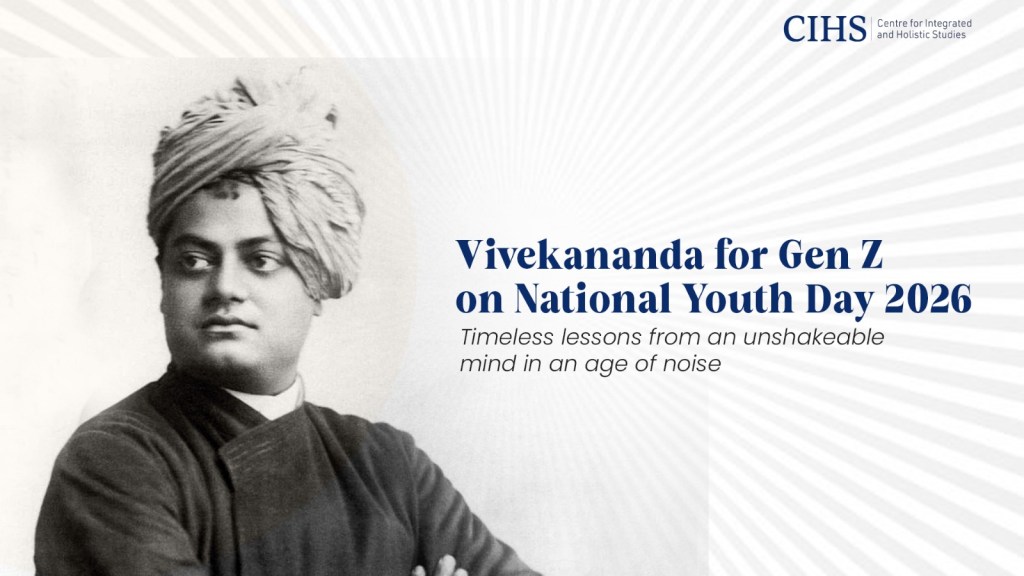
National Youth Day, which is marked on January 12 to commemorate the birth anniversary of Vivekananda, one of India’s most influential intellectuals and enduring voices for youth upliftment, serves as a reminder that while youth power can be destructive if left unchecked, it can also be transformative when it is grounded in strong values. Long before the internet era, Vivekananda was aware of this threat. He cautioned against mental weakness, emotional excess, and mindless imitation, conditions that frequently lead to vulnerability and exploitation in our times.
His timeless teachings connect directly to Gen Z, a generation living through uncertainty and hyper-connectedness, navigating imported “woke” cultural constructs, and increasingly vulnerable to disruptive and extremist ideologies.
Vivekananda addressed young people as active creators of the future rather than as passive inheritors of tradition. His message was straightforward but profound: develop inner strength, have faith in yourself, and direct your energy towards positive endeavours. Vivekananda’s teachings provide an alternate route based on purpose, balance, and accountability at a time when many young people look for significance in extremes, whether they be ideological, digital, or social.
The notion that education is the unfolding of each person’s inherent excellence rather than just the acquisition of knowledge was fundamental to his worldview. Gen Z, generation rich in knowledge and experience but frequently weighed down by comparison, worry and outside approval, finds great resonance in this concept. Young people are reminded by Vivekananda’s emphasis on self-belief that one’s value is determined by one’s character and inner convictions rather than by followers, trends or approbation. His conviction that knowledge without integrity is worthless feels particularly important in this day and age, when radical groups frequently draw highly educated but morally disengaged adolescents.
Self-belief was a fundamental tenet of Swami Vivekananda’s philosophy, as seen by his statement, “Weakness is sin.” He encouraged the young people to believe in themselves by acknowledging the limitless potential that each person possesses. According to him, self-belief is not conceit but rather a profound understanding of one’s inherent power and moral obligation, which elevates people to overcome obstacles, take responsibility and strive for greater goals. This inner confidence, according to Vivekananda, is the cornerstone of nation-building: strong, fearless and disciplined people inevitably develop into responsible citizens who advance society. He thought that a country created by self-assured people would be durable, forward-thinking and cohesive, strong not just materially but also morally and purposefully.
Vivekananda’s emphasis on character development over credentials was equally significant. He cautioned that knowledge devoid of integrity is meaningless in an era fixated on rapid success and immediate recognition. He held that the moral foundation of both people and nations is composed of integrity, bravery, empathy and selflessness. Vivekananda’s emphasis on education as the “manifestation of inner perfection” is vital for Generation Z, who are often faced with narratives that split the world into adversaries and allies. This serves as a reminder that trustworthiness and moral fortitude, rather than indignation or radicalism, are the sources of long-lasting impact.
Another foundation of the ideals held by Vivekananda was discipline. For him, discipline served as a link between values and conduct. People who possess self-discipline in their thoughts and actions can focus on their goals and use their energy in constructive ways. According to Vivekananda, disciplined people construct powerful organisations and nations and disciplined minds produce ordered lives. He believed that discipline was liberating rather than limiting, enabling people to overcome obstacles and flaws.
Another characteristic that set him apart was his fearlessness. Vivekananda exhorted the young people to behave bravely, talk honestly, and think for themselves. But wisdom, not recklessness, was the source of his fearlessness. He was as opposed to blind revolt as he was to blind conformity. This is especially important now since polarisation, fear, and false information can lead young people to adopt extreme viewpoints. Young people are empowered by Vivekananda’s bravery to think critically, question, and change without resorting to violence or hatred. Today, when extremism frequently poses as bravery while stifling introspection and discussion, striking this balance is crucial.
Swami Vivekananda, who helped bring Vedanta and Yoga to Western audiences, understood Bhagwan (God) as the universal, formless, all-pervading Truth. He stressed personal, direct realisation over rigid dogma, taught that the divine dwells in every soul, and encouraged people to seek Bhagwan through love, service, and compassion, an outlook profoundly shaped by his guru, Sri Ramakrishna. Combining faith in Bhagwan with self-belief establishes equilibrium, ensuring that power is used for everyone’s benefit and anchoring human endeavour in higher ideals. For Vivekananda, spirituality is a force that propels national advancement and humanitarian service rather than an escape.
These principles together create a comprehensive foundation for greatness. Swami Vivekananda envisioned young people who are self-assured but modest, disciplined and energetic, courageous and caring and socially engaged but deeply rooted in their spirituality. He felt that these people are the real builders of a powerful, enlightened, and cohesive civilisation.
National Youth Day serves as a reminder that, when directed by admirable ideals, young people’s enthusiasm, inventiveness and tenacity may influence society. Vivekananda’s teachings, “Believe in yourself and believe in Bhagwan (God),” is still relevant and continue to motivate young people to overcome obstacles, give freely to humanity and strive for a just as young people look for significance outside of extremes: true power comes from character, clarity and service rather than radicalism.
On his birth anniversary, we are reminded to reflect upon his teachings and inspire young people to lead with honesty, bravery, and compassion, influencing not only their own future but also the future of the nation.
 CIHS - Centre for Integrated and Holistic Studies