

Dr. Aniket Pingley
I am not a journalist by profession. But like any reader who values intellectual honesty, I expect journalism to adhere to its own stated standards of ethics, verification, and fairness. In its article published by NYT titled “From the Shadows to Power: How the Hindu Right Reshaped India,” that expectation is repeatedly taken for a toss. If the NYT is willing to relax on standards when writing about the RSS, readers are entitled to ask whether what is being offered is reporting at all, or merely a predetermined story wearing the language of journalism.
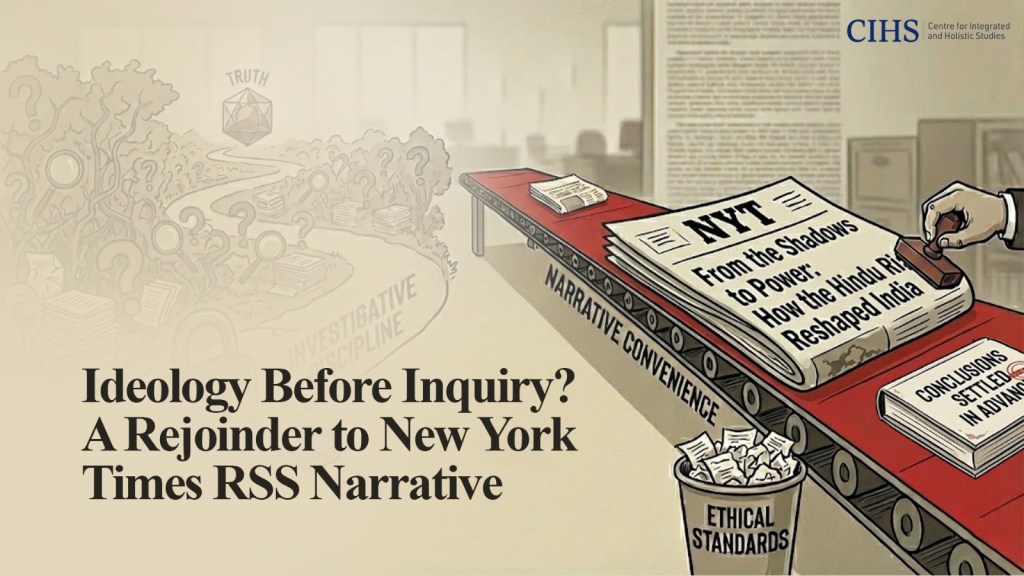
This essay examines where and how the article by Mashal and Kumar departs from those standards. My critique does not rest on disagreement with conclusions alone, but on demonstrable violations of widely accepted journalistic ethics, as codified in the IFJ Global Charter of Ethics for Journalists, the Munich Charter, and the Society of Professional Journalists’ Code of Ethics.
In the sections that follow, I identify specific statements from the article, map them to the standards they violate, and offer rewritten versions showing how the same points could have been presented in a professional manner.
1. Failure: Fact–Opinion Separation Violated
| Statement | Violated standard | How should it have been written | RSS’s stated position |
| “The far-right group known as the R.S.S. has spent a century trying to make India a Hindu-first nation.” | “The journalist shall make sure to clearly distinguish factual information from commentary and criticism.” – IFJ Global Charter, Article 2 | Founded in 1925, the RSS has articulated a vision of national identity centered on Hindu cultural/civilizational unity. Critics interpret this vision as seeking a Hindu-first political order, an interpretation the organization has refuted consistently. | India, that is Bharat, is a Hindu nation. The word Hindu transcends Hinduism (religion). Hindu is the collective identity of the people of this nation called Bharat. The nationhood of Hindus has evolved over thousands of years independently of the kingdoms in Bharat and their political boundaries. |
2. Failure: Loaded Language Used as Factual Description
| Statement | Violated standard | How should it have been written | Some common sense |
| “The R.S.S. originated as a shadowy cabal for the revival of Hindu pride after a long history of Muslim invasions and colonial rule in India, its early leaders openly drawing inspiration from the nationalist formula of Fascist parties in Europe during the 1930s and 1940s.” | “Avoid stereotyping. Journalists should examine the ways their values and experiences may shape their reporting.” – SPJ Code of Ethics | The RSS began as a small, closely organized volunteer movement during the colonial period, operating primarily through local branches, called as shakhas, rather than public political platforms. An honest discussion with the RSS leadership reveals that the founder Dr. Hedgewar was inspired by the vision of Swami Vivekananda, Yogi Aurobindo, Bankim Chandra Chattopadhyay, Bal Gangadhar Tilak etc. | The RSS was founded in 1925, about half a decade prior to the start fascism in Europe. Why would anyone in the RSS had to go to Europe to learn about martial discipline if they could simply observe the British exercise the same, first-hand and for free? Suggested reading for NYT: Bhawani Mandir pamphlet written by Yogi Aurobindo in 1905. |
3. Failure: Suppression of Essential Context
| Statement | Violated standard | How should it have been written | RSS’s stated position |
| “It’s philosophy casts India’s Muslims and Christians as descendants of foreign invaders who need to be put in their place.” | “The journalist shall not suppress essential information or falsify any document.” – IFJ Global Charter, Article 3 | Some critics argue that certain Hindutva interpretations frame Indian history through a civilizational lens that emphasizes foreign invasions. RSS leaders, however, state that their definition of national belonging is cultural rather than religious and applies to all citizens. | As a matter of fact, Sarasanghachalak Dr. Mohan Bhagwat has stated, on record, umpteen times that everyone in Bharat shares a “common DNA”, irrespective of their faith. https://timesofindia.indiatimes.com/india/living-in-harmony-is-our-culture-mohan-bhagwat-says-dna-of-people-in-undivided-india-same-for-40000-years-as-rss-marks-100-years/articleshow/123528212.cms The article itself states: “Their definition is a cultural one, and they consider everyone living in India as Hindu, he (Dr. Mohan Bhagwat) said.” |
4 & 5. Failure: Causal Claims Without Verification and Prediction Presented as Fact
| 2 Statements | Violated standards | How should it have been written |
| “The R.S.S. has infiltrated and co-opted India’s institutions to such a degree …” “that its deep roots will ensure it remains a powerful force long after Mr. Modi is gone.” | “Never confuse the work of a journalist with that of a publicist or a propagandist.” – Charter of Munich, Responsibility 9 “The notion of urgency or immediacy in the dissemination of information shall not take precedence over verification.” – IFJ Global Charter, Article 5 | Individuals associated with organizations that describe ideological affinity with the RSS are present across political parties, civil society groups, and public institutions in India. Scholars and analysts disagree on whether this presence reflects coordinated organizational strategy, informal ideological influence, or the broader political mobilization of Hindu nationalist ideas. However, no judicial findings or investigative agency has proven that the R.S.S exercises institutional control over state bodies or established centralized direction of such influence. |
6. Failure: Unfounded Accusations by Association
| Statement | Violated standard | Counter question for the NYT |
| “And when you see Hindu vigilantes parading through Muslim neighbourhoods or ransacking churches, you are seeing the R.S.S. affiliates exercising their vision of supremacy.” | “Slander, libel, defamation, unfounded accusations are serious professional misconduct.” – IFJ Global Charter, Article 10 | The article itself states: “He (Dr. Mohan Bhagwat) discouraged engaging in hooliganism and incitement of violence”. The basis of this article is a study conducted by Felix Pal that attempts to establish RSS having a tight control over all its affiliates. So does the RSS’s discouragement to incitement of violence and its affiliates’ “exercising their vision of supremacy” through hooliganism logically add up? |
7. Failure: Unverified causal theory presented as settled fact
| Statement | Violated standard | Counter statement with similar flavour |
| “But the formula has remained central to its success ever since: uniting Hindus around grievances from the past and injecting a militant sense of score-settling, right down to the local level …” | “Take special care not to misrepresent or oversimplify in promoting, previewing or summarizing a story.” – SPJ Code of Ethics | The formula has remained consistent in the NYT’s treatment of the RSS.: framing its growth primarily through grievance, militancy, and majoritarian intent, while neglecting organizational sociology, internal variation, and grassroots modes of operation that are reproduced uniformly across time, context, and scale. logically add up? |
8. Failure: Editorial Framing Masquerading as Reporting
| Statement | Violated standard | Questions for NYT |
| “The group’s political dominance has divided India, a country of 1.4 billion people, along religious fault lines more than ever.” | “Publish only facts whose origin is known, or attach clear explanations, caveats and restrictions” – Munich Charter, Responsibility 3 | What is the definition of a divided India? How is the division measured – through electoral outcomes, incidence of communal violence, public opinion surveys, institutional breakdown, or legal adjudication?In the absence of any stated criteria, does not the claim rests entirely on narrative assertion rather than verifiable fact?Has there been any research study that quantified the degree of religious division in the country? |
What, then, is this article by NYT really about?
The authors cite only one research work by Felix Pal. Both of Pal’s publications with The Caravan and the NYT have been thoroughly rebutted here:
- https://www.cihs.org.in/hit-job-guised-as-study/
- https://www.cihs.org.in/whats-rss-starfish-or-spider/
It cites little original research, relies heavily on a single academic voice already contested, and recycles familiar tropes of fascism, militancy, and majoritarianism. Assertions are made first; standards are consulted later, if at all. Readers are told the reporters spent a year attending conclaves and visiting grassroots units, yet the resulting analysis remains curiously detached from how the organization actually functions.
The more plausible explanation is not investigative failure, but narrative convenience. Conclusions appear to have been settled in advance. If the NYT no longer feels obliged to apply ethical standards of journalism when writing about the RSS, it should at least be honest about the genre it is practicing. Journalism earns authority through discipline. What dispenses with that discipline deserves suspicion, not deference.
(Author is an accomplished computer scientist, educator and holds expertise in media content strategy)
P.S.
As a computer scientist, I wonder if the authors merely rehashed Felix Pal’s articles using some large language model (AI) like OpenAI’s GPT or Google’s Gemini? Could it be that NYT is merely publishing meta-articles for the purpose of wider dissemination of Felix Pal’s works through SEO? This is now figment of anybody’s imagination, and so is the article itself, at best.
 CIHS - Centre for Integrated and Holistic Studies