

CIHS Desk
On the morning of 30 December 1943, Netaji Subhas Chandra Bose fulfilled his vow, he hoisted the tricolour at Port Blair. This was no ritual gesture but a declaration that the soul of Bharat had arisen. Under Bose’s leadership of the Azad Hind Fauj, the Andaman and Nicobar Islands were liberated from British colonial occupation. The solemn Cellular Jail, long the symbol of British cruelty, now looked on as its jailors empire began to crumble. The flag fluttering at Netaji Stadium (then the Gymkhana Ground) proclaimed that India’s freedom was no longer a distant dream, it was being claimed here and now.
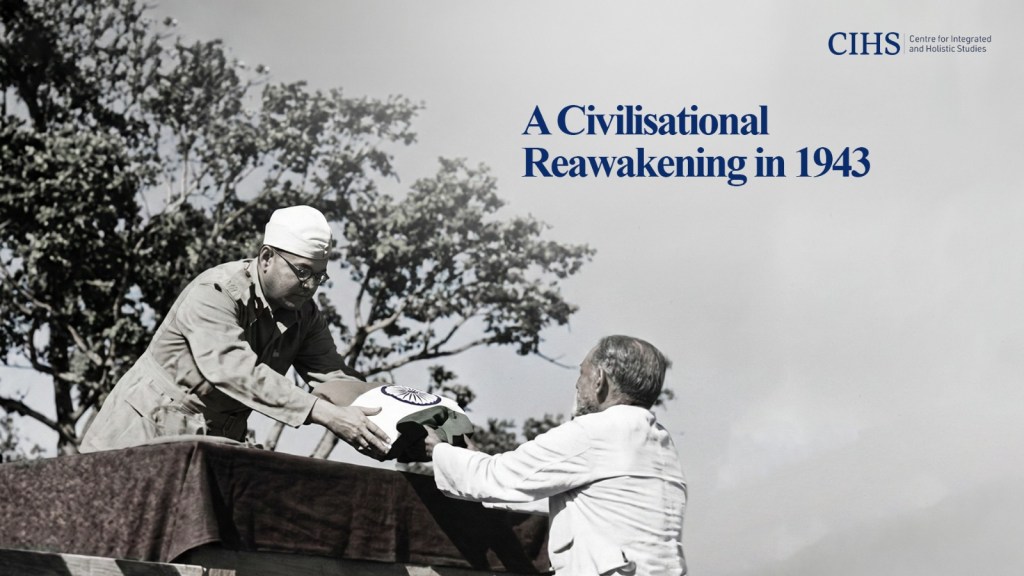
In mid-1943, Bose had already proclaimed the Azad Hind Sarkar, India’s first provisional government in Singapore. He made clear that this was not a symbolic cabinet-in-exile, but a strategic, ideological and military assertion of India’s right to self-rule. The INA raised its own treasury and even issued stamps and currency under Bose’s tricolour, signaling real statehood. India’s freedom struggle had transformed into a true war of liberation. Bose explicitly rejected petitions and half-measures: “India would fight for her freedom not through pleas or petitions, but through armed struggle and sacrifice,” he declared. In his words, the Azad Hind Government was “the Government of the free Indians… representing the will of the entire Indian people”. This fiery claim of sovereignty stunned the colonial occupiers. By late 1943, even a Japanese handover made Port Blair and nearby islands the first piece of Indian soil “freed from British rule.”
On 30 December itself, Bose stood before a crowd of freedom-loving Andamanis. With pride and resolve he unfurled the tricolour at the very spot where countless patriots like Vinayak Damodar Savarkar had once been tortured. The effect was electric. In a speech charged with the fervor of Bharat Mata, Bose invoked the martyrs of the Cellular Jail, comparing its gates opening to the fall of the Bastille in France, and consecrated the day as one of liberation. He renamed the Andaman’s as Shaheed Dweep (Martyr’s Island) and the Nicobar’s as Swaraj Dweep (Self-Rule Island), dedicating them to the memory of India’s sacrificed heroes. This was more than pageantry, the tricolour rising there “symbolised not just the freedom of the islands but the resurgence of India’s spirit”. The colonial empire understood the message: Indians had moved from petitions to power, and Britain’s colonial story was broken. Bose’s act proclaimed that India would seize its destiny “through determination, sacrifice, disciplined action and uncompromising courage,” not through British concession.
30 December 1943 therefore must be remembered not as a footnote, but as a defining assertion of Bharat’s civilizational will. On that day, Netaji, born of a family steeped in patriotism, rekindled the ancient flame of Bharat’s freedom. The raising of the tricolour at Port Blair stands as a witness that India’s independence was not granted but earned, seized by heroes who embodied the country’s spiritual resilience. This is the legacy of that day, a story of national awakening that resonates with the soul of Bharat.
 CIHS - Centre for Integrated and Holistic Studies