

The New York Times & its author fail to understand RSS, that’s open, grounded, service oriented, Hindu centric organization for humanity.
Dr Aniket Pingley
Be it journalistic writing, scientific research or an analytical study, merit and rigour of methods used are compulsive ingredients. Strong conclusions would be accepted when readers see distinct difference between analysis based on facts and otherwise.
Careful distinctions, causal explanation, proportional language and an openness to contradiction are scientific way of analytical writing rigmarole. When those elements weaken, even widely shared concerns begin to read as assertions in search of proof.
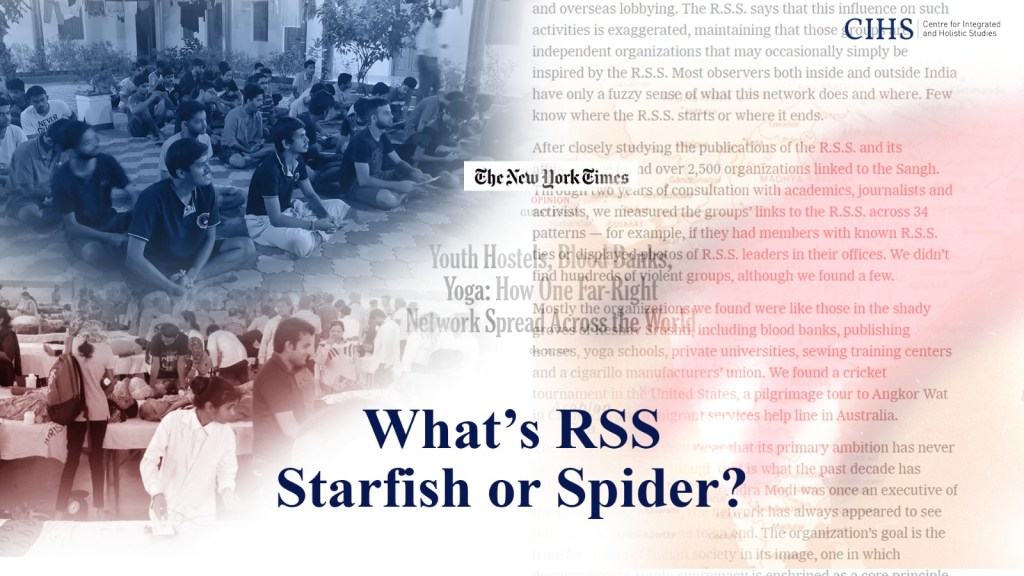
This essay examines The New York Times opinion article, published on December 23, 2025 headlined, “Youth Hostels, Blood Banks, Yoga: How One Far-Right Network Spread Across the World” by Felix Pal, which follows a long-form “study” by the same author in The Caravan. The coveted subject is Rashtriya Swayamsevak Sangh (RSS) and its extended ecosystem across the globe.
Pal’s research study published in The Caravan has been comprehensively analysed and published at https://www.cihs.org.in/hit-job-guised-as-study/
The composite central hypothesis of the author is stated here:
The RSS is not a loose family of ideologically inspired but autonomous organizations (across the globe), as claimed. Rather, it functions as a single, centrally coordinated political organism that strategically uses thousands of legally distinct civil-society entities as proxies to expand power, evade accountability, and manufacture the illusion of an organic grassroots movement. The RSS is a far-right movement that has infiltrated institutions of daily life to achieve power.
The focus of this essay is about whether mechanism of evaluation used to analyse it meets standards implied by the author’s credentials and by the platform that published him.
A close reading, especially when the Caravan and NYT articles are read side by side, reveals a consistent pattern: claims escalate while evidence does not. Interpretive language hardens into assertion; associative facts are recoded as proof of control; and metaphor substitutes for mechanism.
Let us begin by examining a couple of claims that the author had made in NYT article.
Claim one:
“This picture offers insight into the social forces that propelled the Hindu far right to dominance in India. It also helps explain how, as nativist parties are in ascendance globally, a far-right movement can infiltrate the institutions of daily life to achieve political power.”
The claim that “this picture offers insight into the social forces that propelled the Hindu far right to dominance in India” is presented as conclusion, but the article never explains what that insight actually consists of or how it was derived. Nowhere does the author specify a causal mechanism linking the mapped organizations to political dominance. There is total absence in sequence of actions, decision-making processes or measurable effects on voter behaviour identified.
Description is substituted for explanation: the presence of schools, charities, hostels, and cultural bodies is treated as self-evident proof of political causation.
Claim 2:
The second claim that same “picture” explains how far-right movements globally can “infiltrate the institutions of daily life to achieve political power” extends this unsupported inference even further. The article neither defines what “infiltration” means in operational terms nor shows how voluntary, legally registered and publicly functioning institutions constitute covert penetration.
More critically, it offers no comparative evidence demonstrating that this supposed mechanism operates across different national and political contexts. And, most importantly, the statement implies that RSS hasfelt the need to “infiltrate” the same organizations that share ideas, outlook and work independently.
Claim 3
Let us take another statement.
“The organizations we mapped help give the R.S.S. the avenues to work toward the whole-of-society change it seeks. It might be by providing private alternatives to crumbling state health care, by indoctrinating children through tens of thousands of private Hindu nationalist schools or by churning out news and media content through dozens of publishing houses, websites and newspapers. Not all the groups we tracked are explicit about far-right ideas, but many of them become key vectors for legitimacy, information and often resources (financial or otherwise) that sustain the core of the R.S.S. network.”
Let us examine what can be proven here and what is purely an opinion.
Facts:
- Existence of many organizations
- Provision of social services at scale
- Educational institutions and publishing activity
- Variation (of activity-focus) within the ecosystem
By normal civic criteria, these facts describe a robust, resilient civil-society network
Opinions:
- Indoctrinating children
- Key vectors for legitimacy, information and resources
- Providing alternatives to crumbling State-owned systems
If one were to write a book titled: “How to move from description to judgment without crossing the evidentiary bridge”, this article could become a seminal reference work!
Because Dr. Pal is trained in political science and international relations, readers are entitled to expect analytic discipline, which is found wanting.
The author states: “For the past six years, I have been part of a team that has mapped thousands of organizations in 40 countries with links to the R.S.S.” The author believes that looking at GPS navigation map software is same as actually traveling the landscape under purview. A desk-based network analysis could be a legitimate method only if its limits are acknowledged shown as extrapolation of “facts”.
Compositely the NYT write up along with The Caravan article falls flat on their face on several fronts (list is not exhaustive):
- No causal mechanism – Asserts centralized political control without demonstrating how authority is exercised or enforced.
- Description substituted for proof – Treats presence of institutions as evidence that they produce political dominance.
- Correlation elevated to control – Converts association, overlap and ideological similarity to claims of command.
- No stated methodology – Fails to explain what analytical framework is being applied or how conclusions are derived.
- Non-falsifiable framework – Interprets all observations as confirmation, allowing no evidence to contradict the thesis.
- Metaphor replacing analysis – Uses rhetorical imagery (“ecosystem,” “organism,” “infiltration”) instead of causal explanation.
- Semantic laundering – Employs loaded terms (“front organizations, supremacist, far-right”) without operational definitions or proof thresholds.
- Denial of agency – Treats donors, volunteers and beneficiaries as passive instruments rather than autonomous actors.
- Claim escalation without new evidence – Hardens conclusions and language while introducing no proof.
- Selective application of standards – Relies on an evaluative mechanism that would fail editorial scrutiny if applied to other civil-society organizations.
Previously in a rebuttal to Washington Post article, it was explained how consensus-building within the RSS is interpreted as rigidity or control, rather than as indicators of decentralized decision-making and collective reasoning. Here is the link: https://cihs.blog/2025/10/27/western-media-lacks-framework-to-understand-rss/.
Organizations inspired by RSS continue to engage with it because of its ability to stay current through an extensive, continuously feedback-driven network. Any organization would value access to cross-sector, verified and up-to-date information provided unconditionally.
RSS as a phenomenon is a case-study in organizational theory. The book (not related to RSS) by Ori Brafman and Rod Beckstromtitled “The Starfish and the Spider” provides some insights.
While the “spider” organizations are centralized with clear head (CEO / HQ) to alone calls the shots, “starfish” organizations have catalysts. A catalyst is a leader who inspires, connects people and leads by example without exercising coercive power. They step back and let the circle run itself.
Dr. Pal’s six-year long mapping effort has a fundamental flaw – it views RSS as “spider” while it operates much more like a “starfish”. He interprets lack of rigid links as “secrecy” or “obfuscation.” The network is visible; Dr. Pal just either doesn’t have the right lens to see it or intent is purposefully otherwise.
Both the articles are a textbook case of semantic laundering: retaining moral charge while minimizing evidentiary burden. The New York Times has become party to such a campaign.
Eminent sociologist and professor Dr. Salvatore Babones analysed the NYT article in this video: https://www.youtube.com/watch?v=vhMLikrB09E
He noted that the write up relies more on insinuation rather than demonstrated wrongdoing. His critique matters because it focuses squarely on method.
Absence of mechanism, non-falsifiability, rhetorical inflation etc. raise serious doubts about Dr. Pal’s credibility as a scholar. But the bigger question is why the editorial rigour and objectivity at The NYT and The Caravan has taken a serious beating?
There are two distinct failures here. The epistemic failure belongs to the author: collapsing analytic distinctions, substituting metaphor for mechanism and building a non-falsifiable framework. The editorial failure belongs to the platform: publishing an escalated claim set without testing whether the underlying mechanism had stabilized since its earlier, more hedged iteration.
Neither failure requires a rational explanation. Both require editorial correction.
Conclusion:
The NYT article raises concerns that many readers share about power, ideology and civil society. But shared concern does not excuse weak method. When associative facts are elevated to causal conclusions, decentralization is recoded as deception, language substitutes for proof, authority erodes and paucity of rigour is exposed.
This is an argument for proportionality between claim and proof. Lack of proportionality has paved the way for moral urgency to become a shortcut – and shortcuts, in the long run, corrode trust. Editors deciding who to commission should see this case for what it is: not a controversial thesis bravely argued, but an evaluative mechanism that cannot reliably explain power.
(Author is an accomplished computer scientist, educator and holds expertise in media content strategy)
 CIHS - Centre for Integrated and Holistic Studies