

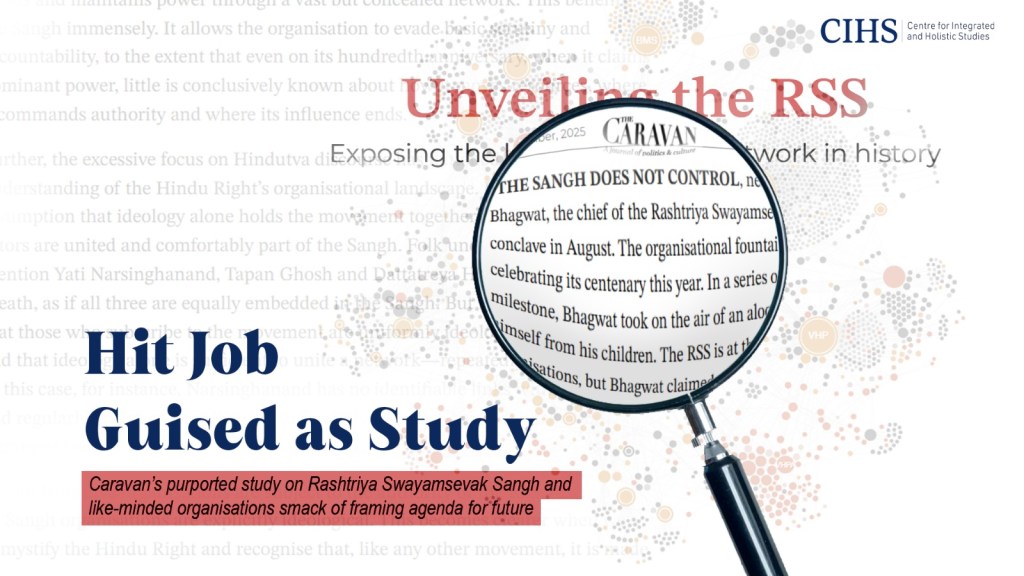
Caravan’s purported study on Rashtriya Swayamsevak Sangh and like-minded organisations smack of framing agenda for future
Dr Aniket Pingley
“A plausible explanation is not necessarily a true one.”
Dr. Richard Feynman, American Physicist & Nobel Laureate
Synopsis:
The Caravan published a study on December 17, 2025 titled “Unveiling the RSS – Exposing the largest far-right network in history”. Its central hypothesis can be summarized as follows:
The RSS is not a loose family of ideologically inspired but autonomous organizations, as claimed. Rather, it functions as a single, centrally coordinated political organism that strategically uses thousands of legally distinct civil-society entities as proxies to expand power, evade accountability, and manufacture the illusion of an organic grassroots movement.
The study repeatedly asserts that what appears as decentralization has in fact concealed bureaucratic control and that RSS maintains a dual narrative: public denial of control and internal acknowledgment of centralized authority.
The central hypothesis smuggles in multiple unstated claims that radically escalate its meaning. Here is what the study actually posits:
P1: Claims of autonomy are intentionally deceptive, not merely ideological framing. Public statements by RSS are therefore bad faith representations, not contested interpretations. Thus, the RSS is consciously lying, not merely describing itself differently.
P2: Decision-making power does not rest with legally autonomous entities. Authority flows downward from a central node (implicitly Nagpur / RSS top leadership), i.e. affiliates lack meaningful discretion.
P3: The legal status of affiliate institutions is instrumental, not substantive. They do not act in their own organizational interest. They exist primarily to serve a hidden political centre. These organizations are fronts, not genuine civil-society actors.
P4: RSS affiliates and thousands of personnel involved lack independent political or social agency, thus implying mass infantilization of participants.
The study advances several interlocking claims:
- Shared infrastructure (addresses, campuses) proves centralized coordination and control.
- Overlapping personnel (trustees, office bearers, pracharaks) demonstrate managerial authority.
- Funding flows between NGOs indicate covert financial pipelines.
- Ideological similarity combined with organizational diffusion constitutes evidence of a single political entity.
- The RSS’s lack of formal registration is a strategic tactic to avoid scrutiny.
- Service organizations function as “last-mile” political conditioning sites.
- Donors and beneficiaries are largely “unwitting” participants in a concealed political machine.
This is not the first, nor the last, “study” that “attempts” to “demystify” RSS and a large bouquet of organizations with shared ideals.
Keeping my subjective opinion about the intention behind this study aside, let us put it to an objective, rational and fundamental test. The test has three questions:
- Q1: Are the core evidentiary findings (shared addresses, personnel overlap, funding flows) gathered through systematic first-hand, in-person verification?
- Q2: Can the evidentiary claims truly be considered evidence?
- Q3: Does the evidence logically necessitate the conclusion or does it merely support one plausible interpretation among several?
“Suspicion, however strong, cannot take the place of proof.”
Supreme Court of India, February 2021
Mapping Caravan’s Claims Against Four Postulations
The afore-stated verification framework which includes first-hand verification, evidentiary validity and inferential necessity, will be applied to all postulations.
P1: “Claims of autonomy are intentionally deceptive; RSS is consciously lying.”
This is an accusation of intentional deception and not mis-description. Here are Caravan’s claims.
- Public denials of control are strategic obfuscation: Mohan Bhagwat’s statement that organizations are “independent, autonomous” with the claim that this ambiguity is deliberate and designed to mislead the public.
- RSS maintains two narratives: one public, one internal: Caravan asserts that internal Sangh publications “strike a different note” and admit coordination that is publicly denied.
- Opacity is intentional and beneficial: The lack of registration is framed as a conscious strategy to avoid scrutiny and accountability.
Failure on Verification Test:
Caravan’s Proof #1: Caravan states that RSS public material states that it “runs” other organizations as well. The books by Rakesh Sinha and Ratan Sharda are used as a proof of RSS own public material. It also hand wavingly states, “It is, however, common knowledge that the RSS’s influence extends far beyond this limited circle.”
Counter-questions for Caravan: What is the basis to qualify a certain literary work as RSS own public material? Does RSS own a publication or on the contrary publicly denies owning a publication?
Are even the authors cited holding any official position in RSS? Did Caravan meet an RSS top-level functionary to ascertain if the authors in-fact officially represent RSS? How does Caravan define and measure extent of RSS’s circle of influence?
Failure: By asserting and concluding, before offering any evidence, that any literary work by an RSS sympathizer, well-wisher or volunteer is automatically RSS public material, Caravan demonstrates that it treats its own conclusions as proof, rather than seeking actual substantiation. Caravan has accused RSS of obfuscation while it being blurry about the mechanism to measure RSS influence by making use of hand waving statements.
Caravan’s Proof #2: Caravan states, “the RSS, as has been repeatedly noted, is —not registered—not as an NGO, not as a religious trust, nor as any other legal entity.” And, that “ … lack of traceability on paper allowed it to set up a headquarters in the heart of the national capital without having to disclose its sources of funding, or even who its members are.”
Failure: Legalese, clearly, is not of Caravan’s botheration. RSS is legally recognized in India as a “body of individuals” under the Income Tax Act, 1961, Section 2(31). This means that RSS, as a BOI, can be assessed for income tax purposes as a separate entity.
Headquarters of RSS are built and operated under Dr. Hedgewar Smarak Samiti, an independent society registered under the Societies Act. Both these facts are (purposefully?) left-out from the study. A cursory reading on Internet shows several legal notices, defamation suits, sedition charges etc. levied against Caravan by a variety of individuals and entities. Perhaps, it is due to lack of rigour for the legalese.
Counter questions for Caravan: Which legal obligation is actually being evaded by RSS? Provided its disregard for legal facts, should anything that Caravan states related to legality be taken seriously?
Closing remarks: The “evidence” by Caravan supports an alternative explanation: a culturally networked movement with loose (or strong) coordination but no unitary legal control, since RSS is presented to be “not” a legal entity. If not legally backed, how is control defined or measured?
P2: Decision-making authority flows from a central node; affiliates lack discretion
Here are the claims made by Caravan:
- RSS operates as a “single political organism”: The article repeatedly states that affiliates are “constituent parts of a single network” rather than independent entities.
- Pracharaks exercise executive authority: Pracharaks are described as being deputed to affiliates to “maintain and consolidate control” and make executive decisions for the RSS.
- Shared personnel, offices, and events demonstrate hierarchy: Overlapping office-bearers at sites like Ved Mandir are taken as evidence that the same people across organisations make decisions.
Failure on the Verification Test:
Caravan’s Proof #3: I will take one example among a few similar ones. Caravan states “the Maharaja Pratap Singh Ved Vidyalaya was established by a Pune-based organisation, Maharshi Ved Vyas Pratishthan, whose founder, Govindadev Giri, is an RSS member, the treasurer of VHP-controlled trust Ramjanmabhoomi Tirth Kshetra and also sits on the advisory board of the Nagpur hospital Madhav Netralaya, named after former RSS chief Madhav Sadashiv Golwalkar. According to RSS mouthpiece, Organiser, Govindadev Giri’s “initial samskars as RSS swayamsevak are manifested in” the Pratishthan.”
Counter-questions for Caravan: Is it being posited that Govinddev Giri (Maharaj) takes orders from RSS on how to conduct his activities? Even if Maharaj is advisor to Madhav Netralaya, does the eye hospital run on whims of RSS through him? If so, can the chain of command be established and proven to be enforced?
Counter-example for Caravan: The creative director at Caravan happens to be alumni of the same University as many members of UK-based Conservative Party, so Caravan must be peddling Conservative views. Is there any apparatus to measure degree of ridiculousness of this “proof”?
Failure: The establishment and operational excellence of Maharishi Ved Vyas Pratishthan is not being considered as a meritorious position of Govinddev Giri’s national influence; but his early association with RSS is posited as his de facto qualification.
Caravan’s Proof #4: “Pracharaks are trained in central RSS mission and, upon qualifying, sent out to Sangh appendages to maintain and consolidate control over the network, often as sangathan mantris—organisational secretaries. These are officials who have the authority, through extensive training, ideological commitment and conditioning, to make executive decisions for the central RSS in the organisations to which they are deputed.
Counter questions for Caravan: A sanghthan mantra (Organizing Secretary) of an organization is empowered by its by-laws to exercise executive decision. But how does that prove decisions being made for/by central RSS? Beyond believing folklore, is there any proof that Caravan can furnish forced compliance or proof of sanctions imposed by central RSS by using pracharaks as instruments?
Caravan’s Proof #5: “The Ved Mandir complex, thus, serves as a microcosm for Sangh’s broader strategy of spawning organisations that remain managed through a thick bureaucracy. What otherwise appear to be over twenty independent entities, working across a range of fields and focus areas, is in fact a dense, well-organised cluster of duplicating organisations.”
Counter-facts for Caravan: The Ved Mandir Organization was initiated using land grant from Maharaja Pratap Singh in 1916 about a decade before the RSS was founded. It continues to evolve. The Ved Mandir complex also houses organizations that are not bracketed with RSS. In fact, Ved Mandir providing its facility to RSS affiliates and general RSS activities speaks volumes about the trust built by RSS with the Dogras of Jammu. The complex has a school, hospital, orphanage, assisted living home, gau-shala etc. Believing that RSS runs all activities is clearly delusional.
Closing Remarks: Long-term association, structural connectivity, network coordination etc. are not proof of hierarchical authority. This is precisely how a body of individuals function – through personal interconnect, regular and honest feedback, moral intervention, information exchange, cross-organizational awareness etc.
RSS has a dynamic nature with ever-evolving characteristics. What other mechanism should it use to touch base with Swayamsevaks and organizations it inspired, publish diktats through Caravan? The whole argument falls flat on its face because no mechanism of authority is demonstrated. Governance is asserted, not evidenced and discretion is denied without proof of override or enforcement.
P3: “Legal autonomy is instrumental; affiliates are fronts, not genuine civil-society actors.”
All claims here indicate institutional bad faith and front activity. This is a broad baseless accusation. In this section, I will not go into details of each claim. Readers can always read the original study.
I will not even try to explain how like-minded organizations are in-fact genuine civil-society actors because the society has experienced it at scale. Instead, I will focus on most important statement verbatim and its implications.
First, let me decompose the following statement to explain why everything said by Caravan is intentional deception and obfuscation. “Front organisations are a term we use more precisely than its common parlance. In this case, we mean organizations that are materially indistinguishable—same funding, same activities, same organizational structure and same flows of authority, among other things—from their parent organization but operate under a separate name in an intentional strategy of duplication and obfuscation. This definition applies to some Sangh organizations, but not all.”
Part one: “Front organisations are a term we use more precisely than its common parlance.”
Calling an entity a “front organization” has legal ramifications. Due to lack of any tangible evidence, Caravan had to redefine it. However, redefining “front” does not actually neutralize the common meaning, instead it repackages it.
Part two: “materially indistinguishable—same funding, same activities, same organizational structure and same flows of authority”
Caravan provides nothing concrete to this end – neither it specifies the degree of overlap, nor it provides the meaning of word “same”. The word “Material” is never operationalized. By using the phrase “flows of authority”, it covertly pushes its connotation.
Part three: “This definition applies to some Sangh organizations, but not all.”
Being hand-waving is a classic technique to accuse someone at large while escaping its legal ramifications.
Summarily, by retaining the term “front” while claiming to redefine it, the study preserves the word’s accusatory force while shielding itself behind a purportedly technical definition.
The definition itself embeds assumptions of intentional deception and obfuscation, thereby reproducing common-parlance meaning the authors claim to avoid. The result is not conceptual precision, but rhetorical double accounting.
In short, this is semantic laundering to pass sinister motives for ethical uprightness.
Caravan has classified RSS like-minded organizations into other categories than “front” organizations. They are “covert”, “showpiece”, “training”, “knowledge production” and “last mile”. Beyond being a creative taxonomy, this labelling provides no real insight, but builds a connotation for disguise and deception.
List below highlights weakness of this postulation:
- Funding sources, activities, organizational design, language and mission, as evidence that organizations are the same entity in substance. This does not establish loss of autonomy or external control. Federated movements, religious charities and national NGOs routinely display high similarity without being fronts.
- Replication is a normal feature of scaling movements. Describing multiple similar organizations as purposeful “duplication” is plain deception.
- Treats organizational complexity itself as suspicious. Complexity does not demonstrate deception unless misuse is shown. Large networks are inherently complex.
- It asserts affiliates do not act in their own interest. However, no evidence shows affiliates acting against their missions.
P4: Affiliates and personnel lack independent agency (mass infantilization).”
Here are the claims made by Caravan:
- Donors are “unwitting”: International donors, including Jack Dorsey are described as unaware that funds support a broader RSS project.
- Beneficiaries are “conditioned”: Service organisations are framed as “last-mile” sites of proselytization and conditioning.
- Volunteers are instruments of expansion: Training organisations are described as “machines” producing instruments of RSS’s growth.
Failure on Verification Test:
- First-hand verification: No donors, volunteers or beneficiaries are interviewed to establish lack of awareness or agency.
- Evidentiary validity: Participation, training or ideological agreement does not prove manipulation. Conditioning is asserted without behavioral or outcome data.
- Inferential necessity: Informed consent and voluntary participation are equally plausible explanations.
Counter questions for Caravan: Which donors testified they were misled? How was “conditioning” measured or observed? Why is agency denied by default rather than empirically tested?
Closing remarks: Caravan had to go to extent of calling Jack Dorsey “unwitting” is indicative of self-delusion. Jack Dorsey’s donation occurred during the crisis of Covid pandemic where the entire humanity had to work together without borders.
However, without omitting that important detail, “unwittingness” could not be established. Classifying volunteers as instruments of expansion is dehumanizing them.
Labelling them as “proselytised” by last-mile organization is refuting the spirit of Seva, i.e. selfless service, at the grassroots.
“The trouble with the world is that the foolish are cocksure and the wise so full of doubt.”
Bertrand Russell, British Philosopher
Summary of the Analysis
The study uses political-science concepts (networks, diffusion, organizational isomorphism) confirmatory:
- Every observed association is treated as validation.
- Every piece of information, regardless of its nature, is interpreted in a way that ultimately reinforces the same conclusion.
The article reflects a form of epistemic overreach in which political-science inference is presented with confidence of investigative proof, without the mechanism-level evidence such proof requires. But wait … there seems to be much more than what meets the eye.
The study intends to, and I quote, “set the basis for a range of new research and journalistic directions: investigations into how the Sangh moves money and resources; new understandings of the Sangh’s less publicised priorities (such as, say, its network of hundreds of residential schools and hostels); and even a new way to imagine, and uncover, a range of internal conflicts within the Sangh that it has kept under wraps. These questions, and so many others that animate those looking into the Sangh, require, as a pre-requisite, an understanding of what the Sangh actually is. We hope we have provided an initial roadmap in this regard.”
Real question therefore is what is really masquerading as this research study by Caravan? With the stated aim now foregrounded, it becomes clear that Caravan article is not designed to stand or fall on the conclusiveness of its own findings.
Instead, it functions as a foundational act, that is an attempt to define, in advance, the conceptual universe within which all subsequent inquiry into the RSS must occur. Perhaps, it works like a new ontological baseline for straitjacketing the RSS?
The concept of a “roadmap” seems benign but is analytically loaded. It determines what is visible and defines what counts as suspicious. Under this roadmap autonomy is presumptively false, transparency is presumptively performative and lack of evidence is presumptively concealment.
This reverses the burden of proof. Instead of investigators having to prove wrongdoing, subjects must now disprove a structurally embedded suspicion – an impossible task maybe?
Closing remarks: Many of the article’s methodological weaknesses don’t seem accidental. Does the lack of first-hand verification and mechanism-level evidence undermine the article’s actual objective? Is this why the study repeatedly resists closure? It is designed to remain open-ended, because open-endedness sustains long-term scrutiny, isn’t it?
The study reveals itself, less as an investigation seeking to establish specific findings and more as an attempt to redefine the RSS in advance of future scrutiny.
(Author is an accomplished computer scientist, educator and holds expertise in media content strategy)
Disclaimer: I am a student of science and technology. I have had rigorous training for examining claims and postulations for their evidentiary rigour, causal reasoning, methodological soundness, data integrity, ethical considerations, and awareness of legal and regulatory consequences.
 CIHS - Centre for Integrated and Holistic Studies